The emerald ash borer was first detected on the West Coast in Forest Grove, Oregon, in 2022.
Since then, the invasive and destructive beetle has spread to Multnomah, Clackamas, Yamhill and Marion counties, with notable infestations in Tualatin, Newberg and Northeast Portland.
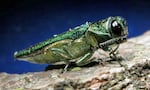
FILE- In this undated file photo provided by the Minnesota Department of Natural Resources, an adult emerald ash borer is shown.
Minnesota Department of Natural Resources via AP / AP
On Thursday, the Oregon Department of Forestry announced the bug has been newly confirmed in Beaverton, Salem, Silverton and the Rock Creek area.
Salem and Beaverton arborists said they have been preparing.
“We have so far treated 22 city-maintained natural area trees, 20 inches in diameter and larger, and planted over 2,000 native trees and shrubs,” said Beaverton arborist Jered Lane.
“We are continuing to monitor ash street trees throughout the city with regular inspections.”
The emerald ash borer is iridescent green and made its way to the U.S. from Asia in 2002. It decimated ash trees in the Midwest. Many tree experts say it’s not a matter of if, but when Oregon’s ash trees endure a similar fate.
Forestry officials expect Oregon will lose up to 99% of its ash trees to this pest over time.
But ash trees can be inoculated against the beetle, with insecticide injected directly into the tree’s vascular system. The injections usually need to be repeated every two years and can cost $400 for a large tree.
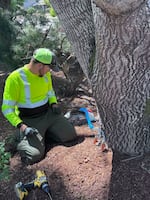
The City of Salem has been actively treating its ash trees in anticipation of the emerald ash borers. Here an arborist injects insecticide into an ash in Salem in 2026.
City of Salem
Oregon has its own native ash tree, the Oregon ash, which is prevalent across the state, namely around low-lying lakes, streams and rivers. Biologists worry that losing Oregon ash will make those waterways and their ecosystems more vulnerable to climate change.
Higher temperatures degrade water quality in many ways — including increasing bacterial and algal growth, decreasing oxygen levels, and changing overall chemical profiles. That could make drinking water treatment more expensive, and it could kill fish.
The Oregon Department of Agriculture already has a quarantine in place to prohibit ash and certain other woods from being moved outside Washington, Yamhill, Marion, Clackamas, and Multnomah counties.
So far, Oregon is the only West Coast state to discover the emerald ash borer. The beetle has yet to infest Washington, California or Idaho.
After the pest was discovered, Oregon forestry officials installed a network of about 300 traps, mostly in the Willamette Valley, to help detect infestations. The traps are large, purple cardboard rectangles, coated in pheromones and a sticky glue, strung high up in tree canopies.
Oregon’s forestry department is recommending cities stop planting ash and olive trees and remove them from their list of approved trees. It’s also recommending staff learn how to identify the beetle.
“Any ash tree can be infested, including native Oregon ash as well as non-native street, park and yard trees,” said forestry department specialist Kat Bethea.
“Signs of infestation include thinning and yellowing leaves, bark splitting, D-shaped holes in the tree bark, and shoots from buds on the trunk or branches.”
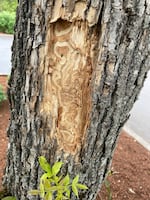
In this photo provided by the Oregon Department of Foresty, galleries carved by emerald ash borer larvae are seen in this ash tree near Newberg, Ore.
Courtesy of Oregon Department of Agriculture
The forestry department has an online map of beetle-infested areas.
Homeowners who want to protect their ash trees are being told to inoculate them, cut them down and replace them with another species of tree, or simply let them die.
“Ash trees become very brittle as they die,” said Matt Mills with the Oregon Forestry Department. “They’ll start breaking apart. Whole branches can fall or the trunk can fail, and the whole tree can fall over.”
Mills says insecticide can be injected at the base of the trunk, where it’s taken up into the tree canopy and is quite effective at protecting the tree from both adult beetles and larvae.
“We recommend only treating high-value trees in good condition,” Mills said. “Ash trees planted in the wrong place to reach their mature size, such as under power lines, should be removed and replaced with species that aren’t susceptible to emerald ash borers.”
Homeowners might also consider replacing young ash trees while they are still small and starting over by planting a species that is not susceptible to the beetle.
“This gets new tree canopy jump-started in urban areas where ash trees will be lost if not treated,” Mills said.