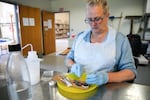
Cheryl Morgan, the principal investigator for OSU on the fish necropsy, looks for the tag in the head of a juvenile coho salmon in Newport, Oregon, on July 29, 2026
Kristian Foden-Vencil / OPB
In a small lab at the Hatfield Marine Science Center in Newport, scores of scientists, students and volunteers paw over trays of fish.
They’re here for the annual fish necropsy organized by Oregon State University and the National Oceanic and Atmospheric Administration.
Cheryl Morgan, the principal investigator here for OSU, leans over a tray with a scalpel and swiftly cuts open the head of a juvenile coho.
“This one has a tag,” she explains. “It’s a tiny, thin piece of wire in its snout somewhere that tells us when and where it was released.”
She digs around trying to find the wire, makes another cut, then digs around some more.
The mass necropsy is not for the faint of heart. But by sampling a couple thousand fish each year, biologists learn how young salmon are faring in the ocean.
It’s a keystone study that started in the 1990s, when several species of salmon were listed under the Endangered Species Act. Scientists back then knew a lot about why the fish were struggling in rivers. They knew about the dams, gas bubble disease and the lack of habitat. But they had little idea what was happening in the ocean.
Since then, this annual fish survey has added to the knowledge base. But the event has also become a favorite with students and researchers as they gather together in the name of science.
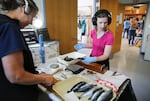
Fish biologist Catherine Nickels measures juvenile salmon for NOAA at the Hatfield Marine Science Center in Newport on July 29, 2026.
Kristian Foden-Vencil / OPB
“It was definitely a little stinky,” said OSU student Madeleine Butler. “And I didn’t love the slime.”
But Butler was fascinated by the stomach contents of her samples. Through their translucent stomach walls, she could see which animals each fish had eaten.
“I think a lot of people might be turned off by it,” said Amy Fowler, another OSU student. “You’re going in the brain of the fish. You’re cutting the stomach. But it’s really interesting you can see what the fish are eating and their health.”
The whole event carries an atmosphere of excitement.
Kelcee Smith, for example, is leading the Oregon Department of Fish and Wildlife’s effort to reintroduce chum salmon. Chum populations in the Northwest have been decimated in recent decades. And they lack the pizzazz of other salmon; they don’t jump big waterfalls, and historically their meat was fed to other animals.
But Smith couldn’t contain her excitement because this year’s samples included chum. Examining them will give her an idea of how the reintroduction efforts are going.
“All of a sudden, you get all this information back that you can use to answer questions you’ve been holding onto for years,” she said.
All around the lab, science is conducted en masse. Fish are being measured, their heads are lopped off, and scalpels are digging around for otoliths — tiny fish ear bones. An otolith looks like a grain of rice and can show when a fish entered the ocean and how well the fish has been growing. Its markings track progress, much like the rings of a tree.
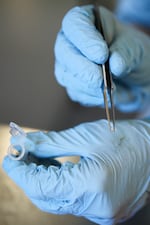
Cheryl Morgan finds otolith in the ear of a coho salmon at Hatfield Marine Center in Newport on July 29, 2026. An otolith can show when a fish entered the ocean and how well the fish has been growing. Its markings track progress much like the rings of a tree.
Kristian Foden-Vencil / OPB
The fins are cut off and can provide genetic information to trace a fish to a specific river. The muscle, liver and eyes are used for stable isotope analyses, meaning they can tell where in the water column a fish has been feeding.
Kym Jacobson, a scientist with NOAA, said the necropsy is great for forecasting returns
“Different [fish] managers start contacting us in December, saying: ‘Do you have those forecasts done? We want to know,’” Jacobson said.
She has been conducting this study since it started in 1997. And she’s been bringing her son, Clayton Jacobson.
“A lot of these people I’ve seen my whole life,” he said, waving across the laboratory. “It’s just part of the village that I grew up with.”
Clayton started attending the necropsy when he was about 6 years old, but wasn’t allowed to use a scalpel.
“People had different body parts in different bags,” he explained. “So I would grab the different body parts and sort them into the larger bags.”
Clayton said he loves being part of a scientific community.
“I thanked my mom yesterday for always bringing me to these, and she said, ‘Well, we didn’t have childcare,’” he laughed. “There wasn’t a camp that week; that’s why I got to come.”
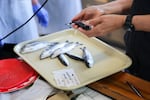
Juvenile salmon ready for necropsy at Hatfield Marine Science Center in Newport on July 29, 2026.
Kristian Foden-Vencil / OPB
This year, trawlers did not catch as many fish as in the last few years. The take was down about 20%. But it’s too soon to draw any conclusions from those numbers.
Scientists like Kym Jacobson say climate change is making forecasting much more complex.
“It’s less predictable than it used to be,” she said. “There used to be shifts that were decadal. And now those shifts in warm conditions, cold conditions … are a lot more random and less predictable.”
For years, scientists have focused on the size of the juvenile salmon, the thought being that the bigger they are, the more likely they are to survive. But climate change is shifting that assumption, because warmer waters may mean more predators.
“There are documented data sets of the recovery of seals and sea lions and porpoises,” said Brian Burke, with the Northwest Fisheries Science Center. “So those types of predators are clearly more abundant now.”
Burke agrees the annual necropsy is an important survey, but he thinks the science should also look more closely at predators.
“Who is eating salmon? Which predators? And what are their population dynamics?” he asks.
The scientists still need to crunch the numbers from the necropsy event before they can determine any trends or forecasts. When asked for immediate takeaways, they said there didn’t seem to be any big drop-off or increase in salmon numbers this year.
Correction: A previous version of this story misstated the name of the National Oceanic and Atmospheric Administration. OPB regrets the error.