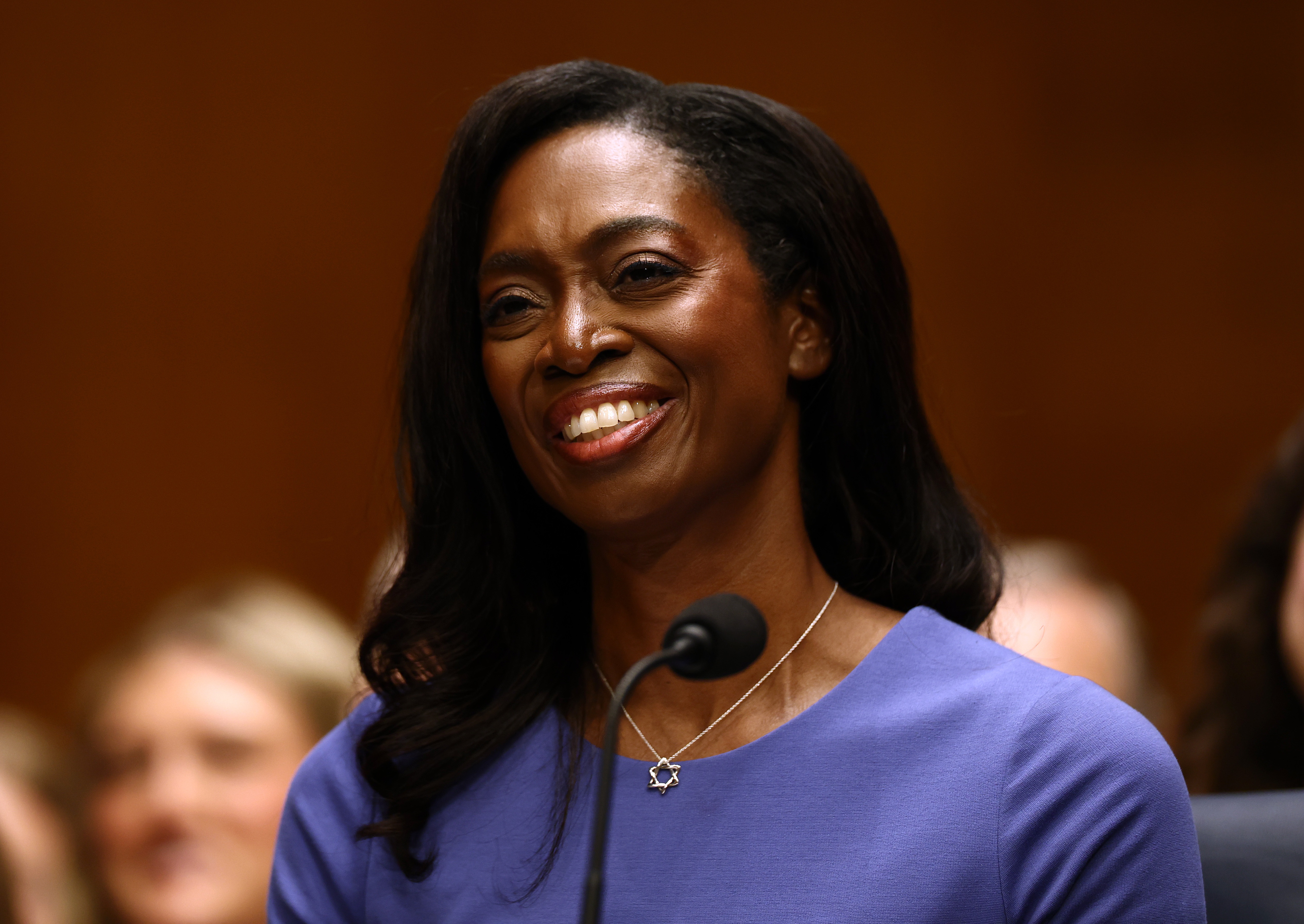
Dr. Erica Schwartz, who appeared before the Senate Health, Education, Labor and Pensions Committee in July, was confirmed Wednesday as CDC director.
Finn Gomez
The U.S. Senate confirmed Dr. Erica Schwartz as director of the Centers for Disease Control and Prevention, nearly a year after the last permanent director was fired in a dispute over vaccine policy with Health Secretary Robert F. Kennedy Jr.
The vote on Schwartz’s nomination was 51-44 in favor, almost entirely along party lines.
She will take command of a public health agency that has lost thousands of employees in the second Trump administration amid layoffs, resignations and leadership shakeups.
The CDC is currently responding to surges in measles cases, cyclosporiasis outbreaks and an Ebola outbreak in the Democratic Republic of Congo and Uganda.
“I really wish her luck in her new role,” said Dr. Demetre Daskalakis, a former top CDC official who resigned last year, “But I would also say, it’s not about the job, it’s about the public health mission — and that needs to be her focus.”
In a July confirmation hearing, Sen. Bill Cassidy led some Republicans in hard questions about vaccines and whether she would support their use if pressured by Kennedy.
Cassidy ultimately voted to advance her nomination out of the Health, Education, Labor and Pensions Committee after she allayed his concerns. He also voted in favor of confirmation.
“After speaking with Dr. Schwartz again after the hearing, reviewing the transcript and speaking to those who served with her and know her well, I’m confident that she knows what she is doing and will stand against those who do not,” Cassidy said on July 23.
But most Democrats and independents were not convinced that she would uphold science- and evidence-based policies, if they conflicted with the positions of Kennedy and the Trump administration.
Sen. Bernie Sanders, an independent from Vermont and ranking member on the health committee, voted against her advancement out of committee and against her nomination on the Senate floor Wednesday.
While Sanders said he was impressed by Schwartz’s credentials and service, he did not think she was prepared to stand up to Kennedy’s false statements on vaccines and other health topics.
“I think the American people are owed better than what President Trump has nominated,” Sanders said on July 30.
Daskalakis, the former CDC official who resigned last August, said Schwartz has her work cut out for her. “I really wish her luck in her new role,” he told NPR. “But I would also say, it’s not about the job, it’s about the public health mission. And that needs to be her focus.”
Many in the public health community shared the concerns that Schwartz might not defend science-based policies from political pressure, based on her performance at the hearing.
When asked how she would respond if Kennedy asked her to approve recommendations regardless of scientific evidence, as he did with the previous CDC director, Schwartz responded that Kennedy would never ask her to do that.
“That seemed to me like an evasion,” said Dr. Amesh Adalja, an infectious diseases physician and senior scholar with the Johns Hopkins Center for Health Security. “Her performance came up far short of what I was hoping for.”
But others thought Schwartz navigated the confirmation process professionally.
“Public health people in these positions often have to manage through influence. You don’t get influence by disagreeing with your boss publicly before you even get the job,” said Dr. Georges Benjamin, CEO of the American Public Health Association.
Major challenges ahead
Schwartz is expected to be sworn in to the role in the next few days.
Now that she has the job, she’s got major challenges ahead, including those created by the actions of the Trump administration, Benjamin said: “The CDC’s influence has diminished dramatically since they’ve taken over. You have to second-guess and verify what is said. We never had to do that before.”
Schwartz is the second CDC director to be Senate-confirmed, following a law passed in the 2023 Consolidated Appropriations Act.
The first Senate-confirmed director, Susan Monarez, served for less than a month before being fired by Kennedy last August. Monarez later told Congress that Kennedy pressured her to rubber-stamp vaccine policies without reviewing scientific evidence.
Some fear Schwartz could also be vulnerable to political interference. “I don’t know how someone that has integrity or professional commitment to the field can actually survive in this situation and not have the same fate,” said Adalja with Hopkins.
Many career scientists have left the CDC, and political appointees have taken charge, said Daskalakis, the former top official at CDC. “My advice to [Schwartz] is to look at her Office of the Director, and make sure that the people there are actually looking after science and the health of the American people, rather than the interests of the secretary.”
Secretary Kennedy has been critical of the agency and dismissive of its scientific expertise.
Schwartz will also be taking the lead on managing the CDC response to multiple ongoing outbreaks, such as Cyclospora and measles.
She could make immediate progress by improving coordination between states and counties, and communicating with the public, said the APHA’s Benjamin.
“These are things she can do to rally the troops and get our hands around those outbreaks pretty quickly, taking back the public health visibility role of the CDC director,” Benjamin said.
Advice from a past CDC director
Nearly a year ago, on Aug. 8, a gunman attacked the CDC’s main campus in Atlanta, shooting hundreds of rounds into buildings occupied by staff who hid in closets and crouched under desks.
“The new director is stepping into a moment where the agency has been under a lot of strain,” said Dr. Mandy Cohen, who served as CDC director under President Joe Biden, citing the shooting, the major cuts to funding and multiple outbreaks of infectious diseases.
“Her job is to navigate between the policy world and the scientific world, and make sure they stay in alignment with each other,” Cohen said. “That is going to be a hard job for her.”
When she assumed the role, Cohen spoke with past directors of the CDC and the Department of Health and Human Services, which oversees the CDC, and recommends that Schwartz do the same.
“These are hard jobs. Only a few people on the planet have stood in those shoes,” she said.
Cohen would also advise Schwartz to focus her efforts on three fronts: being present and accessible at the Atlanta headquarters to help lead and reinvigorate the CDC workforce, being available to Congress to educate and guide legislators and frequently communicating and interacting with the American public so they better understand how the CDC is responding to outbreaks, for instance.
She urged Schwartz to articulate “what she is trying to accomplish at CDC so that Congress makes the investments needed in the work.”
Another key mindset, in these times, is understanding her limits to protect her integrity, said Dr. Dan Jernigan, a former top official at CDC who resigned last year. “My personal view is that anybody that takes the position as director of CDC at this time should come through the door on day one ready to get fired,” he said.
During her confirmation hearing, Schwartz pledged to never compromise on science. “My sacred responsibility is to provide the American people with public health guidance that is clear, honest and evidence-based,” she said.
Signs of success, Jernigan said, would be seeing Schwartz advocate for vaccines and make public statements that demonstrate her willingness to speak and act independently in following the science and not the ideology.