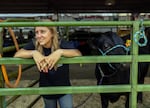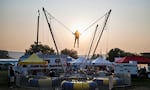
Haze from wildfire smoke hangs in the air as fairgoers attend the Crook County Fair in Prineville, Ore., on Aug. 5, 2026.
Eleanor Moseman for OPB
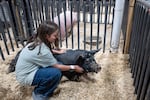
Megan Jones watched as her kids ran off some energy in a science exhibit tent at the Crook County Fair in Central Oregon on Wednesday. They were there to support her 12-year-old daughter, Audrey, who was showing her first animal, a pig named Dexter, at the fair. The whole family spent the day at the fair while Audrey got everything ready for the show. Jones wanted her daughter to have fun, but the thick smoke, which was causing some of the most hazardous air in the world, had taken a toll.
“We have headaches and we’re coughing,” Jones said. “It’s miserable, but we take breaks. We have our trailer here, so we go in and turn on the air and take some breaks.”
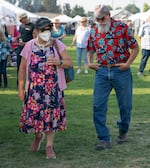
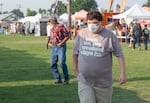
Some fairgoers wear masks on the opening day of the Crook County Fair in Prineville, Ore., on Aug. 5, 2026.
Eleanor Moseman for OPB
Fifteen county fairs are scheduled across the state this month, many of them in communities with unhealthy or dangerous air quality, as wildfires continue to rage across Oregon and Washington. Whether out of a sense of tradition, obligation or affection, people are still going to county fairs, which double as celebrations of agriculture and local economic drivers.
But the health risks are real. Amid warnings from state officials, both humans and animals were feeling the effects of pervasive wildfire smoke.
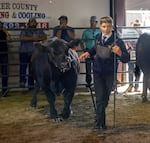
At the Baker County Fair in Eastern Oregon on Wednesday, Shelby Marks gave her steer Maverick a victory bath after he was named first in class.
Taking a break from shampooing his hide, Shelby, 13, said she was proud of her calf, but there had been some challenges in raising him the past few months.
After wildfire smoke settled around her home near Baker City in July, she noticed that Maverick wasn’t eating as much. She started increasing his feeding schedule to ensure he gained weight for the competition.

“I’ve really just adapted to it, but I feel that it’s not good for our animals,” she said. “Especially for the small animals. They have smaller lungs, so it’s going to be harder for them to develop.”
Shelby and Maverick made it to the fair, but not everyone could.
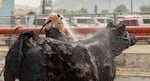
Shelby Marks, 13, of Baker City, washes her steer Maverick on Aug. 5, 2026, at the Baker County Fairgrounds in Baker City, Ore., before the 4-H/FFA steer conformation competition.
Kathy Aney for OPB
Donna Forte traveled from her home in Central Washington to see her three grandkids compete in the Baker County steer competition. Although her husband traveled with her, Forte said he was stuck back in the hotel room because his history with heart disease made it a risk for him to be outdoors.
It was “like you could walk across it, the smoke was so thick,” she said, recalling her road trip into Eastern Oregon. “I hope it rains.”
Forte said her family has a lot of connections to both the fair and the fires burning around it. Her son is a wildland firefighter who spent time on Eastern Oregon fires this year, she said, but for fair week, he and his wife were operating a shaved ice stand.
As another fair commenced 200 miles away in Prineville, the air quality index was 439, meaning being outdoors posed a severe, emergency-level health risk to everyone.
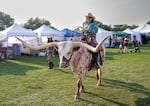
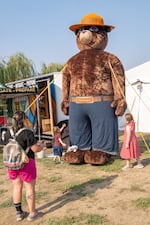
All images: Eleanor Moseman for OPB.
A man riding a full-grown longhorn steer down a row of tents passed through easily — there was no crowd to maneuver the expansive animal’s horns around. Carnival rides ran empty of riders.
Fair organizer Linda Smith sat chatting with a couple of volunteers while people trickled into the main tent. She said she was concerned that crowds would stay away if the situation persisted.
On top of the vendors who had already dropped out, Smith was worried about turnout for a planned breakfast for veterans, even as conditions started to improve.
“I’m worried about that because they’re older and they have more health problems,” she said. “We usually have quite a few people there and it’s kind of one of my passions,” she said.
Numerous people at the Baker County Fair said they had decreased appetites and reported symptoms like irritability, and coughing that worsened during stress or exertion. And humans weren’t the only fairgoers experiencing health concerns.
The best thing cattle owners can do is to reduce as much stress as they can for their animals, said Oregon State University Assistant Professor Juliana Ranches, who studies beef cattle at the Eastern Oregon Agricultural Research Center in Burns. Ranches co-authored a research project this year finding that calves produced an immune response to the smoke and struggled to gain weight.
For 4-H participants showing at the fairs, their animals’ weight is key for entering classes and eventually auctioning the animals.
“I wish I had something that I would tell producers like, ‘Use this and it’s gonna solve all your problems,’” Ranches said. “At this point we don’t.”
All images: Kathy Aney for OPB.
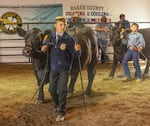
Brothers Bryce and Ryan Thompson had noticed their own steers were eating less than usual, but their family was dealing with more than just smoke.
As the Fox Fire tore through eastern Baker County last month, it charred some of the Thompsons’ pasture, and although the family was able to save some cattle, they said there are still more than 100 unaccounted for.
“We have a bunch of cows that are up by the fire, so the smoke and the fire both kind of affected us because some of our cows are getting burnt up,” Ryan said.
Despite the trying times, Bryce, 15, and Ryan, 13, were still able to bring their competition steers — Wade and Oscar — with them to the fair. Both steers would take home blue ribbons.
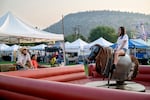
Kimberly Venable, 11, of Alfalfa, Ore., rides the mechanical bull at the Crook County Fair in Prineville, Ore., on Aug. 5, 2026. Venable and her mother had debated coming out because of the wildfire smoke, but the air improved through the day, and she was glad to make it out for the ride.
Eleanor Moseman for OPB