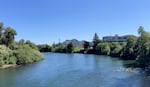
FILE — The Willamette River near downtown Eugene.
Chrissy Ewald / KLCC
Commissioners on the Eugene Water & Electric Board are reconsidering the size of a potential new water treatment plant after seeing financial details.
At its July meeting, EWEB commissioners reconsidered two options: a plant that would treat the utility’s full 19.4 million gallon per day allotment of Willamette River water, or a larger 30 million gallon per day plant that would allow it to seek more rights to river water and possibly become a distributor to nearby utilities that lack the water their communities need to grow.
But at the Aug. 4 meeting, when commissioners were presented with how the 30 MGD plant would stress EWEB’s finances and possibly leave it unable to borrow for other projects, they voted unanimously to direct staff to proceed with further study of the smaller 19.4 MGD plant.
“Last month, we thought that we could really reach for the stars and do what was best for the community,” said Commissioner John Barofsky, who first mentioned studying the larger plant at the July meeting. “Upon further look, we realized that, okay, that isn’t obtainable at this point.”
The smaller plant would cost an estimated $431 million while the larger plant would cost an estimated $498 million.
Either option would stress EWEB’s ability to borrow, according to staff. And while it could cover the cost of either, EWEB General Manager John Hairston told commissioners that building the 30 MGD plant would stress the utility’s finances and its ability to meet unforeseen needs.
“I think of it like buying a house,” he said. “A bank might approve you for a million-dollar mortgage, but just because you qualify doesn’t mean you should tax yourself purchasing a house of that amount. Doing so would leave you without the room to handle something like a job loss, medical bills or a new roof.”
Commissioner Tim Morris noted that this decision doesn’t mean that the idea of EWEB using more Willamette River water is done.
“It can be developed in the future to add once we get to that point of being able to move toward the 30 million gallons,” he said.
Staff told commissioners that the new plant should be a top priority when deciding which projects to fund in the 2027 budget, since the utility stands to lose its allocation of Willamette River water if it is not using it by 2033. Its sole plant that processes water from the McKenzie River also needs to shut down temporarily in the coming years for maintenance.
Meeting materials listed a handful of projects as being deferred from 2027’s capital plan, including two projects that would harden river-crossing pipelines against seismic events.
Board President John Brown, who represents north Eugene–an area that lies across the Willamette River from the rest of the city–expressed concern about that deferral.
“I don’t think we should be put at a much greater risk than 80% of the rest of the community,” he said. “Everybody south, they get the new treatment plant, they get resiliency, and we don’t.”
Hairston assured Brown that the deferred projects will get done even though they are being pushed out to make room for the treatment plant.
Brown also noted there seems to be little federal or state help for such projects at the moment, and he encouraged the community to push elected officials at both levels for funding assistance.
EWEB staff will now prepare further details about how to fund the plant, and are expected to have a plan at the board’s October meeting.
Zac Ziegler is a reporter with KLCC. This story comes to you from the Northwest News Network, a collaboration between public media organizations in Oregon and Washington.
It is part of OPB’s broader effort to ensure that everyone in our region has access to quality journalism that informs, entertains and enriches their lives. To learn more, visit our journalism partnerships page.