
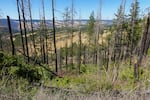
A burn scar from the Mosier Creek Fire in 2020, which burned nearly 1,000 acres and destroyed dozens of structures, remains on a hillside in Mosier, Ore., on July 13, 2026.
Porter Levenson / OPB
Mosier small business owner Drew Merritt and his wife, Kristin Currin, came terrifyingly close to a wildfire in 2020. The raging Mosier Creek Fire crept within 300 yards of their property as they raced home from a camping trip.
“We could see it moving up the canyon and trees torching,” Merritt said. “It was definitely panic inducing at that point because it was looking pretty threatening, but we were extremely fortunate with that fire.”
Now six years later, Merritt is working to make sure they never feel that feeling again.
Earlier this summer, he attended an informational meeting alongside more than 30 other Mosier residents to discuss forming a Prescribed Burn Association in their town. These informal, community-based groups practice a wildfire defense that’s been used for millennia by Indigenous peoples: setting fires proactively and in controlled conditions to reduce the risk of out-of-control firestorms later.

Drew Merritt of Mosier, who was among the dozens of people who attended an informational meeting to learn more about Prescribed Burn Associations, looks on during an interview at his plant nursery in Mosier, Ore., on July 8, 2026.
Joni Land / OPB
A mix of landowners, organizations and volunteers, PBAs connect people with the equipment, training and labor needed to conduct prescribed burns on their property. The burns destroy the fuel that wildfires need to grow and improve the environment by thinning out underbrush.
Over the years, PBAs have been established in 22 states across the country. In Oregon, nine associations across 26 counties have formed since 2021.
Increased fire activity across the West has spurred interest in these associations, said Chris Adlam, a regional fire specialist at Oregon State University’s Extension Service. Landowners, he said, are feeling more of a sense of urgency about the increasing impacts of wildfires — particularly in drier parts of the state like Eastern and Southern Oregon.
“I think more and more people want to participate and feel like they’re doing something to make a difference,” Adlam said.

Another reason Adlam said PBAs have become popular is because of the strain increased wildfire activity has had on wildland firefighters. As hot, dry and windy conditions increase during the summer, firefighting operations become more costly as resources are spread thin.
“With a better understanding of those limits, people are looking for other preventative solutions,” he said. “Prescribed fire is a preventative solution that we know is cheaper. It prevents, to some extent, wildfire smoke emissions. And it makes firefighters’ jobs easier.”
Between 2019 and 2024, PBAs have conducted over 500 prescribed burns on private lands across the West Coast, according to a survey by the University of California Agriculture & Natural Resources. In Oregon, at least 27 burns have been performed by PBAs over the last five years, Adlam said.
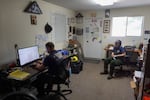
Mosier Fire District Captain Connor McKibben, left, and firefighter Kikyo Hawkins work in the Mosier Fire District office on July 13, 2026 in Mosier, Ore.
Porter Levenson / OPB
A town vulnerable to wildfire
Homes in Mosier are at a greater wildfire risk than 97% of communities in the U.S., according to a wildfire risk assessment website created by the U.S. Forest Service in 2020.
About half of the Mosier Fire District is ponderosa lowland habitat, which burns very quickly, said Connor McKibben, the district’s fire captain. And Mosier sits high on a bluff in the Columbia River Gorge, where notorious winds can further heighten fire risk.
“The vast majority of our fire district is a wildland-urban interface,” McKibben said, adding that it has the same environmental hazards and conditions seen in large swaths of California.
Prescribed burns are the right option in the Mosier area, he said, because controlled and planned fires can destroy invasive plants, reduce wildfire fuels and restore habitat areas. That’s an approach that reflects the fire knowledge that Indigenous people applied to the land long before Oregon or Mosier existed.
For thousands of years, Indigenous people have used burning for ceremonial purposes, to create habitat for wildlife, to ease travel along trails and to increase the abundance of certain plant species, according to the OSU Extension Service.
Burning shrubs and small trees in the understory of forests reduces “fuel ladders” that allow wildfires to reach tree canopies. Fires also thin out the understory, leaving more space for native plant species. This improves the health of many plants across Oregon that depend on fire to maintain their habitats.
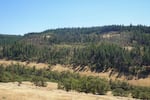
The hills around Moiser, Ore., still bear the scars from the 2020 Mosier Creek Fire on July 13, 2026. The wildfire burned 985 acres of Wasco County.
Porter Levenson / OPB
A community looking to help
Kathi Sleavin, who helped organize Mosier’s informational meeting, became interested in PBAs after attending a presentation in 2025 on the Mt. Adams association in Washington state. She realized how valuable a PBA would be for her community.
“I think, OK, I might be able to help my neighbors if a fire got to my property and was able to drop down in intensity,” she said. “It might give the wildland firefighters a chance. It might give my neighbors a chance.”
Sleavin and her husband began taking burn training classes to learn more about prescribed burns. There she met Kylie England, a prescribed fire operations specialist with the Mt. Adams Resource Stewards (MARS), a nonprofit organization involved with creating one of the first PBAs in Washington. Sleavin credits England with planting the seed inspiring her to form a PBA in Mosier.
“It’s just really nice to help your community,” she said. “I think just helping people or helping with an organization or a concept it’s very valuable work.”
At the meeting, Preston Booker, a local landowner, shared his experience conducting a prescribed burn. After moving to Mosier from Santa Rosa, California last year, a family friend who was a forester visited him and recommended he do a burn.
“I was totally fearful of burning,” Booker said. But the family friend reassured him that the conditions and the weather were just right at his property.
Booker knew he had a lot of work ahead of him.
“I probably owned a weed eater and a lawnmower,” Booker said. “Nothing like chainsaws or taking trees down or limbs, that kind of thing.”
For two months, Booker went to work cutting trees, clearing out dead wood, and removing troublesome limbs from trees in the area that he wanted to burn.
“I went from not being a forester to kind of being a very OK amateur forester,” he said, laughing.
McKibben, the district fire captain, helped Booker create a burn plan. Once it was approved and permitted by the Oregon Department of Forestry, he put together a team of volunteers.
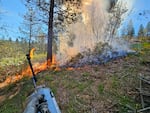
Mosier Fire District Captain Connor McKibben conducts a prescribed burn on Preston Booker's property in Mosier, Ore., on April 4, 2026. The controlled burn is one of the first burns carried out in Mosier on private land.
Connor McKibben
Together they divided about an acre of Booker’s land into quadrants and thinned out more of the brush.
“It was one of the hardest working days of my life,” Booker said. “Really getting out and helping cutting fire lines, cutting higher brush so that it would just be on the ground to burn.”
The change after the burn, he said, was remarkable. It included new grass where underbrush had been and an extremely reduced fuel load.
There is still more work to be done, he said. That includes monitoring and maintaining the area he burned by getting rid of any unwanted vegetation.
“It’s possible down the road there’d be another burn, but you have to see how things redevelop and reestablish themselves over time,” Booker said.
A successful prescribed burn also requires lots of planning and networking behind the scenes. That’s where the PBAs come in, helping connect the dots for landowners who want to act but aren’t sure where to start.
Some PBAs might have a certified burn manager, a person who completed the ODF’s prescribed fire training program. Those managers can create a burn plan and submit it to state forestry officials for approval and a burn permit.
The agency will then analyze the weather and amount of fuels in the area to determine the best time for a burn.
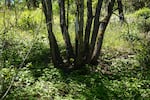
New vegetation surrounds a tree with scars from the April 4 prescribed burn on Preston Booker's property on July 13, 2026.
Porter Levenson / OPB
Concerns over prescribed burns
Several individuals at the informational meeting raised concerns, including high costs associated with burns. Some burns can cost up to $1,000 an acre, Adlam said.
But PBAs can help cut down on costs “by working together with others who have the appropriate expertise and experience and equipment, then it becomes a lot more accessible,” he said.
Others were worried about protecting wild animals and sensitive plant life. Most forests benefit from the thinning of underbrush and debris, but identifying the plants that need to be protected is an important part of the preparation needed for burns.
Residents’ biggest concern, however, was the risk of prescribed fires escaping their containment lines. This can raise liability issues for landowners if it damages a neighbor’s property.
In 2022, a U.S. Forest Service employee was arrested by local authorities after losing control of a prescribed burn on federal land in Grant County. That fire spread onto the private land of a nearby cattle company, burning about 20 acres, and was controlled within an hour. The Forest Service employee’s case was later dismissed by a federal judge.
And in May, a U.S. Forest Service-prescribed burn in Deschutes County escaped its containment lines when the fire spotted outside its planned boundaries. No one was hurt and no homes burned.
However, unlike federal and state agencies, controlled burns performed by PBAs are usually done on a smaller scale, primarily on private land rather than larger public lands.
Prescribed burn associations on the West Coast have conducted hundreds of burns on private lands in the last five years with no escape, according to Adlam.
Despite those concerns, there’s enough interest in Mosier that Sleavin said she plans to host more events to figure out what residents want to do.
McKibben also plans to do more outreach. His goal, he said, is for the Mosier PBA to be seen as a resource everyone can use.
“I grew up here. If I can encourage more people to get involved, then it’s going to make my job easier, everybody’s lives safer and property safer,” he said. “And that makes me feel good.”