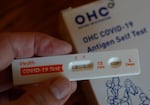
A positive COVID home test is shown in this image. Public health experts say we're now in the midst of a growing summer surge of COVID in the U.S.
Justin Sullivan
Hantavirus. Ebola. West Nile. Measles. And, of course, cyclospora — that stomach parasite making people miserable across the country. Americans have plenty to worry about this summer.
But remember COVID-19? It may not be surprising that many people may have almost forgotten about COVID. Unfortunately, COVID hasn’t forgotten about us.
For stories on the science of healthy living, subscribe to NPR’s Health newsletter.
“We’re now in the midst of a growing summer surge of COVID here in the United States,” says Dr. John Brooks, an infectious disease doctor at Emory University in Atlanta, Ga., who used to work at the Centers for Disease Control and Prevention. “I think most of us kind of feel like it’s fading away and are certainly very grateful for that. But nationally we’re seeing it ticking up pretty much everywhere.”
The virus is spreading the most again in the South and West, but is also on the rise in the Northeast and Midwest. The good news is the virus is still at very low levels. And so far this summer’s wave seems to be continuing the trend of getting milder each year, sending fewer people to the hospital and causing fewer deaths.
“What we’re seeing is very likely evidence of growing herd immunity if you will,” Brooks says. “More and more people have had one or more infections that give them some immunity against the virus and have had more than one vaccination, or maybe both. And all of that really has begun to offer us a lot of protection.”
Now, that doesn’t mean people don’t have to worry about COVID at all anymore. The disease still makes lots of people feel awful for a week or two, foiling their summer vacations and forcing them to miss work and school.
And COVID can still cause serious disease for some people, sending them to emergency rooms, causing hospitalizations and even sometimes still causing death.
“COVID-19 is still dangerous, particularly for older adults, infants and people who are immunocompromised,” says Caitlin Rivers, an epidemiologist at Johns Hopkins University in Baltimore, Md. And that is a lot of Americans. “In a typical office, if you have 20 colleagues, it’s likely that one or two of them have some degree of immunocompromise. So it’s very common that people have risk factors that make COVID-19 dangerous.”
Unlike the flu, which only surges during the winter each year, COVID sees spikes twice a year – both in the summer and winter. The reason for that remains unclear.
“It’s a big mystery as far as I’m concerned. It is the only seasonal respiratory virus that has a summer season,” River says. “To my knowledge, we don’t know what is causing this seasonality.”
Rivers says she still masks up when she’s in crowded places like busy airports, and recommends that people stay up to date on their vaccines. The next shots look like a good match for the dominant strain of COVID that’s circulating and should start becoming available soon.
Unlike previous years, the CDC hasn’t issued updated recommendations for the vaccines because of litigation over the Trump administration’s efforts to overhaul immunizations in the U.S. The administration no longer recommends that everyone aged 6 months and older routinely get an annual shot.
But major medical groups still do recommend it. And insurers have indicated they will keep covering vaccines. The shots are likely to remain available for free through government programs like the Vaccines for Children program.
Public health experts worry that conflicting messages will cause confusion, discouraging people from getting another shot.
“The message is that COVID vaccine and flu vaccine will be available, they’re covered by insurers, they’re recommended by medical societies. People should get them and get them for their kids,” says Clare Hannan, executive director of the Association of Immunization Managers, which advocates for immunization programs.
There’s also even a new drug, called Xocava, that people can take right after they’ve been exposed to the virus to cut their chances of actually getting sick from COVID.
“It is something for people to just have in the back of their mind,” Brooks says. It is expected to be a useful tool in hospitals and nursing homes when exposures happen to vulnerable people.