FILE - Cars drive down U.S. Highway 20 among the sagebrush-filled landscape stretching for many miles in Harney County, Ore., on Dec. 18, 2025.
Eli Imadali / OPB
The federal government wants to open up more public lands for livestock grazing across the West, including in Oregon and Washington.
But conservation groups say that would benefit only a handful of livestock producers at the expense of the environment and wildlife. At least one environmental group is taking the federal government to court over the plan to open up more than 24 million acres of vacant public lands for livestock.
The Center for Biological Diversity filed a federal lawsuit in Portland last week against U.S. Department of Agriculture Secretary Brooke Rollins and U.S. Department of the Interior Secretary Doug Burgum.
The center is accusing the federal agencies of violating the Endangered Species Act.
At the crux of the lawsuit is an agreement signed by Rollins and Burgum and a “grazing action plan” published last year. That plan details the Trump administration’s intent to “fortify the American beef industry” by streamlining and expanding the livestock permitting process on public lands managed by the Bureau of Land Management and the U.S. Forest Service.
Federal government grazing permits are 10-year privileges to run livestock on public lands at highly subsidized rates.
In Oregon, the Bureau of Land Management alone already authorizes livestock to graze on nearly 14 million acres of public lands across roughly 1,400 separate allotments. Of those, less than 68,000 acres are not currently in use for many reasons; the land might be too steep or rocky or too far away from a source of water, according to an email from a BLM Oregon state office spokesperson.
BLM has identified at least 50,000 acres of its own lands and at least 88,000 acres of Forest Service lands that could be opened for more livestock in the state.
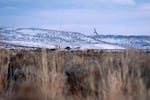
A Northern Harrier flies over a field of sagebrush in Harney County, Ore., on Dec. 18, 2025.
Eli Imadali / OPB
Cattle and public lands grazing lobbying groups have long argued that grazing cattle on rangelands is a form of land management to prevent wildfires from getting out of control and have largely praised the Trump administration’s efforts to strengthen the beef industry.
But conservation groups argue the plan could damage sensitive wildlife habitat and hurt federally protected species.
“We know that grazing has detrimental impacts on wildlife in various ways,” said Andrea Zaccardi, a senior attorney at the Center for Biological Diversity.
Zaccardi said left unchecked, cattle can eat their way through riparian zones along waterways and trample river banks and streams.
“[Cattle] also go into these streams and can cause sedimentation issues, trample fish eggs and impact spawning of fish,” Zaccardi said.
Usually, when a government action could have an impact on species listed under the federal Endangered Species Act, agencies are supposed to consult the U.S. Fish and Wildlife Service or National Marine Fisheries Service to understand what those impacts are, and potentially be required to take action to mitigate those impacts, Zaccardi said.
“It’s a low bar,” Zaccardi said. “If an agency action is going to impact a list of species, they have to consult.”
In this case, Zaccardi said the Center for Biological Diversity has not received any evidence that the federal agencies have consulted either the USFWS or NOAA. She said the center sent BLM and the Forest Service a notice of intent to sue in April.
Zaccardi said the center believes that the federal agencies are moving quickly and are already approving livestock producers to run cattle on those vacant allotments.
She pointed to a video of a high-ranking Interior Department official, Karen Budd-Falen, participating in a public lands discussion. In the video, Budd-Falen detailed the agency’s intention to move fast.
“By the end of next year, every single vacant allotment will be filled by a rancher, who will be able to get their cattle in there grazed,” she said.
The BLM spokesperson did not answer when asked if the agency was already allowing livestock on vacant lots, and told OPB in an email it cannot comment on pending litigation.