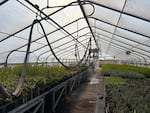
The Confederated Tribes of the Umatilla Indian Reservation operate one of a hundred indigenous nurseries across the country. At the CTUIR nursery, native plants are grown to aid in habitat restoration efforts.
Rolando Hernandez / OPB
Two decades ago, there were roughly 10 indigenous plant nurseries in the country. Since then, that number has blossomed to around 100, including one operated by the Confederated Tribes of the Umatilla Indian Reservation. The nursery only grows native plants, with its primary goal to grow vegetation to aid in restoration of natural habitats in Eastern Oregon, including for salmon. Gail Redberg is the CTUIR Nursery Manager. She gives us a tour of the facility, shares some of what they grow and why it’s important.
Note: The following transcript was transcribed using AI and validated for accuracy, readability and formatting by an OPB volunteer.
Dave Miller: This is Think Out Loud on OPB. I’m Dave Miller. Two decades ago, there were about 10 Indigenous plant nurseries in the country. Since then, that number has blossomed to around 100, including one operated by the Confederated Tribes of the Umatilla Indian Reservation. That is where I am right now. Gail Redberg is a nursery manager. Gail, thanks so much for letting us come by.
Gail Redberg: Thank you for inviting me to be on the show.
Miller: Where are we right now?
Redberg: Right now,we’re standing outside of our 1929 barn that used to be a pheasant farm, and now it has become our place of storage and work here at the nursery. And in front of us we have a blue elderberry bush, and to the right is a chokecherry bush. And the chokecherry is one of the highest rated plants in the First Foods policy of the tribes, and is served at every longhouse dinner, every funeral, every gathering. That’s one of the several foods that are served. It’s a little bit bitter, but actually these are pretty tasty. You should taste some.
Miller: Are they ready? Are they ripe? They look gorgeous.
Redberg: Yeah, they’re ready right now. We just got done picking some that we could reach.
Miller: I don’t know if I’ve had these before.
Redberg: Just a tiny bitter, but they are a little sweet too.
Miller: Oh, there’s a seed I was not expecting.
Redberg: Yeah, it’s a cherry. [Laughter] They have a little pucker.
Miller: The seed makes up most of the size of the circle.
Redberg: Well, that’s the case with almost all native plants.
Miller: Then the sweetness does come.
Redberg: And then the blue elderberry is very high in antioxidants and is often used as a syrup. So make a syrup with the berries and use it as a tonic to ward off flus and other colds. A lot of people started using it during COVID.
Miller: Can you take me into one of the greenhouses here?
Redberg: Sure.
[Sounds of footsteps as they walk]
Miller: How long have you been doing this?
Redberg: Fifteen years.
Miller: And before that?
Redberg: And before that I taught biology for 20 years.
Miller: To high schoolers?
Redberg: Yes.
So right here, this is a red osier dogwood, which is a wonderful plant. I just love it. It has bright red stems during the wintertime when the leaves fall off and the sun activates all of those beautiful pigments. This was my first native plant that I ever acquired.
Miller: As you walked by, you just tenderly grabbed the leaves and gave them a gentle enough squeeze that they didn’t come off. Sort of saying hello to the plant, it seems like.
Redberg: Right.
So this is our longest house, the first place where we sew our seeds and care for them until they have filled out a cone that’s 8.5 inches deep and about 1.5 inches across. It’s called a 10 cubic inch cone, and it’s widely used in all sorts of conservation projects.
Miller: So instead of a big sort of bucket, it’s a relatively narrow, almost 1-inch diameter cone that goes down 8 inches for the roots?
Redberg: Right. So the purpose of that is to get the roots as long as possible before they’re outplanted. Because most of our plants are being planted in areas where nature is going to be the only caretaker. We want those roots to get down and be able to be as functional as possible in finding and utilizing the water in the soil.
[Fan noise in the background]
Miller: I hadn’t thought of that – as we walk away from these huge fans here – that unlike some commercial nurse or other nurseries where the idea is that there’s gonna be a home gardener, a landscaper or some human tending it, almost all of these, when they are eventually planted, no one’s gonna tend to them ever again,
Redberg: In this part of the country because our precipitation is so low, we do generally water for the first and second summers. But then after that, they’re on their own. And of course, a lot of the habitat managers will put up fencing to prevent the elk and deer from foraging on them.
Miller: They would like these young shoots?
Redberg: Oh yes, the elk especially pull them right out of the ground.
Miller: There are, it seems to me, dozens of different species just in this one greenhouse.
Redberg: Right behind you, there are some quaking aspen. I think most people are familiar with quaking aspen. They grow at higher elevations. And these were actually grown out for a project for the Warm Springs Indian Reservation.
Miller: So you do work for other Native tribes in Oregon?
Redberg: Yes. We have sold plants to Yakama, Burns Paiute, Warm Springs.
Miller: Do you have favorites here?
Redberg: Well, I really like this plant that’s right behind you. It’s an Oregon grape, believe it or not. It is very small. It’s a creeping Oregon grape, and it has branches that come up like a fern frond. And these are really beautiful underneath a glade of water birch. It’s just like fairyland.
Miller: How do you all decide what to grow here?
Redberg: The tribe has managers for five different watersheds that are within the ceded territories of the tribe. And those managers have several different restoration projects going on at a time to help the stream to become more … to restore salmon habitat.
Miller: I’ve gotten distracted as you’re talking, because I thought some overhanging piping was moving towards me, and I thought “no, it’s not.” But it turns out it is! It’s this kind of roboticized sprinkler system which was moving towards us, and now it’s moving away and it is watering these plants automatically.
Redberg: This is a great invention. It’s a boom sprinkler. The carriage comes down the aisle of the house, the center aisle, and the booms extend out to the sides on both sides covering all the tables. Because we have so many different types of species that we’re growing, then they all have different water requirements. It’s really nice because we can program a different program for every table or even parts of tables.
Miller: And the system knows exactly what’s underneath it because you’ve programmed it?
Redberg: Right. You tell it where you want that program to start, how fast it should move and for how many passes.
Miller: You were saying that salmon habitat restoration managers are the ones who say, “we would like to plant X or Y plants along this tributary or stream or along this river, and so please grow them for us”?
Redberg: Yes, that’s pretty much it. Depending on the experience of the habitat managers, they may seek our advice on what plants would do well on that habitat. So I’ll do a site visit to the project, and we’ll talk about what kinds of plants would do the job that they need to have done. For instance, some plants that we grow produce a lot of really profuse roots and rhizomes, like the snowberry. So those hold in soil along the stream banks. And in other areas, there’s wetlands and there’s an upland area for plants that don’t require as much water. So we kind of help guide them in that species list.
Miller: Where do you get all the seeds or seedlings that turn into these plants?
Redberg: We gather from all of the ceded territories of the tribe, which is much, much larger than the reservation itself, goes halfway up in Washington and down to Baker City area, and close to Tri-Cities.
Miller: So you and others fan out at different times of the year to places that you know, and collect seeds that you can then grow here in these greenhouses?
Redberg: We try to get seed from several different elevations so that they will match the project site that they’re gonna be going into, so we can select from those seeds to match up the appropriate elevation with each one. With climate change, all of that strategy has become a lot more fluid. After a plant starts growing, it can’t just get up and move. So we try to have seed from a wider variety of locations, because we don’t know exactly what kind of difficulties they’re gonna face as they’re growing.
Miller: The whole idea is that these are native plants that have been on this land for hundreds of thousands of years, maybe longer, as opposed to plants that have been bred and selected for ease of human growing. Does that make it harder for you to raise them here, in a sense, in captivity?
Redberg: Certainly, for many reasons. Just for example, the DNA of these native plants has a lot of variation. There will be seeds that will germinate maybe in February. And then in that same species, that same group of seeds, maybe even from the same plant, there will be seeds that will not germinate until August or September. So instead of being able to plant all of your crop at one time, we go with the flow, so to speak, because we don’t wanna lose any of those genetics. The ones that are germinating in September likely have some really important characteristics that we don’t want to lose, as far as ability of fighting disease, or drought, or freezing, or whatever the case may be.
Miller: What drew you to this job? As you said, you spent 20 years as a biology teacher. I imagine there are a lot of connections between a background in biology and the knowledge required for running a place like this, but the actual work seems very different. Why did you want to do this?
Redberg: Well, I had been teaching students about conservation and about having a reciprocal relationship with the Earth, and giving back and not taking, not taking everything for granted, recognizing that our success as a species depends on the health of the earth and all of the interaction between different life forms to continue that health. I just got to the place where I really wanted to be out doing conservation work, and not just talking about it. I’ve learned a tremendous amount since I’ve quit teaching. You learn all your life, but this has been a great experience.
One of the things that just thrills my heart is how courageous these plants are. We don’t oftentimes think of courage as an attribute of plants. But when you think about a seed that lands in a place that just has a tiny bit of soil, maybe a little crack in the rock, I think that’s courage. It’s the will to live. And I think that every living thing has that.
My first year when I first came here, there were a lot of dead plants out in the pot yard and we put them in the compost pile because we’re gonna take the pots off and save the soil later, but we didn’t have time right away. It rained the next week. And a week after, I walked past it and all these little green leaves were coming up. And the dead plants had crispy, powdery leaves on them.
Miller: That’s why you threw them away.
Redberg: Yes. But they still had that strength to keep going. I know it’s not just a spiritual thing, it’s a chemical thing as well. But it doesn’t make it any less amazing.
Miller: Well, while we’re talking about the more spiritual side of this, what’s it like for you when these plants that you have raised and tended get shipped off to go be planted somewhere?
Redberg: Well, it feels really good when you go out and visit the site two or three years later, and you see them flourishing. What’s really hard is when you have sent off your project load of several trailers and pickups full of plants to go up into the mountains, and then the Hagen Fire or another fire comes along and destroys them all the very next year. I mean, that’s hard.
Miller: Has that been happening just this month?
Redberg: In fact, most of our seed collection is right in the middle of the Hagen Fire. So we have to find new sources of seed. Just have to go a little bit further, work a little harder.
Miller: Gail, thanks very much.
Redberg: Thank you.
Miller: Gail Redberg manages the native plant nursery on the Confederated Tribes of the Umatilla Indian Reservation.
“Think Out Loud®” broadcasts live at noon every day and rebroadcasts at 8 p.m.
If you’d like to comment on any of the topics in this show or suggest a topic of your own, please get in touch with us on Facebook, send an email to thinkoutloud@opb.org, or you can leave a voicemail for us at 503-293-1983.