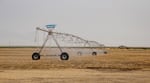
Central pivot irrigation waters a crop south of Boardman, Ore. on July 24, 2026
Antonio Sierra / OPB
Last week, a $6.2 million settlement was made between Madison Ranches and residents living in Morrow and Umatilla Counties whose wells were polluted with nitrates. The Lower Umatilla Basin has been grappling with high levels of nitrates for decades, affecting drinking water in wells in various communities. Food processors and farms using fertilizers are regarded as the source of the problem.
J.R. Cook is the founder and director of the Northeast Oregon Water Association. He joins us to share an irrigator’s perspective on the issue and solutions they would like to see.
Note: The following transcript was transcribed using AI and validated for accuracy, readability and formatting by an OPB volunteer.
Dave Miller: This is Think Out Loud on OPB. I’m Dave Miller, coming to you from Hermiston. We are about seven miles from the Columbia River in the largest city in Eastern Oregon. J.R. Cook joins me now. He’s been working on water planning and policy in this region for nearly 25 years. He’s the director of the Northeast Oregon Water Association. He represents major irrigators and food processors, with one big overarching mission: to pump more water out of the Columbia for farmers, aquifer recharge and drinking water. J.R. Cook, welcome to Think Out Loud.
J.R. Cook: Thank you. Thanks for having me.
Miller: Earlier this week, we took a tour of the Port of Morrow and a few neighborhoods in Boardman to see some of the places that have been heavily affected by nitrate contamination in the Lower Umatilla Basin. It doesn’t seem like there’s a ton of disagreement about what caused the contamination – decades of heavy fertilizer use, food processing and wastewater application. But now those nitrates are in aquifers, so the question is what to do going forward. What’s your solution?
Cook: That’s a great question. It’s a multi-generational solution that I’ve been working on, quite frankly, for the 25 years you referenced before. The first thing that I think is important for people to understand is that there are two different types of aquifers in the Umatilla Basin. There’s the shallow alluvial aquifer, which is what they call an unconfined aquifer, meaning it’s subject to anything that Mother Nature or humans put on the ground, and then there’s the deep basalt aquifer, which is what we call fossil water. It’s water that’s been underground for over 30,000 years. It’s about 1,500 feet below us in the Umatilla Basin. And that aquifer has been underground since before the industrial revolution, it’s very potable.
So, what we started to work on in the early part of my career was to try to get agriculture off of the deep basalt aquifer, which is Mother Nature’s savings account and our most potable resource, and save that for potable needs. Ag has been working for a number of years to get to the Columbia River, get off of the deep salt groundwater. And we’re working to try to figure out a way to save that groundwater for both drought resiliency and potable needs. It is expensive, but it is a solution to get most of our rural residential areas and these areas that you probably toured that have had water problems, let’s get them into the good aquifer. Let’s either get them onto city systems that are treated or get them cased and sealed into the deep basalt aquifer.
Miller: What do you see as the biggest hurdles getting in the way of that? As you said, you’ve been working on this for close to 25 years. It hasn’t happened yet. Why not?
Cook: A host of reasons, and I will say most of them are political. Ninety-three percent of the Columbia River flows to the mouth of the Columbia River. Oregon, on a consumptive use standpoint, out of that 7% that is used, Oregon uses 0.5% of that. The rest is used by Washington and Idaho. So it’s been … one, we don’t wanna affect fish, but two, working through the political hurdles and the environmental hurdles of accessing one half of one day’s flow to fix the entire region’s problems for a year has been daunting, to say the least. And quite frankly, we’re there. We believe we have the science to prove we can do it, but it’s taken a long time to get there. And then a lot of these issues that have come up the last few years have not helped because the politics and the views of what that water is gonna be used for have been kind of strained or been disoriented, or in a way, misconstrued on what we’re wanting to do. But the main goal is still there: get ag off of primary need for basalt groundwater and get potable needs onto it.
Miller: Now, we’re talking here about responding to, in a sense, the legacy application of fertilizer and nitrates in these aquifers. But earlier this week, we did talk to Kaleb Lay from Oregon Rural Action about nitrate contamination, and he also talked about current irrigation practices. I want to play you a short part of what he said and then we can get your response. This is part of what he said.
Kaleb Lay [recording]: You know, the folks like Madison Ranches, Windy River, all the folks who are using industrial wastewater, there are at least some guardrails, so that we know how much nitrogen they’ve been using. When they’ve made mistakes and when they’ve polluted groundwater by overapplying, there’s been some record, so we can hold them accountable.
For a lot of the other operations out here, the massive corporate-scale agricultural irrigation systems, there’s no accountability for that. It’s the wild west. They don’t have to report how much they use or how much they pull off, or any of that stuff. I think we should take those bare minimums and spread that out to the rest of the sources of nitrogen.
Miller: J.R. What’s your response to this idea?
Cook: Well, I think the first thing we need to realize is that Kaleb Lay is not an agronomist, Kaleb Lay is not a hydrologist or a hydrogeologist, so we need to look at the facts and the science. And the science is very clear that 21st century technologies and the use of our water supplies, because our inputs are very expensive and water is very expensive, nobody’s wasting it, nobody’s pushing water past the root zone, unless they know of it. For him to say that that water use and the amount of water use is the “wild west” is completely factually incorrect.
The OWRD, Water Resources Department, has policed our basin more than any other basin in the state of Oregon. We know exactly how much water we’re putting on, and to be honest with you, we’re actually showing that current practices are not leaching any water into the vadose zone or past the vadose zone. But to continue to say that agriculture and that current practices are a problem is almost a disservice to the region to look at how we fix the problem. And if we’re gonna fix the problem, we need to get rid of the legacy contaminants. We have ways to do that through aquifer recharge and what we call aquifer dialysis, where we pump the bad water out in the summer, remediate it by putting it on crops, and recharge clean water in the winter.
We can talk about septic tank efficiency and 21st technologies there, but to continue to go outside of these residential areas and these urban areas, and say that it’s not your fault that this is happening and that you’re drinking bad water, it’s all their fault, that’s completely ignoring the cumulative nature of the problem, and it’s completely ignoring the cumulative nature of the solution.
Miller: How do you feel about data center usage of water in the context of this conversation?
Cook: Data centers are a new development, and I will say for now, our job as an organization is not to pick and choose the industries and land uses that come in. Our job is to ensure that those industries and land uses are committed to the solutions and committed to sustainability. Our data center partners in our basin, albeit, we are not gonna get into all the other aspects of the problems with data. But in terms of water use, it’s probably one of our cleanest cooling systems that we have, and they need water at the same time agriculture does.
We actually had projects in place with them to let them borrow our water first, meaning the Columbia River projects that we had, run it through their cooling system once – meaning they wouldn’t add any cooling water or any contaminants to that – and then put it right back into the irrigation stream. And again, I don’t think people know that non-contact cooling water does not add anything. It’s basically like overgrown swamp coolers. We had that in place, but DEQ said, no, you need a land app permit for that, and everybody downstream of that, even if it’s 500 gallons a minute and a 300,000-gallon-a-minute pipeline, you shall have a permit and be subject to DEQ regulations downstream of that. That doesn’t quite work for agriculture, and it doesn’t quite work for economics.
So, some of the efforts that have been made with data to better reuse their water, I would say require more policy consideration by the state of Oregon. But as a whole, and when we talk about water supply and water quantity, data in our region is not the problem. The problem is getting the state, data, agriculture and the municipalities all together to say how do we fix the problem together.
Miller: In the time we have left, I’m curious where you see room for real compromise and coalition building right now. We’ve got about a minute left.
Cook: That’s a great question. That’s the only way we fix this problem. Trust is the key cornerstone of solving multi-generational water problems that will take multiple generations. And the first thing that comes to mind is executive leadership and memorialization of a solution. We need to get to the point where … In our place, we have a 2050 plan. We need to get the governor’s office in the state of Oregon to commit to the goals of that 2050 plan, and let’s put the measurables around meeting those goals rather than trying to find other problems and point more fingers.
Miller: Does that include the color of water legislation? Will you be bringing that back in 2027?
Cook: We will be bringing it back in full force. If it doesn’t pass in 2027, we’ll run it in 2028, 2029 or 2030.
Miller: OK. And perhaps we will talk more fully about that when you do again. J.R. Cook, thanks very much for your time. I appreciate it.
Cook: Great, thank you very much.
Miller: J.R. Cook is the founder and director of the Northeast Oregon Water Association.
“Think Out Loud®” broadcasts live at noon every day and rebroadcasts at 8 p.m.
If you’d like to comment on any of the topics in this show or suggest a topic of your own, please get in touch with us on Facebook, send an email to thinkoutloud@opb.org, or you can leave a voicemail for us at 503-293-1983.