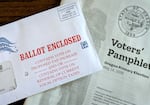
FILE - An unopened Oregon ballot for Washington County and a Voters' Pamphlet for the 2026 primary election are seen on a table on Monday, May 11, 2026.
Meagan Cuthill / OPB
Yesterday, in an emergency opinion, the Supreme Court decided that the Trump Administration can go forward with an executive order that would fundamentally change the way elections are conducted in the U.S.
Under the order, the Department of Homeland Security would create lists of U.S. citizens eligible to vote that it would send to states, and the U.S. Postal Service would decide who can get mail-in ballots.
Though this isn’t the final legal word, the ruling creates a new level of uncertainty just ten weeks from the midterm elections.
Oregon Secretary of State Tobias Read joins us for a discussion.
Note: The following transcript was transcribed using AI and validated for accuracy, readability and formatting by an OPB volunteer.
Dave Miller: This is Think Out Loud on OPB. I’m Dave Miller. Yesterday, in an emergency opinion, the U.S. Supreme Court said that the Trump administration can go forward with an executive order that would fundamentally change the way elections are conducted in this country. Under the order, the Department of Homeland Security would create a list of eligible voters that it would send to states. The U.S. Postal Service would decide who can receive mail-in ballots.
This is far from the final legal word. The unsigned majority decision points out that the justices were not yet weighing in on the legality of the executive order. They simply say that the order can go forward for now. But the Court did inject a new level of uncertainty just 10 weeks away from the midterms.
Tobias Read joins us to talk about this. He is Oregon’s Secretary of State, meaning he is the state’s chief elections official. Secretary Read, welcome back.
Tobias Read: Thank you, Dave. Glad to be here.
Miller: The last time we talked about this was in April, right before Oregon joined about two dozen other states in challenging the executive order. At that point, there wasn’t a lot of clarity about how the process would work. But just a couple of days ago, on Friday, the U.S. Postal Service released its finalized rules. [It’s] nearly 100 pages, but the basics, as I understand them, are that the agency would only deliver ballots if states share voter data with them. They’d only deliver ballots if the envelopes meet specific criteria. And they’d only send ballots to people who are on its own list of eligible voters.
What do you make of these rules?
Read: What I want to say first, Dave, is that Oregonians should know we are going to have safe, accurate, fair vote by mail elections in Oregon. The ruling from the Supreme Court was one about timing, in our lawsuit against the president’s Executive Order, not about the merits. So we can continue to have that conversation because we will argue for what the Constitution says, which is the states run elections, not the president.
On top of all the legal questions, there are a whole lot of practical questions that you alluded to in your setup. But what I can tell Oregonians and you is that we are going to use every legal tool available to us to continue to defend the right of Oregon and other states to determine how we run elections. This is about a president who is increasingly desperate to avoid the accountability that an election represents, and we are not going to give up our authority to run our own elections.
Miller: This is also about a Supreme Court that says that the president, for now, can go forward, see what these rules start to mean in practice. And then at that point they will decide whether or not the rules, the order, are legal. I still am curious about your specific take on the U.S. Postal Service’s plan, now that it’s finally been made public?
Read: Fundamentally, we have to remember that the U.S. Postal Service is a service. It is not a business. This is not a censor, which is essentially what the president is trying to turn the Postal Service into. I don’t think they can pull it off, especially with 10 weeks left to go. Keep in mind as well, there is another injunction on the same case still in place, as a result of a suit that the League of Women Voters initiated. All of this, I think, goes back to your correct interpretation at the start. This is just the latest development, and we will continue to make the argument – we believe it’s a very strong argument – that the president is trying to write election law from the White House, an authority he does not have.
Miller: I’m glad you brought up that other injunction. These things get complicated. But the short version is that just two weeks ago, the same judge who ruled in that lower court ruling in June that the Supreme Court yesterday said no to, also put a hold on the USPS. following some of the president’s executive orders. And that second injunction has not yet been taken up by the high court. But just yesterday afternoon, the administration asked the court to either pause it or cancel it by this afternoon.
So let’s turn to the question of timing, which, as you were saying, is a really important one. So just for Oregon’s side, at what point are voter rolls for the November election here in Oregon going to be finalized?
Read: The last day for an Oregon resident, who meets the other requirements to register to vote, is October 13. But this election, it is safe to say, is underway. Ballots are being prepared now. We are about three weeks away from the first ballot going in the mail to military service members and overseas voters. So everyone knows you don’t change the rules of the game in the middle of the game. This is just another reason that this is not a serious effort on the part of the president. It’s, again, about him seeking any opportunity he can to avoid accountability. Even if this injunction is overturned, we will continue to assert all of our legal authorities. We will continue to fight it in court.
Miller: Another way I guess to ask the question I just asked is at what point would it be too late for your state and the rest of the 49 to follow new voter roll or ballot-printing rules?
Read: I think the answer is essentially now because we are printing ballots and we are very close to mailing those out. I don’t see a way that, practically, the infrastructure is in place to exchange that information. Remember, the federal government sought the voter file from us and a number of other states. We were the first state to have that order dismissed. Now, the U.S. Department of Justice is [zero] and 23 in those records. The executive order also says 60 days in, and as you noted in your introduction, we are 70 days away now.
Miller: Finally, I just want to turn to the question of mail service itself. The president has been consolidating power over the USPS by putting loyalists on the board of governors. And the leadership of the agency has been moving forward with rulemaking to limit vote by mail, despite the fact that courts have told them to pump the brakes. How much faith do you have in the United States Postal Service right now when it comes to vote by mail?
Read: I trust the people of the Postal Service to do their job. We are encouraging people to prepare for voting. So when your voter’s pamphlet arrives, that’s a good clue to start looking at it, to do your research, to be prepared to make your choices, so that you’re ready to vote when the ballot arrives. Using a dropbox is a great way to go as well. We will always follow the Constitution and the law, and make sure that Oregonians have the right to vote to hold politicians and government accountable.
Miller: Secretary Read, thanks very much.
Read: Thank you, Dave.
Miller: Tobias Read is Oregon’s Secretary of State.
“Think Out Loud®” broadcasts live at noon every day and rebroadcasts at 8 p.m.
If you’d like to comment on any of the topics in this show or suggest a topic of your own, please get in touch with us on Facebook, send an email to thinkoutloud@opb.org, or you can leave a voicemail for us at 503-293-1983.