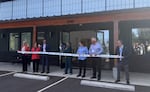
Oregon State University President Jayathi Murthy cuts the ribbon for the opening of PacWave, a wave energy generation testing facility on Aug. 27, 2026.
Macy Moore/KLCC
After over a decade of planning, permitting, construction, and funding delays, Oregon State University’s wave energy testing facility is ready to begin operations.
PacWave is Oregon State University’s wave energy testing facility, where companies are able to test their prototype devices that create renewable energy from ocean waves.
It is made up of two facilities; PacWave North is a smaller test facility in shallower waters. PacWave South is the main grid-connected site that sits about seven miles off the coast. It is made up of four undersea cables that transport the power generated to a facility in Newport for regulation. That power will then feed into the local power grid.
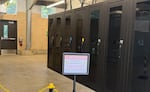
Inside a power regulation area at PacWave.
Macy Moore/KLCC
PacWave director Dan Hellin says the project is a first-of-its-kind facility in the continental United States.
“No one’s done it off Oregon, so there are challenges in itself of doing that,” said Hellin. “We like the challenges.”
Hellin said a variety of different types of wave energy generation devices can be tested at PacWave, and the site is pre-permitted for that testing. This means developers do not have to acquire their own testing permits, which can be time-consuming and costly.
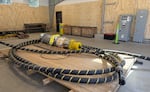
A subsea cable and subsea connector that are used in PacWave.
Macy Moore/KLCC
The site was specifically chosen to not interfere with local fishing and other coastal activities. Hellin said the public will likely not be able to see the testing devices because of how far out they are from the coast.
“Even the largest wave energy devices that have ever been tested are only maybe 30 feet tall,” said Hellin. “Most of the structures are below the sea surface, so even then, it might look like a distant fishing boat.”
The site is now awaiting devices to begin testing, but federal funding and grant cuts have delayed some developers’ plans.
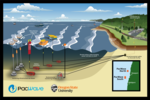
A schematic of PacWave South.
Courtesy of Oregon State University
OSU professor and PacWave oceanographer Burke Hales said PacWave was approved by the federal government in 2025 and was anticipating having prototype devices in the water by 2026.
“The disruption in the government funding and the funding of federal research put our contracted developers behind on their schedules,” said Hales.
He said those funding issues are slowly getting resolved, and they expect to be generating wave power sometime next year.
PacWave is now officially open after hosting a formal ribbon-cutting on Aug. 27. OSU President Jayathi Murthy, U.S. Reps. Suzanne Bonamici and Val Hoyle, and Director Nichole Fitzgerald of the Department of Energy’s Hydropower and Hydrokinetic Office were present for the ceremony.
Macy Moore is a reporter with KLCC.
This story comes to you from the Northwest News Network, a collaboration between public media organizations in Oregon and Washington.
It is part of OPB’s broader effort to ensure that everyone in our region has access to quality journalism that informs, entertains and enriches their lives. To learn more, visit our journalism partnerships page.