

The main street in Culver, Ore., on Aug. 24, 2026. A vacant lot next to City Hall is one possible location for a grocery store retailer that city officials are hoping to attract.
Jen Baires / OPB
On a recent Tuesday, Debbie Taylor rushed around her office, simultaneously taking a call, packing her bag for an out-of-town meeting the next morning and trying to remember all the stops she needed to make on the way home.
“I got to write a sticky note,” she said, pulling a yellow notepad toward herself. “This is how it goes… milk,” she paused, jotting down the sequence on her note. “I got to stop at the bank first, and then milk and then Martin’s Produce.”
Taylor is the executive director of the Madras-Jefferson County Chamber of Commerce. She’s also a mom to three teenagers and lives in Culver — a small, remote town about 10 miles southwest of her office in Madras.
She loves her community in Culver and its location just outside the towering basalt cliffs of The Cove Palisades State Park. Lake Billy Chinook, with all its recreation opportunities, sits just around the corner.
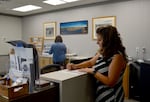
Debbie Taylor, the executive director of the Madras-Jefferson Chamber of Commerce, signs checks on Aug. 25, 2026 at the chamber’s office in Madras, Ore.
Jen Baires / OPB
But there are challenges. The nearest markets with fresh produce, dairy and meat are at least a 15-minute drive one way. The U.S. Department of Agriculture considers it a food desert, one of many in Oregon. A food desert is defined by the agency in lower-income rural areas as requiring a significant number of residents to drive 10 miles or more to get food from a grocery retailer.
Experts say without easy access to fresh foods, communities like Culver often see an increase in diet-related illnesses. Seniors and those with mobility challenges suffer most — often relying on pre-packaged or highly-processed foods instead of fresh fruits and vegetables.
Yet, Culver is growing. Over the last 20 years, it’s steadily increased from a population of around 800 to about 2,000 today. In February, a housing developer broke ground on a 160-plus single-family home subdivision near its main drag — a significant development given the city’s size. And since 2019, Culver’s average annual household income has essentially doubled from $46,000 a year to $91,000 at last count. Tourism is increasing too as people drive through town to get to the lake.

With that growth comes the need for more services nearby. At the top of the list: a place to buy fresh food.
“Give us a small grocery store, give us a, I don’t know, mini Walmart, if you want to call it that,” Taylor said. “Someone who can provide fresh produce, fresh fruits, meats, ice cream, those kinds of things all in one location. I think it would be a good option.”
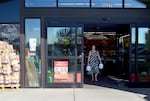
Debbie Taylor exits Grocery Outlet in Madras, Ore. Taylor said her family ran out of milk the night before and the store in Madras is the nearest one that carries the brand she buys.
Jen Baires / OPB
Investing in Culver
Culver is a few miles off Highway 97, on Culver Highway. The city spans a square mile and sits on mostly open, agricultural land. It has its own school district with around 600 students enrolled from kindergarten through high school.
Entering town, there’s evidence of growth in all directions. On one side of the main street is the new housing development, still under construction. Across from it is the city’s first food truck park where a handful of vendors offer everything from coffee to tacos, anchored by a taphouse made from a bright green, converted shipping container. Down the street is a recently expanded city park that, after a grant and community-supported million-dollar glow-up, includes pickleball courts, a bike pump track and a skate park.
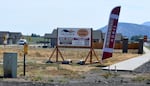
Construction is ongoing at a new development in Culver on August 24, 2026. The plan is for just over 160 new homes, a significant development in a city with around 2,000 people.
Jen Baires / OPB
Karin Crouch is Culver’s first city administrator. She’s been on the job for just shy of a year. When she started, she said she kept hearing from residents about the need for a grocery store.
“One of the things that came up when I met with all of the councilors and different community members is that they would really like to have fresh produce and fresh meat. Grocery options,” she said.
Earlier this year, the city received a $50,000 grant from the USDA through EcoTrust, a regional nonprofit, to conduct a study among Culver’s residents and see if there was enough support for a store.
Nearly 10% of residents responded and the results were clear: people would love a grocery store in Culver. They said they understood that the products might cost more, but the tradeoff of convenience and time was worth it.

Karin Crouch poses in the administrative office at Culver City Hall. Crouch began her role as Culver’s first city administrator in September 2025.
Jen Baires / OPB
The survey also looked at shopping habits, household income and store preferences — valuable information for a potential investor.
“Our initial results do show that it’s very promising,” Crouch said of the feasibility survey. “We’ve got a lot of growth that’s going to happen, and a lot that has already happened — whether it’s population or income level.”
The project has momentum, Crouch said, but there’s no telling yet if or when a retailer will decide to open in Culver.
Until then, residents like Taylor will continue to shop miles away.