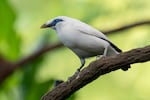
A critically endangered Bali myna in the Vollum Aviary at the Oregon Zoo. Poaching threatens these Indonesian songbirds.
Courtesy of Michael Durham / Oregon Zoo
There is a new bird in the Rose City.
After spending the last few years behind the scenes preparing for her public debut, a snow-white Bali myna is spreading her wings inside the Oregon Zoo’s Vollum Aviary.
The 4-year-old songbird from Indonesia — yet to be anthropomorphized with a name — is one of the rarest species at the zoo, known for its alluring song and the poaching threats that come with it.
“They’re a beautiful, absolutely stunningly beautiful bird,” said Sara Walker, senior advisor on wildlife trafficking for the Association of Zoos and Aquariums. “They’re critically endangered, found only on the island of Bali. So, unfortunately, the rarity of it and the beauty of it and the beauty of its song increases that demand for it and contributes to pushing it towards extinction in the wild.”
In response, zoos have taken on a greater role in conservation efforts.
At the Oregon Zoo, Bird and Reptile Curator Nicole LaGreco and her colleagues are using captive breeding to try and maintain the species’ genetic diversity.
While the exact number of wild Bali mynas today is unknown, conservation groups estimate the population hit a low point of just six individuals worldwide in 2001. Since then, conservation efforts have helped the species recover, but there are still likely fewer than 500 in the wild, LaGreco said. The International Union for Conservation of Nature lists the species as critically endangered.
“Unfortunately, they have struggled for a long time with their wild populations due to poaching,” LaGreco said. “They’re highly sought after for song competitions, which is a problem facing a lot of Asian songbirds.”
A Bali myna’s song is characterized by loud chattering with whistles and piercing, high-pitched notes. They’re popular entrants in bird singing competitions, which are ubiquitous in Indonesia.
“Certain cultures have singing competitions where they bring birds to see who can sing the loudest and the prettiest and the best,” Walker said. “It sort of sounds wonderful, but the hidden dangers of that is that it creates substantial demand for particular species.”
Each year, millions of birds are captured from the wild to be entered into competition. Although Indonesian law prohibits the capture and trade of hundreds of bird species, enforcement is difficult.
The IUCN lists the Bali myna — also known as the Bali starling — as one of the bird species most impacted by illegal trade.
The Bali myna that’s now in the Oregon Zoo aviary first arrived in 2023, after hatching at Zoo Miami the year before. In 2024, she mated with an older male Bali myna, who has since died. But the pair successfully raised a chick now living at the Tulsa Zoo.
The Oregon Zoo’s captive breeding work, in tandem with a broader consortium of zoos and conservation groups, has shown signs of success, LaGreco said. She is hopeful the songbird will get companions and possibly a new mate in the near future.
“My hope is to have a single-sex flock in there, and then a breeding pair off exhibit,” she said, “so that we can control that and make sure they’re successful.”