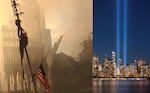
University of Oregon Professor and journalist Peter Laufer interviewed people during three cross-country road trips in the days after 9/11, one in 2011 years later and the other in 2021. Those stories comprise his new book, "We Are All Americans," released on this 25th anniversary of the terrorist attacks in New York, Washington D.C. and Pennsylvania.
Courtesy of Peter Laufer
For adults of a certain age, the September 11th terrorist attacks in 2001 were a defining event, just as the assassinations of John F. Kennedy, Martin Luther King, Jr. and Malcolm X were for earlier generations. The geopolitical world was forever altered, along with how many Americans thought about the country’s place in the world, and even how they thought about their own identity as citizens.
Longtime journalist and University of Oregon professor Peter Laufer documents all of this in his new book, “We Are All Americans.” It’s a series of interview excerpts, photos and reflections from the people he talked with on three separate cross-country road trips: one just days after 9/11, another in 2011, and the last in 2021. We talk with Laufer about what he learned, and we take your calls to hear your memories and reflections about this day in history, 25 years later.
Note: The following transcript was transcribed digitally and validated for accuracy, readability and formatting by an OPB volunteer.
Dave Miller: This is Think Out Loud on OPB. I’m Dave Miller. The journalist Peter Laufer happened to be in Washington D.C. on September 11, 2001. A few days later, eager to get home to California, but with planes still grounded, he rented a Buick and headed west. Being a journalist, he decided to talk to people along the way. What he found, he says, was an extraordinary array of Americans who were eager to talk. That was in the raw immediate aftermath of September 11th, but Laufer wasn’t done. He repeated that same cross-country trip in 2011 and again in 2021, often seeking out the same people he’d met 10 or 20 years earlier.
He has now collected those interviews in a new book. It’s called “We Are All Americans.” Peter Laufer joins me for the hour, and we want to hear your thoughts and stories this hour as well. What are your memories from 9/11? What has most stayed with you from that time? And if you were too young to remember it or hadn’t been born yet, what does 9/11 mean to you?
Peter Laufer, thanks very much for joining us for this hour.
Peter Laufer: Oh, it’s a pleasure to be with you. Well, “pleasure” is really the wrong word, I guess, Dave, because it’s so sobering to think back, that for those of us who were around, it was so long ago. And for all of us, it’s one of those dates that will never go away.
Miller: I want to start with a voicemail that came in. This is Elizabeth from Portland.
Elizabeth [voicemail]: On September 11, 2001, I was a young woman from Oregon who was living in Washington D.C. and working for the NewsHour with Jim Lehrer. On that morning, I had left my home in D.C.’s Adams Morgan neighborhood. Because it was such a beautiful, beautiful day, took a very long walk instead of a bus ride to get on the metro to make the rest of my way to work. Because I left so early, the towers in New York had not been hit yet. I had no idea that that happened when I entered the subway and then got off at the Pentagon, which was the place where I would then catch the bus to get the final leg of my commute to the NewsHour studios in Northern Virginia.
I usually took the 9:40 a.m. bus to be at work by 10:00 a.m. And that day I was on the 9:30. So that when I stepped off the bus at my destination at 9:37 [a.m.], I heard a huge bang, and looked up and saw smoke rising in the distance at the location I had just left fewer than 10 minutes earlier. Because I worked in news, the next steps were to watch everything happening on the monitors in the newsroom and start logging what we were seeing on the screens, including people jumping and debris flying around, and then one by one, the towers falling, and scrambling into the news gathering process.
I remember what an absolutely gorgeous day it was. And it was many years before that perfect clear blue morning with no humidity, and a bright blue sky, and just like a soft breeze, like a kiss on the cheek … It was many years before that weather didn’t immediately make me think of that awful Tuesday morning and how the world was never ever the same again.
Miller: Peter, you were in D.C. too, as I mentioned. What are your memories from that morning itself?
Laufer: Again, it was that gorgeous day so vividly described. I was at meetings at National Geographic, where I hosted a radio show at the time. And the meeting was scheduled at the same time as the towers were hit. So we clearly stopped the meeting. We watched the television for a while, and then I walked back up toward my hotel along the Potomac and watched the Pentagon burning. It was this extraordinary contrast, obviously, of seeing that iconic building burning and the beautiful day.
By the time I got up to Georgetown, Georgetown already had changed radically with National Guards on duty on these usually passive streets. M Street and Wisconsin Avenue was the corner I went to to see not just the National Guard, but their camo Humvees on duty. And that’s when, much as your caller said, I knew that I needed to go to work.
Miller: Let’s take a call from one of our listeners. Anita has called in from Salem. Anita, what’s your story?
Anita [caller]: It was my second year of retirement. I was a teacher for 32 years. And for the first time, I was going to be able to watch something or deal with something that was horrible and process my own feelings. I wasn’t going to have to be the person in the room that kept everything together for the kids. I’d been there for the Challenger, for instance.
Then I got a phone call from the school where I’d been working in. And they said, could you please come in? It was a junior high. Could you please come in because one of the teachers can’t get a hold of her daughter in New York and she can’t be here teaching. So there I was, back the whole day with being the person in the room who held it together and was there for the kids as it went on and on through that day.
Miller: Anita, thanks very much for that call.
Peter, to go back to you, so you’re in D.C. for work. You could have waited to fly, and maybe in the end, you might have gotten home earlier. I forget when planes were eventually moving again, but why did you decide to rent a car?
Laufer: It was four or five days, I think, as I recall, the day before planes were flying again. By the third or fourth day, I just did want to get home, but at the same time, I was thinking about how attention was appropriately, of course, on Washington, on Pennsylvania, on New York, but what was going on in the rest of the country. So I figured I would get myself home as fast as I could. There was no estimate of when planes would be flying again.
I rented the car and bought a video camera, long before iPhone days, and decided that I would just make interviews, conduct interviews, talk with people as I crossed the country. Because the question for me was, what’s going on in what we tend to refer to as the heartland or, pejoratively, as the flyover states? And certainly what I learned is those are not flyover states. The poignancy of the remarks, often in fleeting circumstances, just a few minutes, focused on what went on, how people felt, and how they felt it was affecting their lives and would affect us all in the future. We are, or at least I found, a nation of philosophers, observers and engaged Americans.
Miller: I want to play another voicemail we got because one of the big themes that’s threaded through a lot of the 2001 interviews that you did is a sense of unity. There’s a voicemail that came into us this week from Katie in Happy Valley that strikes a similar theme. Let’s have a listen.
Katie [voicemail]: One of the most meaningful of my memories of that time was something that actually happened on Friday, September 14, 2001 – so the Friday just after. And I was working in my role as an oncology social worker at OHSU. It had been a really rough week … understatement. The university, hospitals and clinics were all directed to try, if we could, to take a five-minute pause, moments of silence at noon on that Friday, the 14th, in honor and in memory of all that had happened that week and all the incredible loss. I was working in the outpatient chemotherapy unit, which included a semicircle of chairs, 19 of them, if I recall, with a little space in between for the patient’s accompanying family member or caregiver.
At about 11:55 that Friday morning, I posted notices about the hoped for moments of silence at several places along the glass that separated the forward facing chemo chairs and the nurses station. My back was to those patients and their caregivers as I posted the notices. When I turned around, I couldn’t believe what I was witnessing. It took my breath away. All those people in all those chairs, the chemo chairs and the caregiver chairs, they were all holding hands spontaneously. Without any prompt. These were largely strangers, people who were already in challenging circumstances before September 11th, but who were reaching out to one another and comforting one another in those five minutes of silence.
And there are many hard and bad memories, but this one is a good one. It’s because I think we were all in it together.
Miller: Peter, what else did you hear about that sense of unity on your first trip?
Laufer: On the first trip, Dave, that sense of unity, as your caller just so poignantly described, was palpable. It was perpetual. It was everywhere. Sometimes displays of flags, sometimes just the raw emotion, as was just described of people saying we have to be together now. And sometimes we need to remember that there’s a role for levity in our lives to help us deal with tragedy. The book is peppered with photographs of the people I talked with and some of what I encountered. And one of the signs that speaks to this for me is a sign in front of a restaurant that said, “Any two subs, $4. Our hearts go toward the victims and family members. God bless.”
This wonderful combination of that unity that so did exist, along with the fact, as is the cliche, “the business of America is business” … So, business did continue shortly thereafter. And as I traversed the country, more and more were things getting back to whatever one could consider normal, really. Dave, these years later, 25 years later, we’re not back to normal, and many of the problems that we face now, I would suggest can be traced directly to September 11th.
But, to your question – and what I lament in the book about – over those 20 years that I crossed the country, that sense of “we are all in it together,” as the title says, “We Are All Americans,” well, everybody in your audience and you certainly know that that’s not the case in our divisive reality of the contemporary era.
Miller: Claudia Brown shared this on Facebook: “I worked for the Pacific Northwest Red Cross Blood Services as communications director. On 9/11, we had people lined up around the block all day to give blood. Everybody wanted to do something to help. Although New York didn’t need big donations of blood, I have no doubt that those Portland donors saved lives all over the Pacific Northwest with their generosity. It was a tremendous effort by big-hearted people, and I was humbled and touched.”
Jade has called in from Portland. Jade, go ahead.
Jade [caller]: Hi. I moved back to Portland from Manhattan on September 5. I was staying with my parents. We were all still asleep in the morning. We had slept in, and I heard my brother’s now wife who was living in Maryland, D.C. area, saying on the answering machine that “we’re OK, everyone’s OK.” I didn’t think to get up and see what it was about.
September 11th is my mother’s birthday and my parents’ anniversary, and when I got up that morning, my mother was preparing the Buddhist altar. And the news was on with the towers burning. I don’t think they’d collapsed yet. And it was a surreal juxtaposition. I remember breaking down and hugging my dad, who was actually having a triple bypass surgery the next day. So it’s quite something.
My memory in Manhattan is I could see the Twin Towers from my bus down to Midtown, down 5th Avenue every day. And before I left New York, I took a trip to Block Island. Coming back on the train, I could see the towers and I thought, well, I’ve been to the base and I never made it up top. Maybe next time when I visit.
So, I did visit. I visited friends almost every year for a few years, and every year was different going back. And this past October, we took a family trip there and my daughter had just started studying 9/11 in her freshman history class. So we went to the museum and I did not expect to be so moved. I went through the entire museum. We had been to the memorial 10 years earlier. So this was quite something. And those are my memories, and it’s unfortunately tied in with my mother’s birthday.
Miller: Jade, can I ask you, because I lived in New York. I was in New York for 9/11. I’d already been there for a number of years and I have a lot of memories from that day. But I remember even that day, that terrible day, being grateful that I was there in a place that was my home on a day when a terrible, terrible thing happened to it, because it was my home. Having lived in New York and then, six days earlier, moved to Portland, was there a part of you that – even though it’s weird to say – wished you had been in that place?
Jade [caller]: I thought about my friends a lot. I worked in children’s publishing, so I was reaching out to all the authors I worked with and such, but I had just moved back for my father’s surgery and to try to be with my now husband, who I had met before I left [for] Manhattan from Portland. So this is home to me. I just really envisioned my life there, working in children’s publishing. But life took a turn. And with my support system here … I mean, not to say that my friends weren’t my supporters because I see them a lot and I’m very close with them, but having it here, having my then-boyfriend, now husband here, that made a difference to me.
I love New York. It is one of my favorite places in the world and I just love being there. So I have a strong connection. I feel fortunate to have had a connection to Manhattan or still have a connection. They say everyone needs to live in Manhattan at some point in their life, and I totally agree with that.
Miller: Jade, thank you very much for calling in. That was Jade in Portland.
Jade [caller]: Thank you so very much
Miller: Let’s take another call. Susan called in from Salem. Susan, go ahead.
Susan [caller]: Hi. I live in Salem, and I was working in Linn County at the time. So on my way to work, I heard about the first plane crashing and immediately thought, oh dear, something must have happened to the pilot, cause nobody would run a plane into a building. And on my way to work, then the second one happened. And then I knew it was war. It was, we were under attack.
My son worked in the Pentagon at the time. He was a contractor, and his captain called him across the hall to come and look at the TV, what was happening in Manhattan, and just then, the plane crashed into the Pentagon. And it got as far as my son’s desk where the wall fell on his desk. If he hadn’t gone across the hall, he’d have been dead. But they got out of the building. I was at work. I didn’t have a number for the Pentagon, so I called his place and of course he wasn’t there, but I left a message saying, “call me, please call me.” And I didn’t hear till the next morning, because he had to walk home from the Pentagon to someplace in Virginia…
Miller: And many of us did not have cell phones then.
Susan [caller]: Right. No, I was calling from my work desk. So, yeah, he didn’t have any way to call back. At any rate, he was safe. It was the grace of God that pulled him away from his desk at the time. And, I remember every year, what could have been. That ‘s really all I have.
Miller: Susan, thanks very much for sharing your story. That’s Susan in Salem.
Peter, in addition to being a journalist, as I mentioned, you’re a professor of journalism at the U of O, putting you in contact with a lot of young people, many of whom now, as undergrads going straight to college from high school, were born after 2001. I’m curious what stands out to you and what you hear from those young people about that day.
Laufer: That is the very question I was thinking as I was finishing the book, Dave. So I decided to pose it to my students. I had two advanced reporting classes that term, and I asked each of the students to just write a few words about what they think from the standpoint of not having experienced it.
One that stands out to me for the purpose of your query now is from student Natalia Robinson, who wrote, “I always heard stories about where my older family members were during 9/11. I was surprised that they had such clear memories with so many specific details …” And I interrupt her for a second. As we’ve been hearing this morning, Dave, from your callers, so specific. “I always found it to be devastating and scary. But I’ve only ever lived in a post-9/11 world, so I didn’t understand how truly shocking it was. The fear and the trauma are unknown.” And then she brings it forward to our current era, Dave, by ending her comment, “Yet, with the rise of school shootings and other terrorist attacks, it’s all I’ve ever known.”
I think that really speaks to the post-9/11 period, these 25 years. Yes, there was the trauma of the moment, and yes, all of the attention, or most of it, was on New York, Washington and Pennsylvania. Yes, it affected the whole country – that’s why I wanted to talk to people across the country. But more than that, here we are in a completely changed American environment from what existed prior to the attacks. In some perverse manner, one could argue that those who planned and perpetuated the attacks won.
Miller: Peter, in 2011, in that second of your three cross country trips, you talked for a second time to the Washington D.C.-based journalist Jeff Kamen. He told you this: “I’m a more worried, more fearful person, but I think that makes me more like everybody else on the planet. The American exceptionalism piece says that you don’t have to worry about it, it can’t happen here. That was truly ground down for everybody on 9/11. I became a part of the national mob response of fear.”
How much did you hear about fear as you traveled the country on that first trip?
Laufer: On the first trip, Dave, I heard about fear in places I never expected to hear about fear: in the heartland, in Kansas particularly. I’d stopped several times in Kansas, right in the middle of the country. And over and over again, I heard fear, that word that you just used. I was in a cafe and it was a themed cafe, the ‘50s, and the whole atmosphere in terms of the decor was frivolous. And the owner and the chef, or the cook … I said, “You don’t have to worry here, do you? There’s nothing here. You’ve got this small town America.” And he said, “We are safe nowhere.” And I heard that same phrase or a variation on it across the country as I made that initial trip right after the attacks.
Miller: What followed from that? I mean, what followed and the people you talked to from that fear, from that sense, maybe for the first time of vulnerability?
Laufer: Both vulnerability and concern about what might happen and really forecasting of what did happen. Initially, after I crossed the Potomac heading west, I stopped in Arlington, Virginia. And two things happened at an Afghan restaurant that I will never forget. One was I talked to the owner and operator. And he was from Afghanistan, had been in this country quite some time, was a successful, popular restaurant. Very shortly after the attacks, he said he was receiving phone calls that were with messages such as, “Hello, I’d like to talk with Osama bin Laden.” Unbelievable thing to hear.
And then I talked with an immigration lawyer who was having lunch there that same day, just after 9/11, and she said, nobody is going to benefit from this. We are all victims. There will be terrible wars. And to hear that kind of prophecy maybe makes some sense from an immigration lawyer who’s thinking about it in that context. But I heard it also from a landscaper high in the Rockies as I was going down I-70, almost getting home, it felt like, to be in Colorado already. And he just looked at me and said, I don’t want this to result in what I fear it will – I’m paraphrasing, of course. But it will be attacks against others, and more innocents will die. So already, just within that first week, there was a sense of going from shock to fear.
Miller: Let’s take some more calls. Omari has called in from Eugene. Omari, go ahead.
Omari [caller]: Yes, so I live here in Eugene. I lived in Brooklyn, right downtown Brooklyn during 9/11, and I operated a domestic cleaning company at the time. I had a client call me at 7:30 in the morning on 9/11 to cancel the appointment. And I was so upset. I’m a painter. I went to a park, Prospect Park, about five minutes from my house to do a painting.
So I’m sitting in the park at 8:45 in the morning doing this painting and, about 9:15 or so, I noticed it was very, very quiet. There were no dogs in the park. You couldn’t even hear the birds. It was very odd and strange. And then suddenly I saw this black plume of smoke come over the sky. But it was very quiet. A few moments later, there was a throng of people coming through the park, walking. I mean, thousands of people coming through the park. I asked somebody, “what’s going on?” And somebody said, “oh, the trains aren’t working.” So I figured, oh, the trains aren’t working. I couldn’t even get to my car. That’s how many people there were.
I walked the 10 blocks back to my house, and I stopped to pick up my TV which was in the shop at the time. And the proprietor of the shop was in tears. I mean, he was bawling, crying. And I said, “What’s the matter? What’s going on?” He said, “Look at the screen, man.” He had all the TVs in the shop. And he said, “Look at the screen, man. Look at the screen.” And I was like, yeah, what’s going on? I thought it was a movie. I’m watching the plane hit the tower, and I’m thinking it’s a movie. And he’s like, “No, man, this is real. This is real.” And he’s crying profusely.
It was then that I understood why it was so quiet in the park and why there were throngs of people, and I was beside myself. This is before cellphones, or just before cellphones. My partner worked way uptown, couldn’t get him on the telephone. But I heard a couple of your callers both talk about the unity that was in New York for those next three days and those next couple of weeks. I mean, it was a really powerful sense of unity. People actually making eye contact on the train. It was quite phenomenal.
But one of the things about those ensuing weeks that I haven’t seen reported anywhere, and I want your listeners to get ready for what I’m gonna say. [Sighs] It wasn’t just the quiet, the unity and the stillness in the air that pursued those few weeks. It was the smell. Of not just the buildings, but it was the smell of burning flesh. And I don’t know why, through all of the commentaries and all of the reports, no one has talked about … I guess it was just too sensitive of a topic to talk about. I lived right downtown Brooklyn. I lived two miles away from the Ground Zero.
And then the next few days, particularly as my husband and I went into the city to volunteer, that smell of burning flesh was so horrific [that] it reminded you of exactly why the unity was there. And why does it take such a disaster, such a tragedy for human beings to communicate with each other? Ever since 9/11, that’s the way I’ve walked around the world, not wanting another 9/11, but understanding it’s going to be another 9/11 that brings us all together.
Miller: Omari, thanks very much for sharing your memories.
Chris has called in from Hillsborough. Chris, go ahead.
Chris [caller]: Hi. So I play an international sport, and two months after 9/11, my U.S. team was in Europe. We compete against like 25, 30 different countries from Africa to Europe, Russia, South America. Every person to the person for every different country that represented, they were so gracious with us and so compassionate. It was so amazing and astounding. It just burned a feeling in me that wishes that we could be that united. Not that a tragedy should do it, but just caring for other people for all the different circumstances that humans go through. Anyway, that’s it. That was my takeaway.
Miller: Chris, thanks very much again.
Cheryl has called in from Milwaukie. Cheryl, go ahead.
Cheryl [caller]: Yes, hello. This is a story about a friend. Her son was in one of the towers, and I apologize for not recalling all the details. It’s been a very long time. And he was, as I mentioned, in the tower, and he was coming down with a lot of people on the stairs, everybody in a terrific panic. Go, don’t go. He got down to a landing place, and all of a sudden everybody else was gone. Somehow they … He paused there, and on this landing, there was a door. He was standing, as I mentioned, and suddenly the door opened and a man came out and took him by the arm, took him down to the bottom of the stairs, to the landing of the opening door, and disappeared.
Both my friend and the son felt strongly that it was a spiritual individual who was coming at that moment to save his life. This story, in the detail of it, which I may have some kind of turned around, was in The Oregonian. I can’t recall that it was the first page, but I think it was very soon after that. She just was, of course, ecstatic that he made it through when the whole story came out from him to her, but it was a miracle – that’s how she sees it.
And I want to mention, on my own side, I happened to be listening that morning to Howard Stern, a disc jockey/commentator, and he was shouting in disbelief. He would not believe it. And it startled me so much, of course, I ran to the television instantly. I did notice afterwards, just as others have mentioned, here in this general area on McLoughlin Boulevard, Milwaukie to Oregon City, there was such courtesy. No one was breaking rules. Everybody was waiting, using their signals as they should, taking the left turn properly, and so on and so on. It was something else…
Miller: Cheryl, sorry to interrupt. I want to make sure we have time for other calls, but thank you very much for calling in. That was Cheryl in Milwaukie.
Flynn has called in from Portland. Flynn, go ahead.
Flynn [caller]: Hi, yeah. I live in Portland now, but I grew up in rural Utah and I was in third grade, so I was not a worldly kid. I didn’t really have this great perspective on what the world was. I had a single mom, living in a little apartment. But I remember my mom sitting cross-legged in front of the TV crying, not really knowing what was going on, and having to reapply her makeup multiple times and how that affected her.
But what I really noticed was the hate for this group that I didn’t know or understand that really permeated in rural Utah afterwards. And I think one of the lasting impacts now is how people are parlaying that hate to hate a group, to try to advance a specific rhetoric. That is one of the unfortunate legacies of this event that I think has really happened and that we’re seeing happen right now on this anniversary.
Miller: Thank you very much for that call, Flynn.
Kat Enyeart, on our Facebook page, said that she saw the events on TV in Oregon as a freshman in high school, so a little bit older than Flynn was. She wrote, “I watched jingoism take over every media channel. I watched anti-Arab bigotry and Islamophobia become normalized and celebrated. And followed along in horror as the government took us to unnecessary and disastrous wars twice, all while passing the Orwellian Patriot Act, stripping all Americans of privacy through warrantless wiretapping and other violations.
“George W. Bush said in his September 20, 2001 speech, ‘Americans are asking, why do they hate us?’ His answer was ‘for our freedoms.’ As a 15-year-old, that sounded embarrassingly stupid to me, so I tried to answer it for myself. In doing so, I realized that a lot of people all around the world have legitimate reasons to be angry with the U.S. That doesn’t excuse terrorism. But it was an insult to our collective intelligence to not engage with a more nuanced conversation about how our foreign policy has shaped the modern world.”
We were talking earlier, Peter, about fear and about a sense of vulnerability. But I want to turn to what that meant in a kind of geopolitical context. What stood out to you in what you heard, in this case, over the course of those two decades, from 2001 to 2011 to 2021, about what people said about our nation’s response to 9/11?
Laufer: It started immediately, and one of the epigraphs to the book quotes Ari Fleischer. He was White House press secretary at the time. And on September 26, as some of these changes that were just described started to take place, eroding our freedoms, his line was, “Americans need to watch what they say, what they do.” An incredible counterpoint, of course, to the First Amendment. And one of the first interviews I conducted was with a National Guardsman who was on duty in Georgetown in Washington. And he said, “It’s beyond me to even fathom what the United States is going to be like after this. Why would we be so despised so that so many innocent lives would be wasted? It’s a deep emotional question that will take many years for me to come to grips with.” And of course that’s what you’re asking, what we’re talking about right now, 25 years later, Dave. Why?
And the answer, post 9/11, I would suggest, is because of our responses. And that has been manifested both domestically and internationally. Two wars, or perhaps you could count three if your listeners heard the current president talked today. He used 9/11 as an explanation for the failed war that he started unnecessarily against Iran. So, the celebrations, Dave, are the unity, how we all came together. The tragedies include how brief that togetherness was, how dysfunctionally separated we are now, and the parade of invasions of our privacy, unnecessarily, and literal invasions of other countries, certainly unnecessarily, that have followed.
This should have been a police action from my analysis, Dave. Criminals engaged in a criminal action go into Afghanistan, arrest the perpetrators and the planners. Tools were available for that. And we’re living the result of having failed, as a nation that came together, to respond in a manner that could have created a positive out of this ghastly event.
Miller: I want to go to some more calls. Kate has called in from Portland. Kate, go ahead.
Kate [caller]: Hi, Dave, this is Kate, friend of the show. I was living in Jersey City, just across the Hudson River from the World Trade Center area. And I happened to be early on in my journalism career and was commuting quite often into lower Manhattan. And, months after, it took a while for the area to open back up after 9/11. But when it did, you could come in through this … literally walk out of a train, and you’d be alongside the site and look down into a gaping hole, if you peered through. But the thing I wanted to talk about was that whole area; there were missing person signs everywhere and this was for months and months. I mean, I think I saw them a year later…
Miller: And it was clear, weeks in…
Kate [caller]: And you would remember, you saw it. You were down there.
Miller: It was clear weeks in, to everybody, that those people had died. They were never going to be found. And yet they remained, they were snowed on and rained on, but they were sort of semi-permanent markers until eventually they came down.
Kate, thanks very much for that call. Erin has called in from Portland. Go ahead.
Erin [caller]: Hi, I was a flight attendant at the time based in Seattle, and I was on standby, meaning you’re just there at the airport ready to go if they need you. So I was there at 5 a.m. So I had the unusual experience of actually seeing it unroll in front of us, because someone brought out a television at 6 [a.m.] and put it in the room to show everybody that the first tower had gone down. No one knew what it was yet. We thought it was an accident. And then the second one hit as we were looking at the screen. And then everyone just suddenly realized, oh, this is not an accident, we are under attack. So that sense of fear started.
I was on the computer and I was pulling up, they said the second plane originated in Boston. We knew the first one was American Airlines. This was United Airlines that I worked for. So I started pulling up the flight list and could see a flight from Boston to New York. As I was looking at it, it disappeared from the screen. Then I tried to pull it up again because I was looking at who the crew members were, and then it just said, “Access Denied.” I just said, “that was us.” The feeling in the room was just … it was a terrible punch in the stomach. And then, within 45 minutes they closed the airspace, right? So we just all left, which is very odd to just leave and not actually fly anywhere.
Then I remember my husband was texting me saying, “Are you at the airport? You need to get away from the airport, it’s unsafe.” So again, that fear was just starting up, even in Seattle, and I remember texting him saying, “Do you really think they’re targeting Seattle right now?” But that sense that no one was safe, even all the way across the country was starting.
And then very briefly, I was sent back for work about two months later, and just as the previous caller was saying, all those tributes were up. I was able to see down into the hole. And the weirdly positive side of that is that people were very unified at that time. And everybody, all these strangers in New York City would just come up and start talking. They just approach you and just start talking about how they were feeling about this and that we all needed to stick together. That didn’t last a real long time, but it was…
Miller: Erin, thanks very much.
Let’s go to Tony in Hillsboro. Tony, go ahead.
Tony [caller]: Hi, my name is Tony. My brother-in-law, Michael David Ferugio, was killed in the World Trade Center. I still get upset thinking about this. In the beginning, we were in denial. After about a week, we accepted that Mike died. And luckily with the DNA analysis, we were able to get remains and have a burial. Every year at this time I think about what Michael would be thinking. And I think Michael would be pushing for everyone to try to be compassionate and love each other. Michael wasn’t the kind of guy who was looking to get even. He was always looking for the best. That’s all I have to offer.
Miller: Tony, I’m very sorry and I really appreciate your calling in and sharing your and your brother-in-law’s story.
Susan has called in from Portland. Susan, go ahead.
Susan [caller]: Thank you. I was interested because our experience of 9/11 is quite different from your guests. We were here in Portland, having signed on a house. We were moving from the East Coast and we realized we were not gonna be flying back. We drove up to Seattle where our daughter and son-in-law lived and waited for four days. We were fortunate to be able to rent another car. And we raced across the country because we both had jobs in Virginia. We lived in the Beltway area. And our experience of driving across Interstate 90, stopping at restaurants. No one was talking about the events of … [pause]
Miller: Unfortunately, it seems like that line has dropped. I was looking forward to hearing, Peter, a parallel version, maybe a reverse direction version of a road trip, but I’m not sure exactly what happened.
I do want to read another email that we got, or a part of an email. It came from Sherry from Silverton. She is a crisis responder and trainer who was called in after school shootings in Columbine, Thurston and Uvalde, and many other schools. After 9/11, though, she spent two years in schools in New York City and Bergen County, New Jersey, which had a very high number of people who died in the towers.
She wrote this: “The work was fascinating, heartbreaking, nerve-wracking, reassuring and impossible to describe. In New York City, I was assigned to the 27 schools that fled – those schools in and around Ground Zero – and had to evacuate in the midst of that terrible storm of debris, and be relocated for the remainder of the year. There were frightening times, moments of elation, ambivalence, sadness, hope and delight. There were challenges no one could have anticipated, like that we’d have the anthrax scare six weeks into 9/11 recovery. I walked into a school and the secretary was opening the mail wearing a mask, gloves and plastic apron.”
“Clearly,” she wrote, “there are endless stories and examples, but this anniversary brings up the appreciation of the importance of traditions, rituals and remembrance. The little pieces that are waiting to be grieved can remain behind the veil until an anniversary arrives and we hear others’ stories. It enables us to reconcile yet one more nugget and carry it more lightly. It allows me to recognize that more of the ragged, jagged edges of that time in my life have gradually been worn smooth and are now a foundation for appreciation of every day of peace. Every butterfly, hummingbird, grasshopper and unexpected guest; each delicious meal shared with loved ones; music, anthems, melodies and poems that give us everyday opportunities to appreciate our lives and find meaning in the past and purpose toward our future.”
Again, that was part of a lovely email we got from Sherry from Silverton. Peter Laufer, thank you very much for spending the hour with us. I really appreciate your time.
Laufer: It’s good to talk with you and your listeners, Dave. Thank you for commemorating this day that those of us who were there will never forget and future generations should not either.
Miller: Peter Laufer is the author of the new book “We Are All Americans: Stories from Three Road Trips Across Our Nation in the Long Wake of 9/11.” He is a professor of journalism at the University of Oregon.
“Think Out Loud®” broadcasts live at noon every day and rebroadcasts at 8 p.m.
If you’d like to comment on any of the topics in this show or suggest a topic of your own, please get in touch with us on Facebook, send an email to thinkoutloud@opb.org, or you can leave a voicemail for us at 503-293-1983.