Gray wolves roaming parts of Oregon and Washington could lose federal protections as part of President Donald Trump’s attempt to pacify ranchers facing multiple economic challenges.
Last week, Trump called on wildlife agencies to review the wolves’ U.S. Endangered Species Act status and consider delisting them.
While that could create more opportunities for some Oregon and Washington ranchers to kill the animals, gray wolves would still be protected by state policies.
Trump’s order was among initiatives meant to address ranchers’ concerns that he’s undercutting them with plans to lower consumer beef prices by importing 300,000 metric tons of ground beef from countries such as Argentina and Brazil.
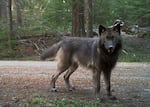
FILE — A juvenile wolf, born in April 2024, of Oregon's Grouse Ridge Pack, standing in front of a trail camera on U.S. Forest Service land on Jan. 23, 2025, in Jackson County, Ore.
Photo courtesy of the Oregon Department of Fish & Wildlife
Ranchers are also struggling with skyrocketing diesel prices caused by the Iran War that was instigated by Trump.
Although ranchers have long advocated for more control over wolves they say are a risk to their cattle, their reactions to the president’s order are mixed.
Some cattle ranchers say removing protections for gray wolves might not be enough to make up for their economic challenges.
“No, it’s not enough,” said Tom Sharp, a rancher in Burns. “I don’t think the administration is helping ranchers.”
Sharp said wolves should lose their federal protections, but he doesn’t support Trump’s other policies overall.
Other ranchers say Trump is doing what he can to support them.
“We do appreciate that he’s got the wolf delisting on the radar screen,” said John Williams, a retired rancher and member of the Oregon Cattlemen’s Association.
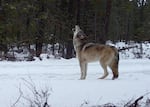
FILE — The breeding female of Oregon's Yamsay Mountain Pack howls in front of a trail camera in the Winema National Forest on Nov. 19, 2024, in Klamath County, Ore.
Photo courtesy of the Oregon Department of Fish & Wildlife
This is not the first time Trump has tried to delist gray wolves.
Near the end of his first presidential term, the U.S. Fish and Wildlife Service removed federal protections for gray wolves, but the regulatory change ultimately didn’t stick.
A federal district court vacated the rule in 2022 and federal protections were restored the following year. The court concluded the wildlife service didn’t use the best available science when it determined that gray wolf populations had recovered.
This time, the president has gone a step further by calling on federal agencies to encourage states to drop their own wolf protections, as well.
Wolf protections in Oregon and Washington
The Pacific Northwest has a long, complicated history with wolves.
The species was wiped out of the region by the 1950s following an extermination campaign led by ranchers. Gray wolves returned in the early 2000s, migrating from other states.
As wolf numbers grew, so did tensions among ranchers. They called on lawmakers to take action.
In 2011, Congress delisted gray wolves in the Rocky Mountain region by attaching a controversial rider to a defense bill. The policy removed wolf protections in Montana and Idaho, as well as the eastern third of Oregon and Washington.
“So when that happened, it created this split listing,” said Bethany Cotton, conservation director at Cascadia Wildlands, an environmental nonprofit in Eugene.
Wolves continue to be federally protected in the western two-thirds of both states, where it’s illegal to kill wolves for any reason other than self defense.
In the eastern regions, wolves are regulated by state policies. Those allow ranchers to kill wolves that are actively attacking livestock. Ranchers can also get a kill permit if wolves have hunted multiple livestock.
It’s unclear if the U.S. Fish and Wildlife Service can move fast enough to remove gray wolf protections before the end of Trump’s term. Typically, removing endangered species protections requires a lengthy bureaucratic process.
Wildlife agencies must assess all environmental harms that could come from the change and provide multiple opportunities for the public to weigh in. The process usually takes years to complete.
That’s why some ranchers hope Congress takes up the issue again, like it did in 2011.
“It’s time. They’re recovered,” Williams said. “We hope that Congress would see it that way and delist them.”
Williams has not personally lost livestock to wolves, but he knows ranchers who have. The experience can be devastating, he said. Wolves tend to shred their prey, leaving behind a brutal scene.
Government programs will reimburse ranchers for their immediate financial loss only if it’s clear that a wolf was responsible. Even then, that money might not be enough to make up for the stress on remaining cattle.
As a result of that stress, conception rates could decrease and calves could come out thinner.
“That’s a severe economic loss,” Williams said. “That’s not on the two or three that die. That’s on every animal that’s involved in the herd.”
Last year, Oregon lawmakers passed a bill to increase rancher payouts. Now livestock owners can get up to five times the market value for calves, sheep or goats harmed by wolf attacks. They get three times the market value for mature cows.
How wolf protections could change in Oregon
If wolves are federally delisted, state wolf policies would apply to the entirety of Oregon and Washington, not just the eastern third.
Those state policies don’t strictly prohibit wolf killings, unlike the federal Endangered Species Act. State regulations allow people to kill the animals for specific reasons, like if a wolf is actively hunting livestock, or if wolves have killed livestock multiple times over a given period.
Even without federal protections, recreational wolf hunting and trapping would still be illegal across the region.
“So the idea that someone could just go out and shoot a wolf, that’s not true,” Cascadia Wildlands’ Cotton said. “That is not the case under current management in Oregon.”
Oregon’s wolf plan splits populations down the middle between east and west. Since there are fewer wolves on the west side, there are stricter thresholds for killing them.
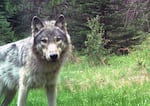
FILE — A gray wolf from Oregon's Desolation Pack is captured on a remote camera in Grant County on June 7, 2021.
Photo courtesy of the U.S. Forest Service
In 2025, wildlife officials counted 88 wolves on the west side and 142 on the east side, for a total population of 230 wolves.
Wolves play an important role in local ecosystems. They cull sick and weak wildlife, preventing disease outbreaks among ungulate herds like deer and elk. Culling wild herbivores can also prevent overgrazing in grasslands and forests.
In Washington, state wildlife officials have found no evidence that wolves have harmed these native herds. That state last counted 270 wolves.
As wolves continue to repopulate the Pacific Northwest, Cotton said, people will need to learn how to live with them, like by using tools to scare wolves away from livestock. Those tools include strings of small flags, called fladry, that blow in the wind. Electric fencing can also help.
“There’s quite a lot of public dollars and private dollars available to producers to receive those tools at low cost or for free that support coexisting with wolves on the landscape,” Cotton said.