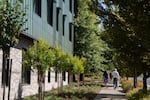
The front of Legin Commons on Sept. 10, 2026 in Portland, Ore. Legin Commons is a new 124-unit affordable housing development in Southeast Portland.
Saskia Hatvany / OPB
Even after two decades, Wanna Lei still keeps a photo of herself and her work buddy at a Chinese restaurant in Southeast Portland where she started working as a part-time receptionist the year after immigrating from China. In the photo, she’s wearing a dark green bow tie that matches the color of the restaurant’s exterior.
Now the resident services manager with APANO, Lei experienced a full-circle moment on Thursday when she — no longer wearing the bow tie — attended a grand opening and toured a new affordable housing community that the nonprofit co-developed and that is named after the now-defunct restaurant.
“My first job [was] in Legin Restaurant,” Lei said. “And right now, I’m serving people living in Legin Commons — that’s just a really interesting and amazing thing.”


First image: Courtesy of Wanna Lei. Second image: Saskia Hatvany / OPB.
Partially funded by the voter-approved Metro Affordable Housing Bond, Legin Commons provides 124 homes to people in the ethnically diverse Jade District and beyond. Located on the edge of Portland Community College’s Southeast Campus, the apartment complex is just a block away from the old site of Legin (pronounced LEE-juhn) Restaurant, an iconic Chinese eatery demolished in 2012 to make way for the campus expansion.
Rosaline Hui, editor-in-chief of Portland Chinese Times, immigrated to the city just a year before Legin Restaurant opened in 1995. A frequent customer and business partner of the restaurant, she said it was originally established by a group of Chinese-Vietnamese immigrants before one of them became its sole owner.
Remodeled from a bowling alley, Legin’s banquet hall could accommodate roughly 1,000 people. Legin was more spacious than comparable Chinese restaurants in Los Angeles and San Francisco she had visited at the time, as well as any Portland Chinese restaurants still standing, according to Hui. She said Legin’s large size, including its parking lot, made it a go-to place among local Asian communities for weddings and other celebrations.


All images: Courtesy of Portland Chinese Times.
Hui remembered that when Legin Restaurant opened, it was significant for Portland’s Chinese dining scene — then dominated by family-run establishments serving styles of Cantonese cooking that reflected earlier Chinese immigrants. Legin introduced professional chefs and siu mei specialists from Los Angeles who could cook dishes similar to what she had had at contemporary restaurants in Hong Kong, the city she’s originally from.
“I liked the dim sum — it’s really fresh and hot from the frying pans on the carts there,” Hui said. “I liked the char siu and roast duck too.” She added that after Legin’s demolition, many staffers remained in the Portland area, diversifying the local Chinese dining scene by working at other restaurants or opening their own.
Related: New housing project opens as step toward restoring Portland’s Albina neighborhood
Thanks to a voter-approved $374 million bond measure in 2008, Portland Community College purchased the Legin Restaurant site and nearby properties to expand its 94,000-square-foot Southeast Center into a 200,000-square-foot comprehensive campus to accommodate the center’s growing student enrollment.
Rebecca Ocken, PCC’s director of planning and construction, said Legin Restaurant’s building, as a single-story structure, didn’t provide the amount and type of space the college needed for educational purposes. But while the building itself was replaced, a piece of Legin remains: PCC’s Southeast Campus Library, which now stands on the former restaurant’s site, still houses Legin’s altar in recognition of the restaurant’s legacy.

Legin Restaurant was demolished in 2012 after its property being purchased by Portland Community College for campus expansion.
Courtesy of Portland Chinese Times
Elsewhere on the campus, another piece of PCC property has undergone a different kind of transformation. In 2021, PCC designated an underused 1.6-acre parcel for affordable housing, signing a ground lease with Portland-based nonprofit Our Just Future to make the property available for development. The following year, Our Just Future brought APANO into the project because of APANO’s connections to the Jade District community.
Duncan Hwang, APANO’s community development director, said the organization had been looking for ways to honor Legin Restaurant’s history since its demolition. Besides studying Legin as part of the “Behind the Wok” project that documents the history of Portland’s long-gone Chinese restaurants, APANO recommended “Legin Commons” as the name of the new affordable housing development in 2024, an idea that the restaurant’s owning family approved.
Related: Portland councilors to consider lifting income limits for some affordable homes
After Our Just Future finalized the name, APANO worked with local designers to create Legin Commons’ signage, drawing inspiration from the carp logo on the restaurant’s menu and the original typeface of the restaurant’s name.
Legin Commons is still accepting applications for its units, but APANO expects some tenants to start moving in within the next two weeks.
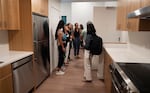
People tour a unit at Legin Commons on Sept. 10, 2026 in Portland, Ore.
Saskia Hatvany / OPB
Hwang said that while APANO is still developing services it will provide at Legin Commons, they could include financial literacy and workforce development programs, resources that tenants could use to build skills for higher-paying jobs.
“Our services are really intended to help you navigate and flourish in Portland,” he said.
The idea of learning to navigate Portland resonates well with APANO Resident Services Manager Wanna Lei’s own experience as an immigrant.
Lei studied English as a second language part-time at PCC while working at Legin Restaurant, her first job in the United States. Besides the freshly made siu mei she brought home, Lei still remembers how working at the restaurant helped hone her English proficiency and American cultural literacy.
Related: After pushing Black families out of North Portland, effort to welcome them back continues
Lei said she was saddened by the restaurant’s demolition, but when she looks at Legin Commons today — with its courtyard, community areas and outdoor play space that she feels are similar to what she imagined when the land was still vacant — she sees something valuable emerging from that loss.
“I worked with the community for many years [on] housing issues, and I know how badly we need more housing in this neighborhood, so I see Legin Commons as a new chapter,” she said. “We lost a piece of the history, but we also created a new housing we really need.”
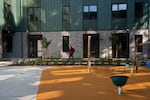



All images: Saskia Hatvany / OPB.