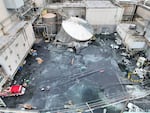
An undated aerial shot of the Nippon Dynawave pulp and paper mill, where a chemical tank ruptured on May 26, 2026, in Longview, Wash.
Cowlitz County Sheriff's Office/Documents obtained via public records request
A Southwest Washington lawmaker has announced the state’s first legislative response to the deadly chemical spill that killed 11 workers and injured eight others at a Longview paper mill.
State Sen. Jeff Wilson said Monday he will introduce a bill in the January legislative session to create state oversight of above-ground chemical storage tanks like the one that collapsed on May 26 at Nippon Dynawave Packaging Co.’s plant. Nearly 900,000 gallons of a scalding hot, corrosive chemical known as “white liquor” spilled during the incident, killing and injuring a group of employees who were just starting their workday.
Above-ground chemical tanks used at paper mills and in other industries are not currently regulated by Washington state agencies. Companies are responsible for inspecting these tanks and making sure they meet safety standards. A recent federal report shows Nippon failed to sufficiently act on its own inspectors’ concerns before the fatal tank implosion. Adding a layer of state oversight at paper mills, Wilson said, could help prevent a future disaster.
“I think that this is the incident to say the self-reporting, self-inspection, self-record keeping probably isn’t in the best interest of everybody,” said Wilson, a Republican from Longview who worked as an environmental cleanup contractor at pulp and paper mills, including at the Nippon plant, for 23 years.

FILE - Washington State Sen. Jeff Wilson speaks during a press conference after the Nippon Dynawave Packaging Co. chemical disaster in front of the facility in Longview, Wash., on May 26, 2026.
Eli Imadali / OPB
The condition of Nippon’s “G tank” had been evaluated and found to be unsafe before it collapsed, according to an August 2026 report by the U.S. Chemical Safety Board. The report found a contractor hired by Nippon had evaluated the tank three times since October 2025. Those evaluations warned that the tank was “not fit for continued service” unless it was repaired and that there was a “high likelihood” that it could fail.
The company has not publicly explained why it did not address the condition of the chemical tank after learning that its walls had corroded and thinned. A Nippon spokesperson did not immediately respond to a request for comment about Wilson’s push for legislation.
Outside of the oil and gas industry, above-ground chemical tanks fall into a “regulatory hole,” according to Marissa Baker, an associate professor at the University of Washington’s Department of Environmental and Occupational Health Sciences.
Today, there are just a handful of pulp and paper mills still operating in Washington. Baker said the focus of Wilson’s legislation could be broadened beyond paper mills to other industries that use large above-ground chemical storage tanks across the state.
“It’s kind of, to me, saying, ‘Until you have a large tragedy, we’re not concerned about you,’” she said.
The federal Chemical Safety Board and the Washington State Department of Labor and Industries continue to investigate the Longview disaster, and those findings could also lead to rule changes for the industry.
Wilson said his proposal for legislation would add oversight of paper mill chemical tanks to a state agency such as the Washington State Department of Ecology. That agency would inspect and certify such tanks, he said, and daily fines of up to $5,000 could be imposed on companies that don’t keep their infrastructure safe.

FILE - Flowers and chalk spelling out “Longview Strong” mark a makeshift memorial on old mill equipment in front of Nippon Dynawave Packaging Co. for victims of the May 26 chemical disaster in Longview, Wash., on May 29, 2026.
Eli Imadali / OPB