This story originally appeared on Underscore Native News.
Editor’s note: The following story contains images of a cougar being skinned and its hide tanned.
For two full days earlier this month, community members from across Portland and beyond gathered to share knowledge and learn from one another during the inaugural Indigenous Food Summit.
Hosted by local Indigenous-led nonprofits, the summit came out of a labor of love and dedication to expanding access to first foods, land tending and food sovereignty.
“This gathering is not simply talking about the connected food systems, it’s practicing one,” said keynote speaker Nora Frank-Buckner, Nez Perce and Klamath. She helped organize the Native Grown and Gathered Food Expo in Seattle last year, which inspired organizers of this year’s Indigenous Food Summit.
“Our people have continued to carry the seeds, protect the knowledge, harvest the foods, and make place for one another,” she continued. “Our responsibility now is to make sure future generations inherit not only that knowledge, but also the land, the resources, the relationships, and power to act on it. Food sovereignty is how we remember who we are. It is how we take care of each other, and it is how we make sure future generations can set the table for themselves.”
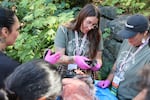
Volunteers and attendees of the Inaugural Indigenous Food summit held in Portland skinning a cougar as part of the cougar hide tanning course on Sept. 9, 2026.
Lyric Aquino / Underscore Native News + Report for America
As community members checked in at the Native American Student and Community Center at Portland State University on Sept. 9 and 10, they opened goodie bags that included a first foods cookbook compiled by the Native American Youth and Family Center, a hot sauce packet from Sakari Farms, a tea blend and smoked finishing salt. Over the course of the two days, just under 200 people attended.
Participants could choose from a wide range of workshops and sessions over the two-day summit, including cougar hide tanning, tea blending, wildfoods preparation, making natural cleaners, conversations about food in pregnancy and postpartum, and more.

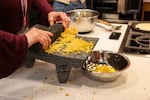
A burdock root salad and goldenrod corn bread are out for class participants to try during a class on wild foods preparation during the Indigenous Food Summit at Portland State University on Sept. 9, 2026.
Nika Bartoo-Smith / Underscore Native News + ICT
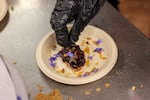
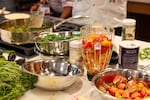
Summit participants were invited to share meals that centered first foods and Indigenous chefs. Meals included wild rice and salmon or bison with a wojapi berry sauce, salmon chowder, elk stew and a three sisters salad.
On day two of the summit, a group of youth from the Siletz Valley Schools’ culinary program traveled to Portland and prepared four dishes to share before participating on a panel called “Nourishing Our Youth and Elders.” The four dishes included a cassava flour cracker with a honey huckleberry pudding; a butternut squash bisque with blackberry barbecue steelhead; a bison meatball with bluecorn polenta and huckleberry vinaigrette; and red heirloom popcorn tossed in duck fat with chili, lime and maple syrup.
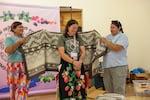
Emma Johnson, Cowlitz, Indigenous Traditional Ecological & Cultural Knowledge (ITECK) coordinator at Portland State University, stands to be honored on Sept. 10, 2026, at Portland State University for her role in helping plan the inaugural Indigenous Food Summit.
Nika Bartoo-Smith / Underscore Native News + ICT
“The hope for me doing stuff like this is just always that people know that they can participate in that reciprocity with our food systems and our medicines, and that they have every right to be in relationship with their prairies and their food forests and all of those wonderful beings that we get to coexist with,” said Emma Johnson, Cowlitz, Indigenous Traditional Ecological and Cultural Knowledge (ITECK) coordinator at Portland State University who helped organize the summit.
Johnson hopes that the summit becomes a regular occurrence, perhaps annual, along with supporting the potential for other similar summits across the region.
Tending to native and displaced plant relatives
For many, food sovereignty can feel hard to access in daily life, particularly for people living in urban areas, according to Johnson.
One of the goals with the Indigenous Food Summit was to make principles of food sovereignty feel more accessible to everyone.
“Everyone in this room carries something,” Frank-Buckner said during her keynote speech. “Some of you carry knowledge of plants or medicines. Some carry seeds. Some carry fishing knowledge, recipes or songs, language or stories. Some carry the responsibility of teaching our youth. Some know how to organize a market or a really awesome conference, write a policy, move resources, teach a class, build a business, or bring people together. Some are still discovering what has been placed in their hands. None of us carries the entire food system alone, and that is the point. Food sovereignty lives in the relationships among us.”
“— Nora Frank Buckner, Nez Perce and Klamath, keynote speakerNone of us carries the entire food system alone, and that is the point. Food sovereignty lives in the relationships among us.”
During the summit, participants were invited to take part in a series of hands-on workshops that centered around working with plant and animal relatives. While some congregated in the courtyard to learn about cougar hide tanning from Polima Joshevama, Hopi, and Amanda Freeman, Confederated Tribes of Grand Ronde, others gathered around tables of plants.
In one room, Adrienne Sampson, Navajo, founder of Waterlilly Botanicals, led participants in a tea-blending session. She provided a variety of herbs such as mullein, blue mallow flower, nettles and peppermint. Each participant walked away with a stress relief blend, a respiratory lung support blend and an immune boosting blend.

Nora Frank-Buckner, Nez Perce and Klamath, gives a keynote address during the Indigenous Food Summit at Portland State University on Sept. 9, 2026.
Underscore Native News + ICT / Nika Bartoo-Smith
“Making your own herbal blends or using herbs is good for food sovereignty,” Sampson said. “It’s giving you that ability to take your wellness in your own hands.”
At a different session, participants passed around a basket of freshly harvested chanterelle and lobster mushrooms, while hearing from presenter Leslie Lekos, founder of Wildroot Botanicals, who discussed how to harvest food in nature. She also identified medicinal qualities of different fungi and plants. Mushrooms are high in amino acids, while goldenrod is high in antioxidants, she said.
Lekos shared recipes with participants as well, like a wild rice and chanterelle pasta and a goldenrod cornbread.
While much of the summit focused on cultivating, harvesting, collecting and processing first foods, other topics included weeds and invasive species.
There were conversations about tending to and working with non-native plants — called displaced or misplaced plants by some — in ways that honor the land and are careful to avoid disturbing native species. For example, simply ripping out non-native blackberries can sometimes harm other native plants that may be coexisting with them. Some presenters pointed to simply continuing to harvest blackberries as invasive plant management work.
As summit participants left with bags of tea blends and recipes and bellies full of first food-inspired meals, organizers hoped they also left with a sense of connection to other land tenders, medicine makers and community members dedicated to incorporating ITECK principles of food sovereignty into their daily lives.
“To see so many people embracing Indigenous foods and reaching back to those roots and embracing these different practices and these different activities, it’s really beautiful to me,” said Marie Knight, Confederated Tribes of Warm Springs. “Because as Indigenous people, this was how we lived our life prior to colonialism, and we’ve had to adapt over centuries of changes. And to see us coming back to this, adapted to this modern world, and bringing those ideas back, this is really beautiful to me.”
Decolonizing your diet
The rich scent of curry powder and jollof seasoning wafted through the air as retired professional chef Darius Mani Yaw prepared coconut milk collard greens with spring onions and fresh ginger, freshly ground corn polenta with garlic confit, spring onions, and African jollof powder and salt-bed roasted salmon seasoned with African nettle powder for a classroom full of eager students.
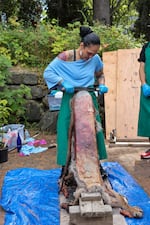
Amanda Freeman, Confederated Tribes of Grand Ronde, demonstrates how to tan a cougar hide during the Indigenous Food Summit at Portland State University on Sept. 10, 2026.
Nika Bartoo-Smith / Underscore Native News + ICT
Darius Mani Yaw, a postgraduate Indigenous traditional ecological and cultural knowledge researcher, hosted a workshop at the Indigenous Food Summit about decolonizing the diet through ITECK and Indigenous internationalism frameworks.
“We’re able to learn so much about one another through food, through history [and] how our foods came to be,” Darius Mani Yaw said.
Darius Mani Yaw, who is Occaneechi, Black Saponi, Freedman and Giriama, told workshop attendees that he uses ingredients that span multiple cultures and encouraged his students to weave together traditional first foods from tribal nations throughout Turtle Island — and the world.
“So many cultures around the globe have three sisters,” he said. “So why is it that we can see the three sisters but we’re not able to see other first foods across these arbitrary borders?”
In his teachings, Darius Mani Yaw encouraged workshop participants to look into the framework of the American food system and spark change by starting or participating in community grassroots efforts.
“We are going to settler colonialists and begging for scraps and for pennies on the dollar,” Darius Mani Yaw said. “We need to start taking community action and better supporting one another and understanding.”
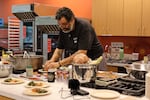
Retired professional chef Darius Mani Yaw preparing plates for attendees of his workshop “Decolonizing the diet using ITECK (Indigenous Traditional, Ecological and Cultural Knowledge) and Indigenous Internationalism Frameworks" on Sept. 10, 2026. Darius Mani Yaw, who is Occaneechi, Black Saponi, Freedman and Giriama, prepared a meal of coconut milk collard greens with spring onions and fresh ginger, freshly ground corn polenta with garlic confit, spring onions and African jollof powder and salt-bed roasted salmon seasoned with African nettle powder.
Lyric Aquino / Underscore Native News + Report for America
For Darius Mani Yaw, this starts by making the conscious choice to eat fewer processed foods and more traditional foods while also making sure his neighbors and community have access to similar tools.
“We have to start eating differently, caring for ourselves differently, growing our food if we can, or at least being in community to grow our own food, and supporting one another with these [traditional] knowledges and whatnot,” he said.
A common theme throughout the summit was community, which Darius Mani Yaw has tried to embody in his life and career. A retired chef of over 20 years, Darius Mani Yaw has made more than 10,000 meals for those in need and spent time in houseless encampments bringing meals and resources to his community.
“— Darius Mani Yaw; Occaneechi, Black Saponi, Freedman and Giriama; Indigenous traditional and cultural knowledge researcher and retired chefWe are going to settler colonialists and begging for scraps and for pennies on the dollar. We need to start taking community action and better supporting one another and understanding.”
“If I have a freezer filled of salmon, but my neighbor is not eating, what’s the point of having a freezer filled of salmon or bison or game or whatever that may be,” he said.
When Darius Mani Yaw reflected on the food summit, he highlighted the importance of sharing information between Native nations in what he calls Indigenous internationalism. For him, that includes combining his Afro-Indigenous ancestry. He said he hopes events like the summit will inspire others to discuss political action regarding food sovereignty, identity and cultural and traditional Indigenous knowledges.
“This was open to the community, and many of us were sharing our Indigenous knowledges across arbitrary borders. Whether we’re Native or non-Native, no matter our tribal affiliation, our European affiliate, it didn’t matter,” he said. “And here we are coming together specifically in this matter, having a meal, having an identity [discussion] and a political discussion over a meal, making medicines, tanning hides, and being able to show this together and be within community. And really, this was not only a sign of action and resistance, but it’s a resurgence specifically.”
This story is co-published by Underscore Native News and ICT, a news partnership that covers Indigenous communities in the Pacific Northwest.
Underscore Native News is a nonprofit investigative newsroom committed to Indigenous-centered reporting in the Pacific Northwest. We are supported by foundations and donor contributions. Follow Underscore on Facebook, X, Instagram and TikTok.
This republished story is part of OPB’s broader effort to ensure that everyone in our region has access to quality journalism that informs, entertains and enriches their lives. To learn more, visit opb.org/partnerships.