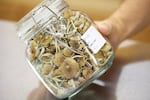
FILE - Gared Hansen shows psilocybin mushrooms that are ready for distribution in his Uptown Fungus lab in Springfield, Ore., Monday, Aug. 14, 2023.
Craig Mitchelldyer / AP
State regulators have backed off pursuing sizable fee increases on Oregon’s magic mushroom businesses after dire warnings from the legal psilocybin industry that it would buckle under the added costs.
The Oregon Health Authority announced Tuesday that it would not adopt proposed rules that would have doubled the annual licensing fees for businesses across the psilocybin supply chain while eliminating discounts for veterans and low-income people.
Regulators justified the fee increases as necessary to cover the cost of managing the first-of-its-kind program where adults age 21 and older take the psychedelic drug under the watch of a trained facilitator. But the hikes drew backlash from an industry already struggling under regulatory burdens even as research points to psilocybin’s potential as a life-changing mental health treatment.
“This was an industry fighting for its survival, and it really came together,” said Andreas Met, the co-founder of Satya Therapeutics, an Ashland-based service center where adults take legal trips. “This is a profound thing.”
While the industry celebrates the defeat of the fee hikes, questions remain about the financial stability of a program that supporters promised would pay for itself. It’s unclear how the authority will fund the program, and what comes next will follow criticisms that the agency wasn’t transparent about the potential consequences of the fee hikes.
‘We can’t be a part of the solution’
The authority released a document last week in response to a records request from Met showing that increasing fees could worsen the program’s finances.
The document included figures showing how the state’s psilocybin licenses have dwindled since the program began in 2023.
Under the document’s worst-case scenario, the program would have a $4.2 million shortfall in the current two-year budget cycle as a result of psilocybin businesses abandoning their licenses instead of paying higher fees.
Even without the fee increases, the document projected a $3.8 million shortfall. It included a third scenario where licenses held steady despite the fee increases but still came up $2.9 million short.
The document’s findings seem to contradict the authority’s rulemaking notice that the “overall fiscal and economic impact of the rules cannot be quantified at this time.”
Health authority spokesperson Erica Heartquist did not answer follow-up questions. She deferred to a statement issued Tuesday that indicated that the authority dropped the fee increases based on feedback from the Oregon Psilocybin Advisory Board, rule advisory committees and public comment period.
The authority will also “post documents on the psilocybin program website in response to questions and requests on the psilocybin budget,” according to the statement.
Everyone who spoke during two public comment hearings held last week opposed the fee increases. Multiple speakers called on the authority to disclose more information on the program’s budget.
“People like me want to be a part of this industry, and we want to help solve this budget shortfall,” said Paul Volk, a Portland resident training to be a facilitator. “But we can’t be a part of the solution without the data and transparency to understand the problem.”
The document was dated August, a month after the authority met with an advisory committee to get feedback on the proposed fee hikes and other regulations.
Met, who leads the Psilocybin Alliance trade group, said the authority released a document containing an analysis of the fee increases just days before public comment on the rules closed. Earlier this month, he wrote a letter to the authority on behalf of his group faulting the rulemaking process for not including a fiscal analysis of how the fee increases would affect the industry.
Program faces budget uncertainty
Released documents suggest the health authority does not expect lawmakers to support the psilocybin program with money from the state’s general fund in the upcoming budget cycle.
The groundbreaking program received general fund money to cover its startup costs after it was created via a ballot initiative in 2020. The ballot initiative campaign promised that the program would be sustained with fees and wouldn’t require additional taxpayer support once it was established.
Heidi Pendergast, Oregon director of the Healing Advocacy Fund, which advocates for psilocybin access, questioned whether licensing fees can cover the program’s cost. Her organization has been lobbying policymakers to support the program, arguing it’s safe and a potential tool to help Oregon’s underdeveloped mental health system.
A recently published study in JAMA Network Open found that 346 adults who used Oregon’s psilocybin services reported decreases in depression, anxiety and PTSD symptoms, in addition to improved mental well-being.
The health authority will begin a new rulemaking process unrelated to proposed fee changes. Documents also show the health authority is considering an increase to the psilocybin product tax to help support the program. People who use service centers pay the 15% tax on psilocybin products they use during their session.
Both Met and Pendergast said the authority should be more transparent as it seeks financial stability for the program.
“We can’t create a program where the license fees pay for a program and we don’t know what they specifically are paying for,” Pendergast said.
Oregon Capital Chronicle is part of States Newsroom, a network of news bureaus supported by grants and a coalition of donors as a 501(c)(3) public charity. Oregon Capital Chronicle maintains editorial independence. Contact Editor Julia Shumway for questions: info@oregoncapitalchronicle.com. Follow Oregon Capital Chronicle on Facebook and Bluesky.
This republished story is part of OPB’s broader effort to ensure that everyone in our region has access to quality journalism that informs, entertains and enriches their lives. To learn more, visit opb.org/partnerships.