
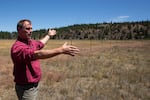
Ben Walsh stands at a corner of his family's property outside Sisters, Ore., on July 9, 2026.
Kathryn Styer Martínez / OPB

Under the noonday sun, Ben Walsh gazed across the meadow where he grew up outside Sisters and pictured an elementary school and homes alongside open fields.
“I think the new elementary school should be right there,” he said of the 20 acres his family owns as hawks cried overhead.
But whether Walsh gets his wish will depend on the outcome of a complicated and protracted battle about how this small Central Oregon city should grow. The community of nearly 4,000 people is one of the fastest-growing places in the region and needs about 2,000 homes within the next two decades.
Planning has been underway for years to make way for more housing, but decisions about what land to use for that growth — and who will benefit from those decisions — have divided the city, slowed the work and cost the city money it doesn’t have. Now, with a deadline looming, Sisters is racing to get approval for its first such expansion in roughly two decades.
“If we don’t finish this process more or less by the end of this year, we might have to stop the process and redo some of these reports, which will then expand our timeline months and months and months,” said Sisters Mayor Jennifer Letz. “Which to me means we are not getting houses built.”

The Deschutes County Planning Commission deliberates over the city of Sisters urban growth boundary application during a meeting in Bend, Ore., on Sept. 10, 2026.
Kathryn Styer Martínez / OPB
The challenges Sisters has faced as it tries to grow are common among rural communities in Oregon, where Oregon’s unique land-use laws determine when and where communities can expand development.
In 1973, the Oregon Legislature created urban growth boundaries, a system that limits outward expansion unless communities fill in enough of their existing space with homes and businesses. Lawmakers created Oregon’s land use system to prevent urban sprawl and to protect the state’s valuable agricultural and forest lands. The boundaries define where a community expects to grow over a 20-year period while protecting open space and natural resources.
But in fast-growing rural cities like Sisters — and in other rural communities statewide — some feel the policy is outdated, a one-size-fits-all approach that unnecessarily limits their growth and economic potential. In Sisters, a dispute between a developer and a land use watchdog over zoned forest land that was targeted for new housing, including affordable homes, has been a focal point, with those who can’t afford housing caught in the middle.
A booming city

Sisters, Ore., located on the edge of the Deschutes National Forest, is known for its Old West-style architecture, Aug 20, 2026.
Kathryn Styer Martínez / OPB
Sisters lies nearly 25 miles northwest of Bend in Deschutes County. It’s tucked into the edge of the Deschutes National Forest and known for its curated Old West-style architecture, the proximity to outdoor activities and small-town feeling.
A sculpture of a line of horses racing through a field, wranglers in hot pursuit, greets those entering the small downtown, with the real-life snow-capped Three Sisters mountains as a backdrop.
The community, thick with ponderosa pines, is also booming. Since 2000, the population has just about doubled every decade, according to Portland State University and U.S. Census estimates.
Sisters is also located in an epicenter of growth in Oregon. Deschutes County had the third-highest percentage of growth from 2020 to 2025 at 7.7%, according to PSU. Over the same period of time, Oregon’s population grew only 1.4%.
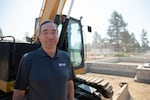
Peter Hoover, at the Sisters Habitat for Humanity job site in Sisters, Ore., on Aug 20, 2026.
Kathryn Styer Martínez / OPB
Now, residents and workers in the small city of just over 3,800 are feeling the squeeze.
“There is a vast number of people who are so important to the community that just cannot live here either on an ownership basis or a rental basis,” said Peter Hoover, the executive director for Sisters Habitat for Humanity, which had affordable housing plans swept up in the urban growth boundary debate. In town, the average hourly wage is about $22 an hour, he said.
In Sisters, a median single-family home costs $685,000 and the median income is $94,500, according to U.S. Census data. About 80% of Sisters’ workforce commutes from outside the city, Letz added.
Amy Shultz moved back to Sisters from Los Angeles in 2016 to raise her daughter, and now owns a thrift store downtown. She and her husband rent but, she said, they’d love to buy a home.
“My husband’s a chef, and, with two incomes in this market still, it is not really affordable,” she said.
A debate over where to grow
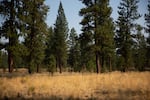
McKenzie Meadow Village, LLC owns 58 acres adjacent to Sisters city limit, in Deschutes County, Aug. 20, 2026.
Kathryn Styer Martínez / OPB
Sisters developer McKenzie Meadow Village, LLC wanted to build at least 400 more homes on property currently zoned as forest land. The company has already built about 200 single- and multi-family units in northwest Sisters, and hoped about 30% of the planned new homes would be affordable — on the adjacent acreage.
But the 58 acres could not be included in an expansion of the city’s urban growth boundary as it was zoned, according to Oregon’s land-use laws, because Sisters has other land more suitable for development. Under the law, resource-rich agricultural and forest lands must be the last ones considered by communities looking to expand growth, and only when other options are exhausted.
When Deschutes County rezoned the land so it could be included in the proposed UGB, the nonprofit land conservation group Central Oregon LandWatch challenged the move with the state’s independent land use tribunal. The rezoning would have “undercut Oregon’s land use system by making it more difficult to stop urban sprawl and protect farm and forest land,” the nonprofit said on its website.

Bill Willitts, right, sits with his wife Zoe at the Deschutes County Planning Commission meeting in Bend, Ore., on Sept. 10, 2026.
Kathryn Styer Martínez / OPB
Other land in Sisters was available and wouldn’t impact land the state law intended to protect “for forest, wildlife habitat, open space, and recreation values,” Kristin Reidelberger, a Central Oregon LandWatch program manager, wrote in a letter before challenging the proposed rezoning.
The tribunal, the Land Use Board of Appeals, overturned the rezoning decision last month, saying in its decision, “The county must base that decision on something more than the landowner’s desire to jump to the head of the line.”
With the January deadline approaching, the city moved ahead with its plans without McKenzie Meadow lands.
Managing partner Bill Willitts told OPB that his development would be the “fastest out of the gate” to build the homes Sisters needs. The company is now waiting for the final outcome to decide how to proceed.
“If it takes another six months or it takes another 16 months, let’s get it absolutely right for the families of this community,” he told OPB in July.
Another option
Earlier this month, the county’s planning commission approved a version of the proposed plan that excluded the McKenzie Meadow Village property. A different development — Barclay Meadows First Addition — is included in the plan to help address Sisters’ acute housing shortage.
Nearly 100 acres there are slated for potential development in an area that already boasts single-family homes on large tracts situated around open space that hosts a thriving marsh after heavy rains.
That plan must receive final approval from both the county and the state before the city can expand its UGB. Sisters City Council will hold a hearing on Oct. 14, followed by the county later this month.
Walsh, who now splits his time between Sisters and Portland, grew up on 20 acres of that land that his mother still owns inside the proposed expansion area. He now envisions a thriving, mixed-use community of houses, many of them affordable, set in the high desert where he played as a child.
“I want to think about what it would be like to build the world’s best elementary school on the edge of the meadow coming back to life, and hawks get to fly overhead during recess,” he said.
For Letz, the mayor, a final decision can’t come soon enough. If the city’s new urban growth boundary is not approved by Jan. 1, Sisters will have to start some of its work over again, further delaying the process and racking up even more expense.
“It’s getting more expensive to live here every minute,” she said.