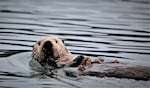
FILE - A wild sea otter swims as he snacks on seaweed covered with roe in Prince William Sound, Alaska.
Ian McCluskey
Except for one failed experiment and a handful of curious wayfarers, sea otters have not lived in Oregon’s coastal waters since they were hunted to extinction for their fur more than a century ago.
But a new, three-year research effort with plenty of scientific heft behind it will see what it might take to re-establish a species once found along much of the coast.
The project is being led by aquariums in Newport and Seattle and two conservation organizations and appropriately coincides with Sea Otter Awareness Week.
“There’s lots of uncertainty and we have a long way to go,” Jane Bacchieri, executive director of the Siletz-based Elakha Alliance, one of the participants, told the Lincoln Chronicle. “But this is a critical early step to sea otter reintroduction to Oregon.”
A decade-long effort lies ahead if sea otters have a chance at long-term survival success, according to Bacchieri and others.
Comparing non-inhabited coastal Oregon and coastal Washington, where sea otters are living, is considered essential to understanding how the presence of otters affects the populations of other marine species and the overall condition of the seafloor.
Keystone species
Sea otters long sat atop the food chain in near-coastal waters, especially where large kelp forests provided habitat for many other species.
The last known wild sea otter in Oregon was killed in 1906 at Otter Rock near Depoe Bay. Once otters disappeared, sea urchins thrived.
In the absence of competition, the spiny invertebrates proliferated to the point that massive “urchin barrens” were all the voracious creatures left behind. The visual effect is an ocean floor vacuumed of anything but thousands and thousands of sea urchins.
Sea otters effectively change that equation, diving up to 50 meters to feed on urchins, mussels and other spineless ocean creatures.
“They aren’t picky eaters,” Bacchieri said. “They’ll eat a variety of marine invertebrates.”
What they won’t eat are salmon and other finned fish, she said. The latter point is an important one, since commercial and recreational fishing groups have expressed concerns about potential conflicts between otters and fish.
“There’s no indication they eat salmon,” Bacchieri said. “They’d have to burn far too many calories for the effort to make biological sense.”
They do eat crab, however.
The players
In addition to the Elakha Alliance, heading the effort to bring sea otters back to Oregon are the Oregon Coast Aquarium in Newport, the Seattle Aquarium and the Wildlife Conservation Network’s Sea Otter Fund.
The effort will involve work in both states. Teams will use scuba divers and remotely operated vehicles to measure the abundance of sea otter prey, including urchins, crabs and abalone.
They will also record thousands of images of rocky reef and soft-sediment habitats in both locations.
“Sea otters provide powerful benefits to their environment,” Shawn Larson, senior conservation research manager at the Seattle Aquarium, said in a statement. “When otters are present, kelp forests and eelgrass meadows thrive. There is more food for other animals in the system, and the system itself is more resilient to climate change.”
The Seattle Aquarium will also train personnel to use remote-controlled vehicles that will make ocean-floor research far easier than sending down divers to collect all of the information.
“We have a dive team,” said Jeremy Burke, the Oregon Aquarium’s marketing director. “But this will allow them to do more of their research from the surface.”
Lengthy timelines
The project is not yet far enough along to let the participants know when, or even where, sea otters might eventually be reintroduced in Oregon. But based on past findings, their best chance of success here will likely be between Coos Bay and Brookings. That’s where otter-friendly habitat, including kelp forests and rocky seabeds, is most common.
Areas around Depoe Bay are also under consideration, according to project participants.
But even the most optimistic projections don’t foresee the first otter hitting the water in Oregon for at least five or more years.
“Hypothetically, if everything goes right,” Bacchieri said, “we could see an initial reintroduction by 2033.”
At that point, a rolling reintroduction of up to 75 otters could join the first bunch, with that number repeating every five or so years, depending on the project’s overall success.
First things first, however, said Jen Miller, director of the Sea Otter Fund.
“After reintroduction, we expect to see sea otters rebuild the ecological resilience of our coasts,” she said. “But we won’t see the change unless we start the science now.”
A rocky past
This is not the first time a sea otter reintroduction has been tried in Oregon.
Oregon, along with a collection of other West Coast sites, attempted reintroduction from 1969 to 1972 when otters were released at Cape Arago and Port Orford. They persisted for about a decade, according to scientists familiar with those efforts, before they “petered out.”
In 2024, two male sea otters showed up off Cannon Beach, providing a rare sight for anyone visiting Ecola Point. Observers surmised they appeared to be from the northern sea otter subspecies in Washington.
The current research effort, parts of which are already underway, will go a long way toward determining if a formal reintroduction is warranted.
“Understanding the ecology of the Oregon Coast is a really important step in reintroducing them,” said Bacchieri of the Elakha Alliance. “In terms of whether we eventually see sea otters along the coast anytime soon, this is a big deal project.”
Dana Tims is an Oregon freelance writer who contributes regularly to Lincoln Chronicle and can be reached at DanaTims24@gmail.com
This republished story is part of OPB’s broader effort to ensure that everyone in our region has access to quality journalism that informs, entertains and enriches their lives. To learn more, visit opb.org/partnerships.