
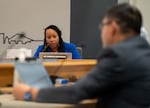
Portland Public Schools Superintendent Kimberlee Armstrong introduces a school closure proposal during a Portland Public School Board meeting about closing up to 14 schools, at Dr. Matthew Prophet Education Center in Portland, Ore., on Oct. 6, 2026.
Eli Imadali / OPB
The Portland Public Schools proposal to close up to 14 schools is getting a lot of pushback. Earlier this week, School Board Chair Eddie Wang answered questions from parents who would be affected. He emphasized that even though the district has had to make a series of significant cuts over the last several years, the closures would not be helping fill a budget gap. Instead, they are aimed at better serving more students in fewer schools with the district’s limited funds.
As first reported by The Oregonian/OregonLive, Gov. Kotek sent a letter to Armstrong and Wang Tuesday, urging them to “take the necessary time” for families to understand and give feedback on the plans. In a statement, a spokesperson said the district is holding regular sessions for public feedback in the coming weeks and is “expanding those efforts to give families, students and staff additional opportunities to share their perspectives.” The board vote on the school closures plan is currently scheduled for mid-December.
We talk with PPS Superintendent Kimberlee Armstrong about the plans for school closures, the data used to formulate them, and how she’s responding to the concerns of parents, students and staff.
Note: The following transcript was transcribed digitally and validated for accuracy, readability and formatting by an OPB volunteer.
Dave Miller: This is Think Out Loud on OPB. I’m Dave Miller. We end this week with the follow-up to our conversation about the proposals by the Portland Public School District to close as many as 14 schools, along with major program consolidations and changes to school boundaries. Nearly 8,000 students in kindergarten through eighth grade would have to change schools under one of the potential scenarios.
On Tuesday, we talked to the chair of the school board about this. Today, we’re joined by the superintendent, Dr. Kimberlee Armstrong. She’ll present her preferred alternative to the Board sometime next month. Dr. Armstrong, thanks very much for making time for us.
Kimberlee Armstrong: Great, thank you. I appreciate being invited to Think Out Loud.
Miller: Very few issues that we’ve talked about on this show have generated as much feedback as this one. We’re going to get into specifics as we go, but I sort of tried to just look at everything and to boil down what I saw as the two biggest issues that have come up.
The two themes that emerged to me are, first, please slow down; and second – and this is related – give us more data, more detail, more information so that we can have faith in what you’re doing and have clarity about what this will look like.
So I want to take these one by one, starting with the speed. What do you say to families, or to people running for governor or currently governor, who say slow this down?
Armstrong: Yeah, well, so closing schools, consolidating schools is not a new conversation in Portland. I like to share the facts that we’ve had over 100 schools over the last 100 years, of course varying numbers in between that. We’ve served over 80,000 students. We have a school system right now that’s built to serve 80,000 students, and that’s just not our enrollment reality.
Miller: OK, that’s a justification for the closure process, but it doesn’t directly address the question about the speed at which this is happening right now. What do you say to people who say this is too important to do at this pace?
Armstrong: Well, regarding the pace, we’ve been in the conversation since April. It started off with the resolution from the school board directing me to get into this work. They then had feedback sessions as they developed their guiding principles, and we have been in the details of that work since the summer. So, when I hear “slow down” and “wait,” I guess I wonder like, what are we waiting for? And to go slower to do what? As we’ve been processing, we’re out in community, and we’re responding with information.
Miller: I want to play you a voicemail that came in from a parent named Zach.
Zach [caller voicemail]: I am a parent of two kids in Portland Public Schools. Their neighborhood school is being slated to close. It’s two blocks from our house. They currently attend a focus option [school] that is also going to be affected by boundary changes and program changes. That will end up meaning that they will be kicked out of that focus option school.
Miller: This is just one family’s illustration, but it shows to me how dramatic the changes are: the closure of a school two blocks away and the end of the focus option program where this parent’s kids currently attend.
What do you think about the idea of phasing in the closures and boundary changes? So, say, doing North and Northeast Portland next year, then Southeast Portland the year after, and then the Westside the year after that, giving the district time to really focus on the needs of the affected communities more fully, as opposed to distributing all of that support all at once.
Armstrong: Yeah, I absolutely agree. There will be some things that are phased in and that will be part of the final recommendation. I think we’re in the active feedback stage. So we’re wanting families to show up and share their concerns, give their ideas. The whole purpose of getting the scenarios out is so that our family, our communities and our staff can react to it.
Miller: Maybe I’d missed this, but I wasn’t aware that that was on the table. So you’re saying that it’s likely or possible that the final scenario that you put forward that the board votes on will have a kind of phased-in approach to closures and boundary changes?
Armstrong: For some of them, yes. I mean, I’ll give the example of Sellwood Middle School. That’s slated to close in June of 2028, not June of 2027. So that’s a whole year-and-a-half away. Also with Marysville, the closure of that school, that’s slated to close in June of 2028, not in June of 2027. And as we’re leaning in, listening to community and hearing feedback, we’re thinking thoughtfully about what’s coming up. That will seed the next phase of work, which will lead to my final recommendation.
Miller: I want to turn to the other and absolutely related overarching issue about data and information, starting with the data that you’ve been using to put together this entire set of scenarios about enrollment. The district hired an outside firm when you did the Southeast boundary effort changes. Why not hire an outside auditor now to make sure that all the data that you’re basing these massive changes on is accurate?
Armstrong: The data that we’re basing the changes on is from the Portland State…
Miller: Demography world.
Armstrong: Right. So we don’t question those numbers. Now, I will say that when you get into the individual schools, there has been some fluctuation, right? Some schools may be a little over, some may be a little under. But in terms of our actual enrollment as a system has not been off. And I know that has been talked about. I’ve heard that in many spaces, and I would love for someone to show us the data where our numbers are off, based on PSU’s data.
Miller: What’s your definition of a well-resourced school? Your definition of the right end result?
Armstrong: Well, there’s a few things. We’re not blending classes. Just to be clear – and I get this question all the time – we have class sizes that are over 30, we have class sizes that are under 10, yet our average is 24, 25. That doesn’t connect with a lot of people because that may not be their reality. And I think it shows the swing, the differences that are happening across our city and many of our facilities.
So when we say well-resourced, we’re saying that we’re getting to a size of 360. And some people do math and say, oh, that’s 60-per-grade-level work. Kiddos don’t present in these perfect numbers. We’re saying two to three classes for every grade level, where we no longer have to blend. We’d like to see supports like library, art and music, and other supports out there that get at supporting our kiddos.
Miller: I want to play you a voicemail that came in because this gets to what you’re talking about there in terms of class sizes.
Emily [caller voicemail]: Hi, this is Emily. I live in Sellwood, and I’m a mama and a teacher in PPS. What does 360 students mean in a classroom? PPS says an elementary school needs 360 kids in an elementary school, and that’s about 60 kids per grade if you break it down, K-5. Depending on staffing, that means 18 classroom teachers would be 20 kids, or 15 classroom teachers would be 24 kids per class, or 12 teachers would mean around 30 per class. So which one is PPS planning for at receiving schools, and will it put a class size cap in writing?
Armstrong: Yeah, I appreciate hearing that and the questions within it. It’s difficult to answer that question when enrollment isn’t that perfect, right? Where we have 30 in first and 30 in second, or 60 in fifth and sixth. I mean, that is some of the things that we’re experiencing when we’re spreading out all of our students across our system in the many schools that we have in different regions in our district. We appreciate the average of 24, 25 students in the class, and we would absolutely want to be there. And at the same time, there’s other personnel that we want to have in schools to be able to support students.
So, it’s a complicated question, but here’s what I’m committing to. When I put out the final recommendation in early November, it will have the staffing plan attached. And I know that that is something that people are anxiously waiting for, and we will have that to go with the conversation on that final recommendation.
Miller: This connects to some key questions that came from an audit that the district commissioned following the Southeast Guiding Coalition work. It is an audit report that has gotten a lot of attention from parents in the last couple of weeks. Two questions from the audit, of many, stood out to me. The first was, what specific resources will students gain in the receiving school? And the next is, will students gain access to additional specialists, electives, intervention staff and counselors?
What can you tell us now about what you will commit to in terms of the resources that these receiving schools or that all schools will have?
Armstrong: Well, I appreciate the “all schools” because it gives me the opportunity to clarify something. Not all of our elementary schools will be at that ideal level of 360, or at middle school, the ideal level of 500. So when we talk about resource, we know that our first immediate action is to stabilize. Once we are stabilized, and we’re seeing those numbers, we’re able to resource differently. What I can tell you that I absolutely commit to is reinvesting all of the funds from closures and consolidations directly back into schools.
Miller: What do you mean “reinvesting” the funds from closure, because I guess, as has been said many times, this is not about saving money. This is about putting existing money to use in different ways.
Armstrong: It’s about reinvesting those funds. We’re not reducing, or we’re not closing, or we’re not consolidating or changing the profile of a school to save money to reduce our deficit, which is $65 million by the way. We’re looking to reinvest those funds so that we can have more resources spread to fewer places, which, within itself, then increases the number of staff that we have in our buildings and other supports.
Miller: But this gets to one of the issues that we were talking about with the chair of the board just a couple of days ago. For parents who can see very clearly what they would lose if their community school, or the school their kids currently go to if it were to close, those losses are really clear. And I think what is really more vague and harder to understand is what they will gain. Even here, I guess I appreciate your hesitation to promise that there’s going to be another librarian at the school, another specialist or more electives, because it seems like you can’t necessarily promise that. But it makes it harder then for parents to see what they will gain, and all they can see is what they will lose.
Armstrong: I think one of the reasons why we’re not able to get into promises or those commitments is, as you know, we’re funded per pupil. And also, our governor sets the State School Fund that goes into the legislative session, and they adopt their budget in June. So many of the things that we have to do in public education, in terms of staffing our schools and communicating about what we’re able to do or not able to do, is based on that State School Fund. So we’re committed to getting out with that staffing picture, and speaking more clearly and definitively about those resources after the election on November 3.
Miller: We got this question in an email from Megan. She wrote: “Before selecting schools for closure or restructuring, did PPS model whether these changes could accelerate enrollment losses as families leave the district?” She wrote, “If so, where can the public review that analysis? The district presents its proposals as a response to declining enrollment, but the changes themselves may accelerate that decline.”
What’s your response?
Armstrong: Yeah, we actually will present that information, and we did build in a percentage of loss for families that may choose to opt out. We based it on the information that we had on families that opted out after other changes. As we know, as I’ve said before, Portland has closed over 30 schools in its history. The other thing that I’ll say–
Miller: How significant? Maybe you don’t have the numbers in front of you right now, but how significant do you think that loss is going to be?
Armstrong: I don’t think it will be as significant as people are saying. Our capture rate for Portland Public has been in the mid-80s, and then post-pandemic, it dropped. That’s when we saw the largest drop to about mid-70s. And so–
Miller: It’s still around there, right?
Armstrong: It’s still around there. It has not gone back up. So within that we’re looking at what another percentage drop will be. But I will tell you that even if we see a swing, and students and families choose to return back to Portland that left after the pandemic hit, we’ll still have enough schools and seats.
But here’s what I want to say, Dave, and I feel like this is perhaps the most significant thing that I want people to hear and understand. We got into the details of the work after the board resolution and the guiding principles. We put out the scenarios so that our community, our staff and our families can react, to give comments, to ask questions. And we’re in that phase now. So when I hear comments like “slow down,” or “you don’t have this information,” or maybe this is missing, OK, we’re capturing your thoughts and comments. We’re posting actively on our website, and we are answering questions. We’re out in community. But this is the time to talk about those things that are coming up.
Miller: What are examples of how the feedback that has already come in has changed your own thinking about how you should proceed?
Armstrong: Yeah, it definitely has been shaping my thoughts as I think about that final recommendation – looking between the two scenarios, A and B, looking at where we’re hearing a lot about whole communities and the importance of those whole communities, even in some of our program moves. I spend my time out in communities in the morning and afternoon, hearing from families at schools. And yesterday, I had an opportunity to sit with a community, and hear directly from them about our modeling and the way that they’re receiving it. And they shared important things that I immediately took back to the team. It definitely is seeding my thoughts for the final recommendation and what that’ll be.
Miller: Do you not want to tell us right now any of the specifics? The reason I ask this is because the point you’re trying to make is, hey, people are telling us to slow down, but we’re actually listening to you right now. This is the way the process should work and we’re being responsive. So have faith in us that we are listening to you. We are going to take your input and it will actually have an impact on us.
I’m wondering if you can share with us an example of where that is actually true?
Armstrong: Yeah, I love that question. I would love to be able to share some of my initial thinking, but I’m not yet ready to do that because there’s more engagement to go. We have a full day of engagement this Saturday. Next Saturday, we have a full day of engagement, plus all the days in between. Even this afternoon, I’m going and sitting with another school community and I’ll hear directly from them. And all of that information will be public in the themes on November 4 at that board meeting, when we share out what we heard from the community and share some of that initial thinking as I prepare to write that final recommendation.
Miller: What do you think, at this point, is going to be lost or sacrificed in the hope for systemic improvement?
Armstrong: I will tell you, I am pretty excited and committed to the promise of public education in the city of Portland. I think that Portland is beautiful, probably one of the most beautiful in the Pacific Northwest. And when I think of the closure of schools and what that does to the community, the neighborhood, it is impactful, horrible and very sad to think about.
But that promise that I go back to, of saying, what would it mean for us as a system to better support every single one of our learners across the city, where we’re no longer struggling to fill a classroom of students and resourced properly? I’ve been in some communities, and I hear families and staff say, “But we’re resourced now, we feel well-resourced.” But well-resourced doesn’t always mean fully staffed. And getting to a place where we can have the resourcing and the staff to support our learners is what will make the most impact moving forward.
Miller: Communities like Sunnyside Environmental School, a unique focus option, as you’ve heard, I’m sure – because we’ve heard from a lot of them, so you must have as well – they don’t talk about necessarily being well-resourced, but they say that, whether it’s students or parents or teachers, that it’s thriving, it’s serving their students well. And they say we’re being sacrificed for the district’s notion of the greater good, what do you say to them?
Armstrong: Well, I will say it’s not just the notion of the greater good, but we’re a public school system. And while I love the energy, excitement and faith that 81 school communities have for their individual sites, I need that same energy, enthusiasm and love for our system as a whole. We’re serving all 43,000 students, not 300 from this location, or 200 from this location, or 160 from that other location.
Miller: Can you tell us where you’re leaning right now in terms of the three scenarios?
Armstrong: Yeah, well, I can share that I’m really compelled to really dig deep into scenario B and see where there are some flexibilities, some timelines, some adjustments that can be made in a response to what’s coming up right now. So, I guess if I were to just say, completely independent of team processing or where others may be at, I’m definitely leaning into scenario B and curious about what that could mean for our city as we contemplate changes there.
Miller: Why B right now as opposed to A?
Armstrong: Yeah, I think with B–
Miller: I should say … Sorry, I say this question as if everybody listening knows. But B is three fewer school closures, right? It’s 11 schools closed. And C is do nothing.
Armstrong: C is do nothing.
Miller: So, why B?
Armstrong: Let me just say C is do nothing right now. C can’t do nothing forever. C just delays the inevitable. So I’m not into delaying the inevitable. I will say B, one of the things that we often think about is the magnitude and the complexity of change. I appreciate that B’s magnitude and complexity of change isn’t as great as scenario A, but it still gives the opportunity to have 70% of our students or above in schools that are sustainable. So it’s what’s the least amount that we can do right now to promise an opportunity for our students to be able to thrive.
Miller: Kimberlee Armstrong, thank you very much for your time. I have a feeling we will talk again about this.
Armstrong: I am sure. Thank you.
Miller: Dr. Kimberlee Armstrong is the superintendent of Portland Public Schools.
“Think Out Loud®” broadcasts live at noon every day and rebroadcasts at 8 p.m.
If you’d like to comment on any of the topics in this show or suggest a topic of your own, please get in touch with us on Facebook, send an email to thinkoutloud@opb.org, or you can leave a voicemail for us at 503-293-1983.
