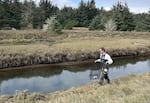
Lower Elwha Klallam Tribe biologist Justin Stapleton carries green crab traps near Pysht, Wash., on Sept. 11, 2026.
Courtesy of Aina Hori / Washington Sea Grant
More than 2 million invasive green crabs were captured in Washington state from July 2025 to June 2026, smashing previous records.
More European green crabs were trapped in those 12 months than in all previous years combined since the pinchy invaders were first documented in Washington state in 1998.
“We’ve seen some pretty dramatic increases,” said aquatic invasive species researcher Brian Turner, who’s with the Washington Department of Fish and Wildlife. “It’s not good news.”
The haul more than doubled from the previous year, according to the Washington Department of Fish and Wildlife’s annual report on the state’s emergency response to the crab invasion.
Former Gov. Jay Inslee declared an emergency over the crabs in 2022 due to the threat they pose to the Northwest shellfish industry.
European green crabs are smaller — and thus less desirable as seafood — than native Dungeness crabs, which support the state’s most lucrative commercial fishery.
Yet the smaller invaders successfully prey on juvenile native crabs. The European green crab is a voracious predator and prolific reproducer, considered one of the world’s most destructive invasive species.
In addition to Dungeness crabs, European green crabs also eat juvenile salmon and high-value shellfish including oysters, mussels and clams.
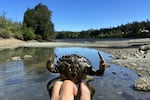
This adult male European green crab was trapped at Deer Harbor on Washington's Orcas Island in June 2026.
Courtesy of Washington Department of Fish and Wildlife
Washington Sea Grant crab researcher Emily Grason said efforts to find markets for either green crab meat or green crab shells have had little success in Washington. Green crabs are about 60% shell, and methods to cost-effectively separate shell from meat have been elusive. For now, the trapped green crabs mostly become compost.
Scientists say the total population of the unwanted invertebrates in Washington is unknown. Trapping only hints at their numbers.
“It’s not hard to imagine the numbers could become worse,” Grason said. “We are still in the middle of an ongoing invasion that hasn’t necessarily reached any sort of equilibrium.”
The vast majority of crabs, 1.9 million, were caught in Willapa Bay, with tens of thousands also found in Grays Harbor (192,000) and North Puget Sound (18,000).
Juvenile green crabs thrive when seawater warms, and Willapa Bay had higher than usual temperatures last winter, said Turner with the state Department of Fish and Wildlife.
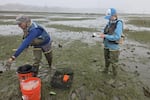
University of Washington researcher Jennifer Ruesink, left, and student Bridget Reed trap European green crabs on Willapa Bay near Nahcotta, Wash., on Aug. 12, 2026.
Courtesy of Colin Frank / Washington Sea Grant
An exceptionally strong El Niño weather pattern has warmed Pacific Ocean surface waters in recent months. Researchers say Washington could have a bumper crop of European green crabs this winter, when El Niño’s effects are expected to peak.
“We expect that we will see an increase in green crab numbers just because, historically, that’s what we’ve seen during El Niño years,” Turner said.
State and federal agencies spent at least $8 million fighting the European green crab in Washington in the 2025-2026 fiscal year.
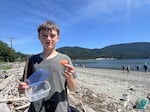
Orcas Island Middle School seventh grader Paxton Erwin holds a European green crab molt he found on the island's Crescent Beach in May 2026.
Courtesy of Amy Sprenger / Washington Sea Grant
Between professionals and volunteers, some 500 people in Washington set and check traps targeting the green crabs, Grason estimated.
Orcas Island Middle School seventh-grader Paxton Erwin found the island’s first-known green crab during a marine science class field trip in May.
“It was a bummer to find it because they’re bad for our environment but also kind of good that we know they’re here,” Erwin said.
“This is a species that’s repeatedly changed the ecology and the economy of marine shorelines around the world,” Grason said. “This is not a species that we’re going to 100% eradicate in our state in the near future. But slowing down the invasion and figuring out how to best protect resources is worth, I think, a lot.”
Turner said he has instructed managers to keep an eye out for young green crabs too small for trapping to see if warm waters spreading north with El Niño deliver a new crop of crabs to Washington waters.
John Ryan is a reporter with KUOW. This story comes to you from the Northwest News Network, a collaboration between public media organizations in Oregon and Washington.
It is part of OPB’s broader effort to ensure that everyone in our region has access to quality journalism that informs, entertains and enriches their lives. To learn more, visit our journalism partnerships page.
