Federal land officials are rounding up about 140 wild horses in southeastern Oregon after a wildfire burned across much of the area.
The U.S. Bureau of Land Management began capturing horses from the Riddle Mountain herd southeast of Burns in Harney County on Tuesday.
Land officials initially planned to gather the entire herd, an estimated 418 horses, but a temporary court order limited the roundup.
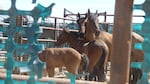
FILE - The U.S. Bureau of Land Management captures wild horses from herds about 50 miles southeast of Burns, Ore., including the Riddle Mountain and Kiger herds, shown here in a 2015 photo.
Photo courtesy of the U.S. Bureau of Land Management
The case is part of a long-running conflict between land managers, ranchers and wild horse advocates. The BLM is tasked with balancing multiple uses of hundreds of millions of acres of public lands, including foraging for wild horses and livestock.
But wild horse advocates often accuse the agency of pushing wild horses off the landscape to benefit ranchers, then mistreating the horses it gathers.
The bureau lamented the order in a press release, saying it would leave hundreds of horses “in peril” this winter, arguing they wouldn’t have enough forage to survive.
“Our priority is to protect as many of these horses as we’re allowed,” said Don Rotell, Burns district manager, in a press release. “We need to act before late fall rain limits access.”
In her order, U.S. District Judge Karin Immergut found the bureau failed to adequately study how the roundup would affect genetic diversity among wild horses in the area. Immergut said the bureau relied on “ocular estimation” to determine a wildfire had severely reduced forage, which she described as “little more than a guess.”
Wild horse advocates celebrated Immergut’s order to limit the scale of the roundup.
“It’s great to see the judge cut through the excuses and bureaucratic smokescreens the BLM throws up to justify its arbitrary suppression of wild horse populations,” said Theresa Barbour, president and executive director of the Oregon Wild Horse Organization.
Wild horse advocates initially sued the bureau in 2024 over a broader plan to remove horses from the Kiger and Riddle Mountain herds.
Two years later, the BLM announced an emergency roundup following the 2026 Bald Mountain Fire. Wild horse advocates requested Immergut to stop or limit the roundup through a preliminary injunction.
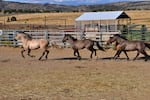
FILE - Wild horses captured by the U.S. Bureau of Land Management in Harney County in 2015.
Photo courtesy of the U.S. Bureau of Land Management
Ecologists and wild horse advocates sometimes butt heads over whether wild horses belong on Western landscapes and how many the land can sustain. Similar to livestock and other grazing animals, wild horses can stress rangeland habitats if there are too many of them in one area.
Although horses originated in North America, they disappeared from the landscape at the end of the last ice age about 10,000 years ago.
Today’s wild horses are descended from breeds introduced by European settlers. The bureau is legally mandated to protect wild horses as “living symbols of the historic and pioneer spirit of the West.”
“A lot of Americans value seeing wild horses out on the landscape,” said Erik Molvar, executive director of the environmental nonprofit Western Watersheds Project, which sued BLM along with wild horse groups.
While wild horses may reduce native grasslands, Molvar says they’re a minor problem for watersheds and rangeland health.
“Wild horses are only a distraction,” he said. “It’s really the cattle and sheep that are causing the lion’s share of the grazing impacts.”
The bureau regularly gathers wild horses and burros to prevent overpopulation. It sells many of the wild horses it gathers at auctions.
Earlier this year, a New York Times investigation found the bureau has been selling horses to buyers who then resell them to slaughterhouses. According to the report, wild horse sales drastically increased during President Donald Trump’s first year in office, though some ecologists believe there weren’t enough wild horse sales prior to his administration.