
Talilo performs at the Patricia Reser Center for the Arts on May 9, 2026 in Beaverton, Ore. The nonprofit 550-seat arts center opened in 2022.
Saskia Hatvany / OPB
It started like any other show at a performing arts center. Hundreds waited quietly in rows of lush, blue theater seats. A black screen in front of the stage played a video introducing the artist about to appear. Then the screen lifted, multi-color lights flashed as performers flooded the stage and Talilo’s voice rang out.
“Make some noise! It’s a hip-hop show!”
From the moment Talilo’s first song pounded through the speakers on that May evening, cheers filled the space. People stood up, their hands in the air, dancing in place. By the end of the first song, dozens of audience members packed in front of the stage.
Talilo’s performance was part of the 503 RISING Hip Hop Showcase presented by the Patricia Reser Center for the Arts in Beaverton. The event was a culmination of the center’s 2025-26 season called “Rhythm + Revolution: The Legacy of Hip Hop Culture,” the center’s first attempt at a themed season focused only on one genre. It was an intentional departure from the center’s “Reser Presents” programming, which features a variety of music, dance, film and visual art.

A crowd attends Magik9's performance at the Rhythm + Revolution event.
Saskia Hatvany / OPB
The nonprofit 550-seat arts center opened in 2022 with a mission to make the fast-growing city west of Portland a modern arts destination, while reflecting the inherent diversity of its residents.
The Reser took a chance with last year’s special season, investing in diverse genres and storytellers to challenge the “old-school concept of a performing arts center, which tends to be very Eurocentric and white,” Reser Director Chris Ayzoukian said. And recent data suggests that investment is paying off.
Now, as The Reser launches its fifth anniversary season, the young center is forging a path for what the future of Portland’s iconic, older arts centers could look like.
‘We don’t want to be a traditional performing arts center’
“Rhythm + Revolution” was created to highlight hip-hop as a cultural and artistic phenomenon, and recent numbers show it was a financial success, attracting hundreds of new patrons to well-attended shows all year. That’s notable considering how difficult attendance has been for arts venues in the Portland metro and nation.
For an older arts center with an established audience, such an unusually themed season could be risky. But Ayzoukian said The Reser is young, and still forming its identity, so it could more comfortably challenge what a performing arts center should show.
“We don’t have a lot of baggage and expectations, and we want to keep it that way,” he said. “We don’t want to be a traditional performing arts center. We want to be a space which welcomes hip-hop music and hip-hop culture.”

The exterior of the Patricia Reser Center for the Arts.
Saskia Hatvany / OPB
According to city data from 2023, Beaverton has greater racial and ethnic diversity than both Washington County and the state. The city’s residents are 62% white, along with 38% Latine/Hispanic, Asian, Black, Indigenous, and other or multiple races.
Part of what helps make The Reser a welcoming space comes from being accessible. It’s right by a TriMet MAX line in Beaverton’s downtown and tickets average less than $40. Plus, The Reser’s programming has focused on diversity of all kinds since before “Rhythm & Revolution,” featuring everything from mariachi bands and street dance to symphonies, ballet, jazz bands and nontraditional storytellers.
And that focus has helped The Reser’s bottom line.
‘They got the access, they got the money; we got the talent’: Why The Reser matters to artists with political messages
MC Mic Crenshaw said the effort to prioritize diversity in The Reser’s programming this past season rang especially true in hindsight.
“When we started doing this, we didn’t know that ICE would be attacking people of color and prioritizing Spanish-speaking, you know, immigrant communities first,” said Crenshaw, a national hip-hop legend, educator and activist based in Oregon. “But the fact that we were hosting ‘Rhythm & Revolution’ and making a conscious effort to platform art with a message and that speaks to social issues, it felt synchronous.”

Ric Decatoria, left, gets ready backstage.
Saskia Hatvany / OPB
The center’s 2025-26 season was curated in partnership with a community advisory committee, including local artists, educators and performers like Crenshaw, DJ O.G.ONE, Alexandra Washington and Andre Middleton. It was unmistakably designed to spotlight artists of color, and did not shy away from highlighting political themes in their storytelling.
Early in the season, Crenshaw presented an educational workshop on the ties between rap lyricism, social justice and revolution, and performed at the 503 RISING Showcase.
Days after the concert, Crenshaw said he was still smiling from the success of the season.
“I’ve been doing hip-hop for 34, 35 years as an independent artist, but both of the big shows we did at The Reser this year, La Russell and Neighborhood Kids, were two of the best shows of my career,” he said, becoming emotional. The Neighborhood Kids headlined the 503 RISING Showcase.
Portland Trail Blazers DJ and music producer O.G.ONE said he was blown away the first time he saw The Reser. After realizing there was young hip-hop talent in the Portland metro suburbs a couple of years ago, he held the first Star Awards as part of “PDX Hip-Hop Week” at The Reser in 2025, and again in 2026.
“[The Reser] didn’t act like they knew everything about the culture,” O.G.ONE said, recalling how he and his fellow committee members shared “cultural norms” while Reser operators worked through venue logistics. “So being able to find those fine balances in the discussion to me represents what hip-hop is all about and bridging communities is all about.”
Out in the foyer on the night of the May showcase, audience members admired an art gallery by the front doors, and floated between tables, selling items ranging from artist merch to homemade granola from a local small business.
But there were also more politically provocative items, such as stickers labelled with “F*CK ICE” and the Spanish equivalent, “CHINGA LA MIGRA.”
“— MC Mic Crenshaw, "Rhythm & Revolution" committee member, hip-hop legendWhen we started doing this, we didn’t know that ICE would be attacking people of color and prioritizing Spanish-speaking, you know, immigrant communities first. But the fact that we were hosting ‘Rhythm & Revolution’ and making a conscious effort to platform art with a message and that speaks to social issues, it felt synchronous.”
Hip-hop artist Carl Angelo, who performed “PTI” with Talilo at the showcase along with four other Filipino artists, said he’s performed at upscale performing arts centers in Los Angeles and Seattle, and thinks they’re crucial in allowing artists to honestly express themselves.
“I was raised in a neighborhood where I wouldn’t expect a prestigious-looking place like this to take in the kind of arts that we do like, you know, ‘Fuck ICE’... just going against the man,” Angelo said. Like Crenshaw and O.G.ONE, Angelo noted those centers actually listened to the hip-hop community when they wanted to incorporate hip-hop into their programming.
“Because it’s just as valid as, let’s say, like a ballet or like a classic symphony or some kind of, lack of a better word, ‘bougie’ arts — I mean that with all respect,” Angelo said. “So for them to reach out and connect with communities like ours, I think that’s very important because it kind of — it does something for us, you know? Like we feel represented. They got the access, they got the money; we got the talent.”

Miesha Wilson-Harris Love, who goes by Magik9 on stage, celebrates after her performance.
Saskia Hatvany / OPB
The Reser as a case study: How can performing arts centers stay relevant and in demand?
The Reser’s relative strength financially comes as Portland’s Keller Auditorium faces an uncertain future, other venues face budget issues, and Portland State University pursues building a city-managed performing arts center downtown.
“We value highly the team that we have here. But like many organizations, our highest cost is labor costs,” Ayzoukian said. “And so those are rising because [of] inflation. It has historically, in recent history, been very high. So we are facing some headwinds, but we are still very financially strong.”
In 2025, The Reser’s annual expenses cost $4.1 million but its revenue totaled $5.7 million. Also, its net assets added up to $9.6 million. Of the center’s total revenue, nearly 70% came in the form of contributions.
Older arts organizations have over time been forced to navigate hurdles like the COVID-19 pandemic and make changes that The Reser just hasn’t had to face yet, Ayzoukian said.
Rachael Lembo, executive director of Portland’5 Centers for the Arts, which include Keller Auditorium and the Arlene Schnitzer Concert Hall, said decreased attendance is one of the most significant financial challenges facing performing arts centers today. Portland’5 centers rely heavily on earned revenue, accounting for more than 80% of its operating budget, which was about $25 million in 2025.
Overall, attendance at Portland’5 remains below pre-pandemic levels, she said. Over the last three years, they’ve averaged about 800,000 attendees annually down from more than 900,000 before the pandemic.
“However, the picture is nuanced. Attendance for commercial and Broadway presentations has rebounded and now exceeds pre-pandemic levels, but many of the local arts organizations have not yet fully recovered their audience base,” Lembo explained.
Since opening, The Reser Center has welcomed over 220,000 visits. Each season lasts from fall through summer averaging multiple events per week. In the 2025-26 season, Ayzoukian said attendance fluctuated, but has been good overall, with several sold-out shows.

A crowd watches Talilo perform.
Saskia Hatvany / OPB
Dozens of Portland nonprofit arts organizations have seen arts funding decline recently, reaching a “historic low point” this year as inflation has made the city-wide arts tax more expensive to administer over the last 10 years. Many of these organizations never fully bounced back from the impact the COVID-19 pandemic had on attendance rates, with long-standing groups like the Portland Chamber Orchestra dissolving earlier this year due to fundraising woes and lower attendance.
But The Reser’s director said he’s an optimist. Even if people’s attention spans are getting shorter, Ayzoukian argued that people are still searching for deeper experiences.
“It’s just a matter of connecting them and bringing them in,” he said. “So we think about that a lot here: How are we relevant to the maximum number of people and identities in our community?”
He echoed something the center’s namesake, Pat Reser, said: “People come here as strangers and they leave as friends.” Ayzoukian feels that’s true every night there’s a show.
“We actually have more in common than we have different, as much as the national kind of landscape would have us believe; we’re not that different,” Ayzoukian said. “That’s a really inspiring part for me in being in a place like this.”
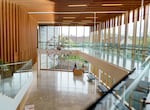
The Patricia Reser Center for the Arts in Beaverton, April 18, 2022.
Kristyna Wentz-Graff / OPB
Seeking a community legacy for artists beyond the bottom line
Leroy E. Bynum, Jr., dean of Portland State University’s College of the Arts, holds a doctorate in musical arts and has decades of experience as both a scholar and opera singer. Growing up, he was enthralled by opera singers on TV, but he never thought the performing arts were a viable career path for Black kids like him until he saw Leontyne Price, a Black woman, perform on The Merv Griffin Show in 1955.

FILE - An undated photo of Leroy E. Bynum, Jr., dean of Portland State University's College of the Arts, at Lincoln Hall, on the PSU campus.
Courtesy of Portland State University
Music has been a central part of Bynum’s life ever since. He is acutely aware of how long arts centers have been stuck in turbulent cycles of survival — not just today, but decades ago, when venues were reserved for wealthy, white patrons. As older generations died, performing arts venues lost relevance and were compelled to modify their programming to attract Baby Boomer and Gen X audiences, Bynum said.
“You know, unfortunately, we’ve all come to learn, the impetus or the motivation to do the right thing usually takes a backseat to financial and necessity imperatives,” Bynum explained. “And so, all of a sudden, these houses began to look at other ways of making revenue. And that is when all of a sudden — ‘Oh, we need to be more diverse. We need to be more open.’”
The next big problem, that still challenges a lot of arts centers today, was how to keep attendance high. Back then, and perhaps now, the solution was to innovate, he said.
“Why don’t we just break down those barriers?’” Bynum said. “Because a wonderful rap opera or rap or hip-hop production that is done well that has production value has just as much validity as grand opera, or a mariachi band, or a folklorico dance troupe, or a dance other than ballet.”
As other cities face their futures, Bynum said they need to continue appreciating the arts for their economic growth, which also means investing in details like acoustics, sightlines and backstage areas. He pointed to The Reser as a primary example of that being done with intention.


All images: Saskia Hatvany / OPB.
“That has made Beaverton a destination place for artists. Artists want to come there and perform,” he said. “And people want to be a part of that experience.”
And it’s not hard to see why. In the dressing room on the night of the May showcase, backup dancer Ric Decatoria from the Filipino American Association donned a glittery outfit with multi-colored fabrics and a feathered headdress. Once he added a smiling mask, his final look drew cheers backstage.
Representing the city of Bacolod in the Philippine island of Negros, Decatoria said the outfit is one that Filipinos would wear to the city’s MassKara Festival. He said sharing his history and culture through his performance with Talilo that night was an honor.
Talilo was born in the Philippines but grew up in Portland. He creates what he calls “flip-hop”, or Filipino hip-hop, and credits Beaverton for helping diversify the music scene across the Portland area.
“I think there’s an ecosystem here. It just needs more light. You know? It needs more light nationally. And it’s artists that have a bigger platform — it’s almost their responsibility to play a role in helping that. Shout out to O.G.ONE, artists like Swiggle, who create,” Talilo said, waiting in the hallway before his performance was set to begin.

Talilo Marfil, who goes by the stage name Talilo, performs.
Saskia Hatvany / OPB
His own sense of responsibility led Talilo to found Peer Tribe Foundation, a nonprofit aimed at empowering youth and helping them to earn money while learning how to work in the arts.
“At first, it was about me. I made music to express my emotions,” Talilo explained. “But now I make music because it’s a way to shed light on issues and be a part of the solution.”
Talilo likes to quote from fellow Oregon-based artist Ernesto Javier Martínez, a fellow recipient of the 2026-28 Fields Arts Fellowship, when thinking about the place of performers and venues in the art world: “I don’t say I’m an artist. I say I am the art.”
“When you see artist centers, they were developed and built for people that appreciate that and also — they are art too,” Talilo explained. “We are the reflection of the times we’re living in. If you look back at our life, right? Our life is going to pass, 100 years, 200 years ago. People looking back at this time will see the art that was here, and they’ll be like, ‘Oh, this was what was going on.’ Through the lens of the artists, through the lens of the writers, through the lens of the sculptors.”