
An undated photo of the bay at Port Orford, south coast of Oregon. The state regulates ocean uses along the full length of the coastline from the shore to 3 nautical miles offshore.
Stephani Gordon / Stephani Gordon, OPB
Oregon is taking a look at the three-nautical-mile-wide ribbon of ocean that runs along the length of the coast.
This offshore ribbon is managed under Oregon’s Territorial Sea Plan and covers issues as varied as undersea cables, fishing and renewable energies. But the plan is more than 30 years old and doesn’t consider emerging issues like climate change and ocean acidification.
“It’s high time to take a look at the foundational chapters of the Territorial Sea Plan and update them,” said Joe Liebezeit, the chair of the Ocean Policy Advisory Council.
So the Oregon Department of State Lands has asked the Ocean Policy Advisory Council to review the sea plan in an effort to strengthen protections for Oregon’s marine ecosystem and ensure Oregonians get fair compensation for the use of the seafloor.
From the ‘Beach Bill’ to a bigger plan
Oregon’s coastal management system is relatively recent. The first protections stretch back to 1967 and the “Beach Bill,” when lawmakers decided the public owns the shore between low and high tide.
It was only in 1994 that concern about offshore drilling and foreign fishing prompted the state to develop the Territorial Sea Plan.
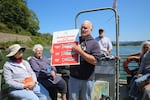
Duncan Berry at the Cascade Head UNESCO Biosphere site, where he is co-director, seen on July 18, 2026. Berry is also vice chair of the Ocean Policy Advisory Council.
Kristian / OPB
Duncan Berry, the vice chair of the Ocean Policy Advisory Council, said Oregon has proved relatively good at protecting land over the years, but the ocean seems like an afterthought.
“I call it ‘terrestrially chauvinistic,’ he said.
“We really think about the places we walk and visit and live, and very few of us go to the ocean for other than just occasional recreational purposes.”
The plan has five basic parts:
- rocky habitat management, because that’s where a lot of the fish live;
- seafloor uses, like pipelines and communication cables;
- renewable energies, for example wind and wave farms;
- resource decisions, like fishing and tribal consultation;
- and overall ocean management, like legal authority.
But the sea plan was put together in 1994, and Lieberzeit said a lot of things have changed since then.
“We live in a time now of climate change, which was not taken into account when the Territorial Sea Plan was originally written,” Liebezeit said.
“We all know things about ocean acidification, hypoxia, all these kinds of impacts from a warming ocean that we’re really concerned about.”
The advisory council will start by reviewing the first two parts of the Territorial Sea Plan — ocean management and resource use decisions. The council is composed of people who work with the ocean on a regular basis, like commercial fishing groups, tribal members and offshore wind interests.
“We’re going to take the input from 100-some-odd community members, our own OPAC members, and meeting with each of the agencies that historically have worked with OPAC,” Berry said.
Liebezeit and Berry are trying to set things up so discussions don’t end up simply as battles between environmentalists and businesses. Instead, Liebezeit said, they see the review as a visioning moment.
“I think it’s more like: ‘Hey, let’s get everybody together, all the different community partners and figure out what we envision is important for the ocean for the next five to 10 years,’” said Liebezeit.
Delving into the details
But while visioning is an important part of any plan, inevitably people have to delve into details and things get difficult.
For example, offshore wind. In 2024, the US Bureau of Ocean Energy Management tried to lease two large wind farms off Coos Bay and Brookings. Fishing and other interests came out against the idea.
“We were all opposed to the speed at which things were moving,” said Heather Mann, the executive director of the Midwater Trawler’s Cooperative in Newport.
In the end, the wind energy auction was canceled.
“It wasn’t that we were necessarily opposed to offshore wind,” said Mann. “It’s just that there were so many questions.”
Questions like: How might a wind farm affect fishing? Or whale migration? Mann wonders whether it is even possible to anchor a 1,000-foot-tall floating wind turbine in such deep waters.
“You know we can’t create a weather buoy that doesn’t break off. So having those machines out there, there was really no understanding of what could potentially happen,” Mann said.

Viewpoint of Sunset Beach, Ore., on Dec. 7, 2023.
Monica Samayoa / OPB
Ross Tyler was on the other side of the offshore wind debate in 2024. He owns Offshore Renewable Energy International, a Virginia-based company that specializes in developing offshore wind. He thinks Southern Oregon has great wind potential, and that Coos Bay would be great for fabricating big offshore wind components.
He hopes that, as Oregon reviews the sea plan, leaders reach out.
“If they’re going to change the regulations, they should not do it in a vacuum,” said Tyler. “They really need to have consultation with the offshore wind industry.”
So, a review of the Territorial Sea Plan is likely to be difficult. In addition to wind power, eventually it’ll have to address all kinds of difficult subjects, like climate change, wave power, a possible liquified natural gas terminal, ocean acidification and ocean hypoxia, which is low oxygen conditions.
But despite all those potential battles, Mann and many others are supportive of the review of the Territorial Sea Plan.
“I think as long as it’s transparent. It’s done the Oregon Way and people are able to participate in that process, then it’s good,” Mann said.
The Ocean Policy Advisory Commission is scheduled to meet up to nine times between now and next August to come up with recommendations.

An undated provided photo of Cascade Head on the Oregon Coast.
Courtesy of Duncan Berry