
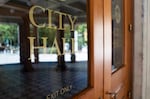
FILE - The entrance to Portland City Hall on Oct. 5, 2026, Portland, Ore.
Saskia Hatvany / OPB
Portland voters have opted for continuity over change as the city’s fledgling government enters its next chapter.
As of midnight Election Night, all six incumbent city councilors up for reelection appeared poised to keep their seats.
“I’m pleased with how things went, it’s affirming to me,” said District 4 Councilor Olivia Clark. “I’m hoping that with this security there may be a greater willingness for councilors to work together.”
More ballot results will drop at 6 p.m. on Wednesday.
The early results, which maintain the current political balance in council chambers, surprised few who closely watch local politics. But they felt instructive to candidates and political advisors navigating the second election under a new voting system and governance structure.
Under the city’s form of ranked-choice voting, candidates only need 25% of their district’s vote plus one vote to win. Prior to the voter-approved overhaul in 2024, candidates needed more than 50% of votes citywide to win. Under that structure, incumbents frequently won reelection. But for incumbents with name recognition and a committed band of supporters, this new system appears to make it even harder to lose.

(Left to right) Olivia Clark, Mitch Green and Eric Zimmerman, incumbent candidates in Portland’s District 4 council race in November 2026.
Left: Anna Lueck for OPB; Center: Eli Imadali/OPB; Right: Saskia Hatvany/OPB / OPB
“Our new system has created something of a superincumbency,” said Laurie Wimmer, the executive secretary and treasurer of the Northwest Oregon Labor Council. “Hypothetically, someone could be loathed by 75% of their constituents and still win.”
The power of incumbency appeared to trounce the power of the dollar this election.
In the final month leading up to the election, an independent expenditure campaign called Unity PAC spent nearly $400,000 to support District 3 candidate Kellie Torres — the most outside money spent on a council campaign this cycle. Torres was trailing the District 3 incumbents in fourth place as of Wednesday morning.
Unity PAC is largely funded by Portland’s moderate business groups and public safety labor unions. Another independent expenditure committee funded by the chamber of commerce dubbed “Ditch Mitch” spent roughly $140,000 on billboards, yard signs and buttons to oppose incumbent District 4 Councilor Mitch Green.
To Green, his ability to win despite this well-funded attack sends a clear message.
“This was a repudiation of the old style of Portland campaigning, where you get a couple of rich guys in a trenchcoat and throw money at ads,” Green told OPB Wednesday morning. “You have to run campaigns, you have to knock doors.”

(Left to right) Tiffany Koyama Lane, Angelita Morillo and Steve Novick, incumbent candidates in Portland’s District 3 council race in November 2026.
Left image: Jenny Kane for OPB; Center and right images: Eli Imadali/OPB / OPB
District 3 Councilor Steve Novick agreed that the outcome proves “money is overrated” in council races.
Portland City Council’s political balance — with six more progressive councilors and six moderates — has often left the 12-person body at loggerheads. Some had seen the election as a way to shake up that tidy divide, giving one of the planks an upper hand. But that didn’t happen.
Novick is hopeful that much of that schism was stoked by the fervor of campaign season.
“How much of that was just election year posturing?” Novick asked. “Maybe the fact that we know we’re stuck with each other now will make this easier.”
Portland council terms last four years. However, District 3 and 4 councilors entered the newly expanded city council in 2024 with just a two-year term, while District 1 and 2 councilors had four years, a plan meant to allow for alternating district elections every two years. But that left District 3 and 4 councilors with little time to govern before thinking about their reelection campaign for four-year terms.
“I do think tensions are amped up when you have a two-year term,” said District 3 Councilor Angelita Morillo. “You basically have one year to prove yourself.”
Morillo, who has frequently butted heads with her colleague Novick, shared his outlook for the future.
“With the election behind us, it’s time to take a moment to pause, sit down, have coffee, get some therapy, figure out what it takes to work together,” she said.
Morillo is one of the three members of Portland’s Democratic Socialists of America chapter on council who won reelection. Portland DSA spokesperson Nick Caleb views the results as a mandate for the quickly-growing political group, which only dipped its toe into council elections for the first time in 2024.
“We learned a lot as a chapter about organizing inside the building since then,” said Caleb. “And we feel confident we can move the council to the left. We’re going to shake off our hangovers, roll up sleeves and get back to work.”
The other half of the Portland City Council and the mayor’s office are up for election in 2028.
