

A ripened Himalayan blackberry on the bush in Portland this summer.
Kyle LaMontagne / OPB
Picking berries is a quintessential summer tradition for many Pacific Northwesterners. The region has many farms, but fruit can easily be found in everyday corners.
For about the past 140 years, the Himalayan Blackberry has taken over Oregon’s alleyways, waterfronts, forests and backyards. This thorny vine is actually a cousin of the rose, the plant behind Portland’s most famous nickname, but instead of beautiful flowers, the vines produce juicy fruit.
While generations of Oregonians love to enjoy these blackberries, they might be surprised by the fruit’s prickly history.
The background on blackberries
From a botanical perspective, blackberries aren’t even berries.
They are aggregate fruits, which are made up of dozens of individual single-seeded stone fruits called drupelets. Picture this: A blackberry is kind of like a large group of plums all stuck together and shrunk down. This is the case for many of the so-called berries that share a similar taxonomy to the blackberry, like raspberries, boysenberries and the Oregon State University-created marionberries.

FILE - A blackberry pie entry at the Sutherlin Blackberry Festival in Sutherlin, Ore., on Aug. 15, 2026.
Kyle LaMontagne / OPB
While there are hundreds of varieties of blackberries, one has climbed above others: the Himalayan Blackberry. The invasive berry was popularized in Oregon after famed American botanist and horticulturist Luther Burbank introduced it to the U.S. in the late 1800s. Despite its name, Burbank actually got his seeds from India. Its scientific name is Rubus armeniacus, and it originates in Armenia.
The berry made its way across the West and soon started to take over. It loved the Pacific Northwest’s climate and crowded out other varieties. It’s now become so pervasive that many have given up trying to fight the stubborn and resilient bushes back and have accepted the invasion of the thorny stalks.
Fruits of labor
“A couple of years ago I came up with the idea of the ‘If You Can’t Beat ‘Em, Eat ‘Em!’ blackberry campaign,” said Kathryn Howard, community and partnership manager for the Portland Fruit Tree Project.
In the campaign, Howard leads gleaning events. Gleaning is when leftover, unharvested or dropped fruit from edible plants is collected. Kind of like foraging, but instead of searching through the woods for mushrooms, apples or plums, blackberries are picked off of urban bushes and trees where property owners aren’t using the fruit.
“You could kill a man with this,” Howard joked while gleaning for blackberries. She held a heavily thorned stalk and laughed about the pricks and scratches while picking blackberries — as a worthwhile trade-off.

FILE - Ripening blackberries at Blue Lake Regional Park in Portland, Ore., in 2025.
Morgan Barnaby / OPB
The Portland Fruit Tree Project offers services to many homeowners and businesses who aren’t picking their fruit, collects the fruit and donates it to its volunteers and local food banks.
But what can be done if you do want to fight back the Himalayan blackberry bushes that crowd Oregon? While some turn to chemical weed killers, the bushes are very resilient, and unless you cut back and dig up the root crown, they can come back year over year. Another combat method? Goats.
Linda Williams owns and operates WestSide Goat Girl. She rents her goats to homes and businesses across the greater Portland metro area that want a more organic way to manage weeds.
“The most interesting thing about a goat’s mouth is they don’t have any teeth on the top in the front … but they have pretty sharp teeth down here, and then of course they have grinder-type molars in the back, and I think that’s what allows them to be able to eat blackberries with thorns, said Williams. “Put the thorniest branch or leaves, even the leaves have thorns on them in their mouth, and they don’t wince, they don’t notice it at all.”
Williams says that the goats are an effective way to manage the bushes as an alternative to spraying chemicals.
An annual berry time – plus some mud
While many people take on tackling berry bushes, an annual event is all about the fruit.

All images: Kyle LaMontagne / OPB.
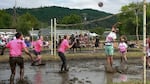
The Sutherlin Blackberry Festival may mostly focus on car shows, mud racing and an atmosphere of food trucks and community; there is the famed blackberry cook-off. People from all over Oregon come to the festival, which can draw as many as 10,000 in a town of about 8,500.
“It’s a historic mill town. Everybody here has been through poverty, been through good times, mostly a whole lot of bad times because all the logging communities have been shut down. You can’t do anything,” said Duane Waller, chairman of the Sutherlin Blackberry Festival. “We have to find something to celebrate. And to find a little weed to call the blackberry festival. We get to come out and join together and have a good time over a weed.”
Waller, who coincidentally hates blackberries, explained that the festival was conceived over 30 years ago after the original organizers had a blackberry pie while the fruit was ripe and easily found around town.
Blackberries have choked out native plants, swallowed alleyways, and become one of Oregon’s most stubborn invasive plant species. But somewhere along the way, this weed also became something people around the state build summer experiences around. A reason to risk cuts from thorns, make a pie and bring a town out to the fairgrounds. It’s a nasty weed, but a delicious one.