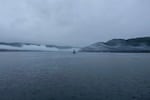
Raindrops and a University of Washington ocean-monitoring buoy dot the surface of Hood Canal near Twanoh, Washington, on Nov. 27, 2021.
Courtesy of Kathleen Lumiere / via KUOW
A government panel hit the pause button Thursday on a proposal to rename Hood Canal after tribal leaders spoke against it.
The 60-mile-long fjord is currently named for a British aristocrat who fought against the United States in the Revolutionary War.
“It’s important that our tribe, who did settle the entire Hood Canal drainage in ancestral times, has the opportunity to weigh in on such a significant change,” Skokomish Chairman and CEO Tom Strong told the Washington State Committee on Geographic Names.
Retired elementary schoolteacher Barbara Stark of Poulsbo is proposing to change the name to Salish Fjord.
“If we would look at [Mount] Rainier, no one would consider calling it a hill. If we looked at the mighty Columbia, no one would call it a stream,” Stark said. “I think it’s time that we recognize this marvelous waterway.”
”My recommendation is that it be the Salish Fjord in recognition and thanksgiving for all of the tribal communities that have lived along this waterway for hundreds and hundreds of years,” she said.
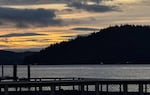
Hood Canal, near Twanoh, Washington, is shown on Sept. 22, 2024.
Courtesy of Kathleen Lumiere / via KUOW
Hood Canal is not a canal. The natural waterway was carved 13,000 years ago by Pleistocene ice sheets, is home to wild salmon and giant Pacific octopus, and is 600 feet deep in places.
Long before British Royal Navy Captain George Vancouver dubbed it “Hood’s Channel” in 1792 in honor of British Admiral and Lord Samuel Hood, local inhabitants called it “tuwaduq sidaqʷ” [too-wah-duke SEE-dock], or “the Twana people’s saltwater.”
Tuwaduq, or Twana, is the language of the Skokomish Tribe. Rivers flowing into Hood Canal, including the Duckabush, Dosewallips, Hamma Hamma, and Skokomish, all bear Twana names, or at least anglicized versions of them.
“Every drop of fresh water that drains to Hood Canal is in Tuwaduq, or Skokomish, territory,” Strong said.
Strong said he agreed that Hood Canal was not a proper name for the area.
“To us, it’s tuwaduq sidaqʷ. It’s our saltwater, tuwaduq people who settled the area, and we’re here since time immemorial,” he said.
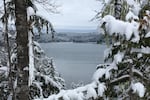
Snow covers the shores of Hood Canal near Lilliwaup, Washington, on Dec. 28, 2021.
John Ryan / KUOW
Strong said he had no idea the Salish Fjord proposal was being considered until a KUOW reporter informed him of it five minutes before the committee meeting began.
“I implore the board to table this request until the Skokomish Indian Tribe, the primary tribe of Hood Canal, is properly consulted in the process,” Strong said.
“When I started this process three years ago, I reached out to several tribes via email and did not hear back from any of them,” Stark said.
Stark said she did not have any connections with tribal communities in order to get suggestions from them.
After some debate, the committee voted to table the Salish Fjord proposal for initial consideration until its next meeting in May.
“There’s no rush on getting these names right, or on hurrying a name,” said Cowlitz elder Mike Iyall, the committee’s tribal representative.
“This is not a small change. This is not a creek. This is a bigger issue. So sometimes government needs to step back and take its time and not just rush ahead,” said Washington State Historic Preservation Officer and committee member Allyson Brooks.
“Salish” is an umbrella term encompassing dozens of distinct Indigenous nations and tribes in British Columbia and the U.S. Northwest.
According to the Salish School of Spokane, there are 22 Coast Salish languages, including Twana, and seven Interior Salish languages.
The Committee on Geographic Names reviews proposals submitted by the public to name or rename the state’s geographical features and makes recommendations to the Washington State Board on Geographic Names, which ultimately establishes official place names.
In 2009, the Board on Geographic Names approved the name “Salish Sea” for the inland seas of Washington and British Columbia, encompassing but not replacing Puget Sound, the Strait of Juan de Fuca, the Strait of Georgia, and Desolation Sound.
The Committee on Geographic Names on Thursday approved a proposal from the Port Gamble S’Klallam Tribe to rename an island, now known informally as Rat Island, to Duck Net Island in recognition of the tribe’s long tradition of hunting ducks with tall nets there.
The small island near Port Townsend is in the Marrowstone Wildlife Area, habitat for shorebirds, harbor seal pups, and other wildlife.
John Ryan is a reporter with KUOW. This story comes to you from the Northwest News Network, a collaboration between public media organizations in Oregon and Washington.
It is part of OPB’s broader effort to ensure that everyone in our region has access to quality journalism that informs, entertains and enriches their lives. To learn more, visit our journalism partnerships page.
