
For the first time, bird flu has been detected on a commercial dairy farm in Oregon.
On Tuesday, the Oregon Department of Agriculture confirmed a positive test result for the virus, known as highly pathogenic avian influenza, at a Morrow County dairy. State agriculture officials have not identified any other affected dairies as of Thursday.
Oregon agriculture officials say they’ve put the Morrow County farm under quarantine and will continue to investigate how the cows got sick.
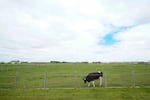
FILE - A cow stands in a field at the U.S. Department of Agriculture's National Animal Disease Center research facility in Ames, Iowa, on Tuesday, Aug. 6, 2024.
Charlie Neibergall / AP
Earlier this month, a farmworker in Washington’s Yakima County died after contracting the virus, though human deaths linked to bird flu are very rare. Health officials in that state say that the dairy worker had underlying health conditions. Two Yakima farmworkers also contracted the virus but did not experience severe illness, nor were they hospitalized.
Officials maintain the nation’s milk supply and other dairy products are safe to consume since pasteurization effectively inactivates the virus. Milk from sick animals is also diverted or destroyed so that it does not enter the food supply.
The current public health risk to the general population remains low, according to the Centers for Disease Control and Prevention, although people working in close contact with dairy cattle or poultry are at a higher risk of getting sick.
While the Oregon detection is significant, it’s not surprising, said Dr. Ryan Scholz, the state veterinarian for the Oregon Department of Agriculture. The virus is spreading among dairy cattle across the country, he said.
“Oregon’s milk surveillance program worked exactly as intended, identifying this infection quickly and allowing us to respond rapidly with our state and federal partners,” Scholz said in a statement.
Bird flu was first detected in dairy cattle in March 2024 and has since been identified in multiple states, including Washington, Idaho and California.
Oregon officials first discovered the virus in Morrow County through the state Department of Agriculture’s routine statewide milk surveillance program, which began weekly testing in late 2024.
Oregon health officials did not immediately disclose how many people were exposed to the sick cows in Morrow County. But they are monitoring farmworkers exposed to the infected animals and will keep checking them for symptoms, said Dr. Melissa Sutton, the medical director of respiratory viral pathogens at the Oregon Health Authority.
“With the use of appropriate personal protective equipment, the risk to farm workers remains low,” Sutton said in a statement. “Our public health approach is focused on ensuring rapid testing and treatment for any individuals who develop symptoms to prevent severe disease.”
In Washington, the virus has spread rapidly with at least 41 dairy farms testing positive for bird flu over the last 30 days.
This is the same virus that has affected millions of poultry birds across the U.S. since 2022, including more than one million commercial and backyard chickens in Oregon, according to the U.S. Department of Agriculture.
Of all known bird flu infections in Oregon, most have been on commercial poultry farms and backyard flocks.
There is evidence that suggests the virus affecting dairy cattle is mainly spreading from cow to cow, unlike in commercial or backyard poultry farms. Poultry usually catch the virus from wild migratory waterfowl.
Unlike what the name suggests, avian flu can jump to other animals, including wild mammals. In Oregon the virus has been detected in at least one pig at a noncommercial farm, in skunks, raccoons, rodents and at least five cats last year.
