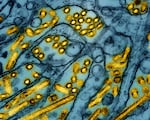
FILE - This colorized electron microscope image released by the National Institute of Allergy and Infectious Diseases on March 26, 2024, shows avian influenza A H5N1 virus particles (yellow), grown in Madin-Darby Canine Kidney (MDCK) epithelial cells (blue). (CDC/NIAID via AP, File)
National Institute of Allergy and Infectious Diseases / AP
A Yakima County farmworker died yesterday after contracting the highly pathogenic avian influenza (HPAI), according to the Yakima Health District.
The individual, who had underlying health conditions, contracted the bird flu after exposure to an infected animal at a dairy. They were hospitalized when symptoms became severe. The district did not disclose the person’s name, gender or age “out of respect for the family’s privacy.”
“My deepest sympathy to this individual’s family,” Gov. Bob Ferguson wrote on X. “I’m being briefed on this situation, and my team is in close coordination with public health and agriculture officials.”
Two other Yakima farmworkers also contracted the virus after exposure at a dairy, but have not experienced severe illness or hospitalization.
Over the last two years, the Washington Animal Disease Diagnostic Laboratory conducted more than 7,000 bird flu tests on individual farms. Until early October, all tests came back negative.
A Yakima County dairy farm was the site of the first confirmed detection of HPAI. Since then, animals at 39 more farms, in both Yakima and Benton counties, have tested positive for the disease.
“While this is a serious and heartbreaking outcome, the risk to the general public remains low,” said Dr. Dave Atteberry, health officer at Yakima Health District.
Officials say dairy workers and others who work closely with infected cattle are at greater risk of contracting bird flu. Currently, no evidence exists that suggests humans can transmit the flu to one another.
Washington State Standard is part of States Newsroom, a network of news bureaus supported by grants and a coalition of donors as a 501(c)(3) public charity.
This republished story is part of OPB’s broader effort to ensure that everyone in our region has access to quality journalism that informs, entertains and enriches their lives. To learn more, visit opb.org/partnerships.
