
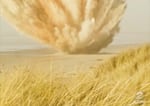
A screenshot from the KATU-TV report from Florence, Ore., Nov. 12, 1970, when the Oregon Highway Division blew up a sperm whale carcass.
Courtesy of KATU-TV / Courtesy of KATU-TV
When 23-year-old Paul Linnman received an assignment in 1970 to cover a dead whale that had washed up on the shore of Florence, Oregon, he initially thought it was beneath him.
Just two years earlier, the young reporter for Portland TV station KATU had made a name for himself covering a massive and high-profile prisoner uprising at the Oregon State Penitentiary.
But then when he heard that officials from the Oregon Highway Division planned to explode the whale with dynamite, he hopped on a plane to Florence.
What transpired became one of the most legendary public gaffes in Oregon history — officials blew up the 8-ton whale with boxes of dynamite. The blast sent gigantic chunks of whale blubber and entrails into the sky and across the beach, the pieces destroying vehicles as they landed and sending spectators running for their lives.
Linnman and his cameraman, Doug Brazil, were there to capture it all.
The subsequent newscast — full of whalish phrases like “landblubber newsmen” — quickly became Oregon lore and later one of the first viral videos in history. The video has more than 25 million views on YouTube.
“The whole doggone thing was so bizarre,” Linnman said. “It was goofy, and that’s how I wrote it.”
Much of the disturbing scene is still fresh in his mind: the initial blast, the sound of whale blubber hitting earth, and his beige jacket covered in a glistening pink hue.
“I had no expectation that was going to happen,” he said of the blast.
He also remembered the inescapable putrid smell. On the flight back to Portland, Linnman and his cameraman stank so bad, the pilot had to vomit outside the plane.
Fifty-six years later, Linnman still can’t escape the impact of the video. In the Pacific Northwest, it seems most people have at least a passing knowledge of the story.
“I think mainly it has to do with this part of the country kind of being enamored with whales and wildlife. We protect them. We don’t blow them up, and this was the exact opposite of that,” he said.
In the years since, officials have taken a vastly different approach when whales wash up on shore. Last year, for example, after a whale was beached near Yachats and euthanized, a team of scientists collected samples in an effort to figure out what happened to it before it washed ashore. Later, members of the Confederated Tribe of Siletz Indians collected artifacts from the animal, which is considered sacred.

FILE — Veterinary students from Oregon State University and professionals from the Oregon Veterinary Diagnostic Laboratory at OSU perform a necropsy on a beached whale near Yachats, Ore., on Nov. 18, 2025. Left to right: Kaitlyn Oliver, Makenna Bailey, Jose Cruzado Diaz, Caitlin Gaffney and Dr. Rachel Fost.
Saskia Hatvany / OPB
And despite Linnman’s decades-long career in television news, nothing came close to the impact of the dead whale blown to bits. Out on assignment or in his personal life, it followed him everywhere. One person in a grocery store walked up to Linnman and unceremoniously dubbed him “blubber boy.”
“It kept coming up, coming up, coming up,” Linnman said. “For a long, long time, I really didn’t like that very much.”
But he said a colleague eventually reminded him: most people aren’t remembered for anything on such a scale, but Linnman’s work would likely stand the test of time. It was better just to accept it.
These days, he welcomes the recognition. He recently attended the premiere of “Oh, Whale,” a documentary about the story. The line to get in was around the block, with many recognizing Linnman as he walked by.
“In all the years that I’d been in public life on television, nobody ever reacted to me like that before.
“And it was because of the whale.”
