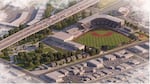
A rendering by KNO Construction of a potential site for a Minor League Baseball Stadium in Medford, Ore.
Courtesy of the city of Medford
In an abrupt turnaround, the City of Medford and the Eugene Emeralds have ended their exploration of building a stadium for the Minor League Baseball team.
“We believe the best path forward is to focus our efforts on keeping the Emeralds in Eugene,” said Eugene Emeralds owner DG Elmore. “We’re grateful for Medford’s partnership and thoughtful consideration.”
The city said it remains committed to exploring opportunities for economic development.
The decision comes after councilors heard more details of the project at a study session Thursday night. At that meeting, a city-commissioned study revealed the cost for Medford to build the stadium on the site of Hawthorne Park was more than $75 million.
Councilors shared concerns over the large cost and tight timeline to bring the Eugene Emeralds to the Rogue Valley. City staff said the $75 million cost was likely an underestimate, with the true cost closer to $90 million.
Although Harry and David Field was included in the study as a potential stadium location, the Emeralds owner said his team would only be satisfied at the site of Hawthorne Park.
“We’re willing to put $10 million into the ballpark if we can get it on a quick timeline and we can get an agreement in place that makes sense for both parties,” Elmore said.
The stadium would have been owned by the city, with the Emeralds leasing the facility for an undecided amount.
Elmore wanted the stadium to open by April of 2029. That would have likely required the council to move forward with the plan at next week’s meeting. The city was first approached by the Emeralds about the potential relocation to Medford in the spring of last year.
“What appears to me is the city of Medford taking a bulk of this, and it’s still a very expensive project,” Medford Mayor Michael Zarosinski said last night. “It’s going to really suck up a lot of resources that could be used in other places.”
Councilor Nick Card also shared concerns over the short timeline.
“I think we need the opportunity to talk to the state and see if the state is willing to participate in this kind of a project, see if we can find other community partners who want to participate,” he said.
Councilor John Quinn said the stadium would divert resources from a potential conference center.
“You don’t want to start with something that puts you in a hole of debt that will never generate property tax, and hope that it generates revenue in other ways,” Quinn said.
He also doubted the study’s breakdown of potential parking spaces for the 3,000-seat stadium.
“Those parking spaces are not real,” Quinn said. “They’re already reserved and they’re being used by other people.”
The meeting attracted around 40 members of the public, including organizers collecting signatures to protect the downtown park from being developed into a stadium.
“We’re here because we don’t want it at Hawthorne Park,” said Miriam Grayer with Citizens for Hawthorne Park. “It’s the only [park] in walking distance of those downtown residents.”
Now that the stadium proposal has been shelved, Hawthorne Park would appear to be safe, at least for now.
Justin Higginbottom is a reporter with Jefferson Public Radio. This story comes to you from the Northwest News Network, a collaboration between public media organizations in Oregon and Washington.
It is part of OPB’s broader effort to ensure that everyone in our region has access to quality journalism that informs, entertains and enriches their lives. To learn more, visit our journalism partnerships page.
