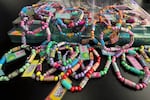
Sky Castle Toys' Sticki Roll friendship bracelets have taken the toy industry by storm.
Lisa Wood / Lisa Wood/OPB
Sky Castle Toys’ Sticki Roll bracelets are lined with beads filled with tiny collectable and shareable stickers. The bracelets initially gained a cult following on YouTube a few years ago.
They’ve since been nominated for several toy industry awards, and won Creative Toy of the Year last year at the annual U.K. Toy Industry Awards.
OPB’s Lisa Wood spoke with Josh Loerzel, one of the founders of Sky Castle Toys, about the business of creating joy.
This conversation has been edited for length and clarity.
Lisa Wood: Let’s start with Sticki Rolls. What is the toy’s origin story?
Josh Loerzel: One thing that a lot of people don’t know is in the toy industry, a big portion of the toys that are released by toy companies are actually created by inventors. There’s a huge healthy inventor community. And this inventor brought the concept to us: a bracelet that dispensed little happy messages. He thought, ‘In this world today we’re so polarized and I want a product that’s just kids sharing positive, happy messages.’ We love that angle to it. But what my business partner Lev [Nelson] and I saw was a bigger upside. This could be a platform for art. Artists could put their art on these little stickers. The biggest thing that attracted us about the brand was that there’s never been stickers that came off of a bracelet.
In the toy industry, to get a hit, what you’re always trying to do is innovate on a concept that’s already known. The stickers are actually rolls of stickers, almost like tape. It’s pre-perforated and then that’s on a friendship bracelet. You’re actually wearing all 50 stickers on your wrist. Anytime you want to give a friend at school one, or someone’s having a bad day, you can literally give them a sticker right off your bracelet.

Josh Loerzel (left) and Lev Nelson (right) pose with Sky Castle Toys' Sticki Roll brand in this undated, provided photo.
Bob Aniello / Courtesy of Sky Castle Toys
Wood: Adults are wearing friendship bracelets because of Taylor Swift.
Loerzel: It’s so funny you mentioned that because when we were developing the product and getting everything ready to launch, she was doing the Eras tour. And so that was another component.
No one owns friendship bracelets. Everyone can have it, but there’s not really anything new or innovative about the bracelet. The fact that the bracelet itself dispenses these cute stickers, marrying the two was like, ‘Oh, this could be a home run.’
Lev and I are going to a [toy convention] in Chicago, where inventors from all over the world come to this hotel. Every inventor gets a little room and they speed date you for a half hour on all your ideas. So we’ll give them a creative brief ahead of time, like, ‘hey, we’re looking for games, we’re looking for dolls or we’re looking for building sets.’ These inventors, they’ll come and they’ll show you all the new prototypes that they have and all the different stuff that they’ve been working on.
Wood: So it’s like toy “Shark Tank?”
Loerzel: Yes!
Wood: Why do you think this connected with people the way it did?
Loerzel: Kids love sharing. When we did focus group testing, actually with the kids in my neighborhood in Portland, we gave the early prototypes to them and saw how they would interact with them. All these girls that we gave bracelets to always said, ‘I want to give this one to my cousin. I want to give this sticker to my friend Susie.’ They had stickers and they just wanted to share them.
And that’s what’s been so special about the brand. You’re using it and you’re giving stickers to other people. It’s pretty awesome in that regard.
Wood: Spreading joy.
Loerzel: Yeah, it really is!
Wood: I keep thinking about Tom Hanks in “Big.” Do you conceptualize toys?
Loerzel: Lev’s strategy is that he writes down 10 bad ideas every day. Every so often we’ll get together and he’ll just run me through all the bad ideas. But there’ll be some good idea that we’re like, ‘all right, this one and this one, let’s take those and explore them some more with our team and see if there’s something there.’
Wood: What was your favorite toy growing up?
Loerzel: I was a big He-Man fan. For some reason, I think I carried He-Man’s sidekick, Teela, around. I love action figures, but I was also a huge Lego nerd.
Lego is stronger now than it was when I was a kid. And that’s because of people our age who still play with Legos. The kidult space in the toy industry is actually the fastest growing segment by far.
Wood: Are you saying kidult?
Loerzel: Kidult. That’s our toy term for a kid adult.
Wood: I wanted to make sure I heard that right.
Loerzel: Yeah, we call them kidults. That’s adults buying toys. You think about “Magic.” You think about “Pokemon.” A lot of that stuff is adults buying those trading cards.
Wood: What makes a great toy in your opinion?
Loerzel: I think the ability to access the imagination and have some open play is really important. For example, with Sticki Rolls we keep it open-ended and we let the kids come up with their own ideas about the backstory of this ape named George that’s on these stickers. It lets kids come up with their own stories about why they like the sticker or who they want to give it to.
Wood: I love that. It’s like a collaboration.
Loerzel: For sure. And you know, that does tend to be the psychology of girls.
If you notice, boys will tell you every detail of “Star Wars,” and then the girls would be like, ‘Oh no, that’s not Darth Vader. That’s Jim.’
I remember we made products and I’d try and tell girls, ‘OK, this is the good guy, bad guy and the most powerful.’ And they’re like, ‘Nope. That’s Samantha. They’re like, ‘I’m gonna make up my own story.’ So we made sure not to put too much [backstory] on the toys and let [kids] come up with their own stories.