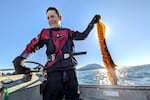
Mike Spranger, of Lummi Island SeaGreens, pulls a blade of sugar kelp.
Joshua McNichols / KUOW
“Hooked on kelp.”
That’s how Seattle-based startup owner Emily Power describes herself.
She became so captivated by seaweed that she quit her job working in sales and advertising at Microsoft to pursue making eco-friendly products out of the nutrient-rich algae. Power’s Seattle-based company, Ocean Made, makes biodegradable kelp pots for growing plants.
“I think that seaweed — I don’t want to say it’s the magic bullet that’s going to solve all of our problems — but I think it is one of the most incredible organisms that’s on this planet,” Power said.
An alternative to plastic containers, the kelp pots break down into the earth within eight to 12 weeks. The pots go directly in the ground, fertilizing seedlings as they grow.
Power is part of a nascent local industry built around sustainable, wide-ranging uses of kelp — from clothing and makeup to food and plant fertilizer.
“[Kelp is] one of the most regenerative materials that we could possibly be using, and the fact that we are not using this broadly across the United States or North America is just such a shame,” she said.
The U.S. imports over $100 million worth of seaweed every year, much of it from South Korea’s $1 billion seaweed industry. But with the Salish Sea in Washington’s backyard, people like Power are hoping to make the Pacific Northwest a bigger player in the kelp industry.
One big reason is the area’s Asian cultural influence. In December, a new shop at Pike Place Market called Bounty of the Salish Sea is partly staking its future on a kelp soup based on a Korean recipe traditionally eaten on birthdays.
It turns out farming seaweed is a lot harder than it looks on the surface. And building a seaweed industry takes more than just finding a good place to grow it.
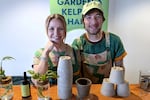
Emily Power and Les Hilliard of Ocean Made show off their products at Ocean Week in Seattle, October 2026.
Joshua McNichols / KUOW
Building a farm
Just past Bellingham, in a little bay on Lummi Island, is a kelp farm called Lummi Island SeaGreens.
On a recent day, the bay was full of fishing activity. Nearby, people used traditional reef nets to catch salmon. Another boat crew pulled in a commercial crab pot.
KUOW rode along with a crew there to gather seaweed.
Riley Starks piloted the boat to a wild kelp forest to collect spores. It was the most important day of his year.
“Everything is at stake today,” he said.
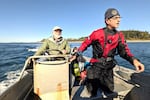
Riley Starks and Mike Spranger of Lummi Island SeaGreens on Legoe Bay, Lummi Island, in October, 2026
Joshua McNichols / KUOW
Diver Mike Spranger put on scuba gear and backflipped over the side of the boat. He disappeared into the kelp forest with a knife and diving bag.
On that sunny day, the kelp below resembled a cathedral made of green and brown stained glass.
These kelp forests are a key habitat for salmon and other wildlife, providing cover from predators and places to hide. Kelp forests are declining everywhere in part due to climate change. Regulators are concerned about anything that shares water with them. But the folks at the Department of Natural Resources are also hopeful because kelp farms could also help bring some of that habitat back.
We can see his bubbles coming up from his scuba gear. As we wait, Starks tells me what they’re looking for — sugar kelp blades covered with dark patches called sorus. That tissue contains the spores they need to start their farm.
The spores are only viable for four to six weeks. Starks has already lost some days due to weather. But today is calm and beautiful.
If they find sorus, they’ll take it back to their nursery on land to germinate.
If they don’t find any spores, then years of securing permits and thousands of dollars could all go to waste. Today, Starks figures they have a 50/50 shot.
“We don’t know, we’re new to this,” he says. “If we don’t get seed this year, we’re, we’re gonna be in trouble. ‘Cause we’ve had two years of seed failure, and you can’t build a business if you don’t have a farm.”
Starks says they’ve struggled with seed failure because these are not domesticated crops. These are wild algae. Even if things go perfectly today, all sorts of things can still go wrong.
Once they’ve brought the spores to the nursery, it’s hard to perfectly recreate oceanic conditions in plastic water tanks. You can think everything is going great — and then some microscopic snails living in your tank eat them all.
Plus, they’re growing something that’s wild — and messing with a wild ecosystem in any way requires you to follow certain environmental regulations set by the Washington State Department of Natural Resources and other government agencies.
You can’t just go get seaweed starts from South Korea and plant those in the sea. You have to plant seaweeds that grow wild in this specific area. And you have to harvest your spores from many different plants to preserve the genetic diversity of the area.
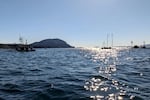
Reefnet fishing platforms on Legoe Bay, Lummi Island, in October 2026.
Joshua McNichols / KUOW
“Kelp is kind of where Puget Sound starts, right?” says Joe Smillie, spokesperson for the Washington state’s Department of Natural Resources. “That’s where baby salmons can come out and grow up and grow large and get something to eat and not be totally exposed to prey. So we like to protect that as much as possible, especially given that we’ve seen declines in [kelp forest] coverage all over the Puget Sound,” due in part to climate change.
For those reasons, regulators care deeply about anything that shares waters with wild kelp forests.
In the boat, about 15 or 20 minutes have passed. Starks says that‘s a good sign. If the kelp spores were no longer looking viable, Spranger would have surfaced after just a few minutes.
Then, he pops up — way in the distance. The boat has drifted away. Starks pilots over and Spranger tosses some seaweed over the side. It’s a big blade of sugar kelp about 10 feet long.
At the end of the morning, they’d collected a couple buckets full of kelp sorus. Next, they put it in tanks full of water, hoping it would germinate.
Then they plant it using long ropes in the sea like a clothesline, 350 feet long. The sugar kelp grows on it like long brown pants. It grows all winter long, providing habitat for fish as it grows.
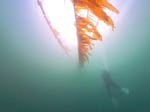
In this image from 2024, a diver for Lummi Island SeaGreens inspects a test line with young sugar kelp starts.
Phil Parisi / via KUOW
And in the spring, they’ll harvest it when it’s maybe 10 feet long, hauling those ropes into their boat and stripping off the seaweed as they go.
These farmers plan to set out 30 of these long clotheslines. They’re hoping to harvest about 30,000 pounds of seaweed this year, worth about $180,000 retail. It’s enough to fill two standard shipping containers with wet seaweed.
Once the kelp is established, it does a lot of the work itself. It gets its nutrients from the sea and needs no fertilizers or pesticides.
But nothing that touches the sensitive waterways of the Salish Sea comes without risk, even when the people promoting it are driven by concern for the environment, as many seaweed farmers are. Another concern regulators have is that ropes can get loose, and those can get tangled with propellers or wildlife.
Spranger, the diver for Lummi Island Sea Greens, has personal experience with this. He used to have a farm of his own down by Vashon Island.
But the current was too strong where his farm was and the ropes got loose and floated away. We don’t know that they tangled with anything, but the ropes were never found, and he lost his lease over it.
He’s determined to avoid it at this location.
“We check on it regularly to make sure the lines are all taut and the buoys are where they’re supposed to be and the anchors are set,” he said. “I dive off the anchors regularly to make sure that everything’s in place and that it’s working the way it’s supposed to.”
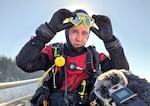
Mike Spranger of Lummi Island SeaGreens.
Joshua McNichols / KUOW
Scale of a potential new industry
Every major agricultural product we associate with Washington State has scaled up with the help of government support. Construction of dams opened up the sagebrush desert to apple orchards. Washington State University researchers help research new crop strains. Trade ambassadors promote our apples in China.
In Korea, where seaweed is a huge export, the Korean government spent heavily to build up that industry. Its investment in developing heat-resistant strains of seaweed has helped that country’s industry thrive, even as farms in places like Japan have struggled.
We saw a tiny bit of that kind of investment in Alaska. The Biden administration awarded a $49 million grant to supercharge a seaweed and oyster production cluster there, and now Alaska is the top seaweed grower on the West Coast.
The success of Alaskan seaweed farming is partly what’s inspiring farmers and manufacturers down here, where theoretically it’s a lot easier to process it and distribute it to reach other markets.
Farmers here are not asking for government investment, at least not at this time. They’re asking for state agencies to approve seaweed farm leases, so they can continue to try to build economically successful farms. Lummi Island SeaGreens’ lease, which gives the farm access to this patch of the sea, will be up for renewal after this season. A skeptical agency could sink the enterprise.
For those who want to see the industry grow, many see the possibility that Washington could not only be a producer, but also the most important processing hub for Alaskan seaweed. That would start bringing in some real economies of scale.
Smillie, the state spokesman, acknowledged seaweed farms could bring some habitat back and replace some of what’s been lost. That’s one reason Lummi Island SeaGreens is located next to traditional reef net fishers. It’s why another farm being planned in Washington will be near oyster beds.
“The hope is that we can use kelp farming as a chance to expand and provide more natural environments for the existing kelp,” he said.
Joshua McNichols is a reporter with KUOW. This story comes to you from the Northwest News Network, a collaboration between public media organizations in Oregon and Washington.
It is part of OPB’s broader effort to ensure that everyone in our region has access to quality journalism that informs, entertains and enriches their lives. To learn more, visit our journalism partnerships page.
