From large universities to small community colleges, Oregon’s higher education institutions are seeing fewer students than they did a year ago.
University numbers are continuing a downward cycle, but the decline in students enrolled at the state’s community colleges is a first in years.
That’s according to the Higher Education Coordinating Commission’s latest data, released on Wednesday.
The HECC is responsible for data collection, analysis, reporting and research on postsecondary education and workforce training in Oregon, and every fall, it releases an enrollment summary.
The latest summary shows the total number of students enrolled at Oregon community colleges and public universities declined 2.7% since last fall, though some individual schools saw increases.

FILE - Clackamas Community College’s admissions and recruitment office on the Oregon City campus, seen on Oct. 8, 2026. The office is located in the Wacheno Welcome Center.
Natalie Pate / OPB
The total number of learners at Oregon’s 24 community colleges came in at 95,583 students — down from 98,393 last year. This decline follows three years of increased enrollment. The number of students carrying the equivalent to a full credit load at community colleges is also lower.
Higher ed institutions across the country are facing several challenges right now. Declining birth rates mean fewer students in the K-12 and college systems. That leads to less funding. Federal cuts take away even more.
The lower enrollment numbers in the latest HECC summary will likely compound financial problems across Oregon’s public universities and community colleges.
The HECC’s data points to another trend: Enrollment is lower now than it was before the COVID-19 pandemic.
Compared to 2019, overall enrollment this fall is 17% lower, and full-time enrollment is 13% lower. That full-time decline isn’t quite as steep, according to the report, because students enrolled today are taking more classes on average than students before the pandemic.
HECC officials said this year’s enrollment decrease, following recent increases, suggests that “post-pandemic trends have not yet fully stabilized.”
Five community colleges saw enrollment increases: Chemeketa, Lane, Rogue, Clatsop and Southwestern. However, most enrollment changes among community colleges are slight.
For public universities, the number of admitted undergraduates was 1.9% lower statewide, and the number of admitted graduate students was 5.4% lower.
The total number of students studying at Oregon’s seven public universities came in at 97,077 — down from 99,610 students the year before.
WOU bucks the downward trend
Enrollment change at most institutions was small, less than 4%, according to the report. Enrollment rose slightly at Oregon Tech and Western Oregon University, by less than 1%. Western was the only school to increase undergraduate enrollment.
WOU is celebrating the win. Its freshman class grew 10% from last year, marking the largest incoming class in five years and the second year of consecutive growth, according to the university.
They also increased the percentage of undergraduates studying full-time.
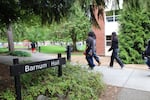
FILE - Students and families are welcomed to campus at Western Oregon University on Monday, Sept. 21, 2026, in Monmouth, Ore.
Natalie Pate / OPB
Officials said they see this, despite national enrollment declines, as “a sign that more students see Western as a place where they can belong, learn and succeed.”
Officials at WOU say their 3,600-student school also has the highest percentage of enrolled first-generation and Hispanic and Latiné students of all of the state’s public universities.
Related: Western Oregon University becomes federally recognized Hispanic-serving institution
Additionally, officials said Western’s five most popular undergraduate majors showed increases this year: criminal justice, psychology, pre-nursing, business and education.
WOU saw a decrease in total graduate enrollment. However, enrollment in Western’s occupational therapy doctorate, the state’s first public OTD program, has grown 50% since the program launched in 2023.

Occupational therapy doctorate program students work on digital cadavers at Western Oregon University’s Center for Graduate Studies in Salem, Ore., on Nov. 19, 2026.
Eli Imadali / OPB
“Every one of these students made a choice to invest in their future,” WOU President Jesse Peters said in a recent press release.
“Our growth tells us that students from all walks of life know they will find a community here that believes in them, a strong education that prepares them, and the support to see it through.”