Wild turkeys roaming around the Northwest today have ancient DNA related to turkeys in the Southwest.
Courtesy of the National Archives
If you think there’s a lot of turkey talk around the Thanksgiving table, just imagine studying turkeys for a living.
Cyler Conrad is a zooarchaeologist and turkey expert at Pacific Northwest National Laboratory in Richland, Wash. The ancient birds have been a topic around his dinner table for years.
“They’ve all heard it so much, but I always try and think of new or clever things to bring to the table,” Conrad said.
For one thing, Northwestern wild turkeys roaming around places like Spokane’s South Hill aren’t native to the region. With a bit of turkey genealogy, their DNA can be traced back thousands of years to the Southwest.
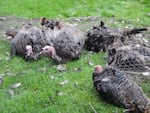
In this 2018 photo provided by the Department of Fish and Wildlife, wild turkeys in Douglas County are trapped with a net. When a flock of wild turkeys builds past the point of tolerance, the fish and wildlife district office determines if they can be successfully trapped and relocated.
Courtesy of the Oregon Department of Fish and Wildlife
Originally, turkeys were found in the eastern U.S., Southwest and Midwest, Conrad said.
After colonization, turkey numbers dwindled. The birds were over-hunted and kicked out of their habitats, Conrad said.
Northwestern wild turkeys
Then, after WWII, the drive for turkey hunting helped revitalize their populations.

Surrounded by Arrowleaf Balsamroot flowers, Jamie Dawson of the Greater Hells Canyon Council pauses while turkey hunting at dawn in the Wallowa-Whitman National Forest in the northern Blue Mountains near Enterprise, Ore., on May 21, 2026.
Eli Imadali / OPB
“People started to try and essentially conserve and protect turkeys and then reintroduce them to different parts of the United States that never had native wild turkey populations,” he said.
While turkeys had been raised in Northwest backyards and farms since the early 1900s, dedicated efforts brought wild turkeys to the region around the 1960s.
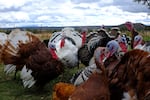
Turkeys at Rainshadow Organics will soon be headed for Thanksgiving dinner tables.
Sage Van Wing / OPB
“They undoubtedly have surviving DNA of turkeys that were domesticated largely by the Native American population of the American Southwest,” Conrad said.
Turkeys were one of the only domesticated animals precontact, he said, including in Mesoamerica and the Southwest Pueblo tribes.
“There was just a really complex and interesting relationship, and I think that that speaks to things today,” Conrad said. “Like, how do we today want to interact with our environments? How do we want to interact with wild animals?”
Ancient turkey bones, eggs and feathers from the Southwest are a big part of what Conrad studies at PNNL.
Bones, feathers and eggs
These birds weren’t often eaten for food, he said. Instead, albumen in eggs was used as a binder in paints and pottery. Bones could be used as tools or instruments. Feathers were often used for blankets.
“The big evidence that we see in the past, and it’s led to a lot of debate about how turkeys were domesticated and when they were domesticated, is the use of feathers,” Conrad said.
Even less studied, he said, is the iconographic depiction of turkeys. They’re often seen on pottery and rock art. Sometimes, turkeys were intentionally buried, as if they were pets. And there’s early evidence of people helping to heal injured turkeys.
“In many cases that turkey would not have survived without some sort of human care. Turkeys that might have broken their wings or their legs,” he said.
One mummified turkey in the Southwest was discovered with a leash-like cord around its neck in a cave.
“As you might walk a dog or you might have a leash around another animal, turkeys might have experienced that same thing in the past,” Conrad said. “It’s fascinating to imagine that and think about what that would’ve been like at that time.”
A turkey myth

Massive turkey legs and other greasy treats are cooked up for fairgoers at the Oregon State Fair in Salem, Ore. Aug. 29, 2022
April Ehrlich / OPB
However, there’s some misinformation about turkeys, he said. One myth he’d like to bust: Benjamin Franklin jokingly wrote a letter to his daughter that criticized the Great Seal. It wasn’t a formal request to make turkeys the national bird.
“Turkeys are always, and have always been, a part of, kind of, the American identity, I think,” he said.
And if you’re eating a store-bought turkey this Thanksgiving? Conrad said it’s genetically related to Mayan turkeys from the Yucatan.
“When the Spanish first arrived in North America, they found domesticated turkeys there in Mesoamerica,” he said. “They took those turkeys back to Europe. Those turkeys interbred in Europe for a few hundred years, and then those were brought back over to North America.”
With that in mind, Conrad’s favorite turkey preparation? To spatchcock the bird.
“I’ve had a lot of bad experiences with undercooked turkey, usually because I don’t know what I’m doing. Now I really like to have it flat and it cooks really well,” he said.
Courtney Flatt is a reporter with NWPB. This story comes to you from the Northwest News Network, a collaboration between public media organizations in Oregon and Washington.
It is part of OPB’s broader effort to ensure that everyone in our region has access to quality journalism that informs, entertains and enriches their lives. To learn more, visit our journalism partnerships page.