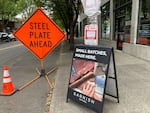
Parts of Northwest 12th Street in Portland's Pearl District, seen here on Sept. 18, 2026, were closed for construction from July through October. The internet company Astound was installing a fiber optic cable line. The construction caused retailer Garnish Apparel to lose out on peak tourist season sales.
Kyra Buckley / OPB
Erica Lurie’s downtown Portland apparel shop is ready for the winter holiday shopping season. The store is nestled in downtown Portland’s Pearl District, which is bursting with local stores hoping to attract holiday shoppers.
Lurie, however, is coming off a rough summer. Normally, tourists help boost summer sales for Garnship Apparel.
But this last July, the view from Lurie’s retail store included a torn up road scattered with workers operating jackhammers and bulldozers. The construction was for a fiber optic cable line and was set to wrap up within a few weeks.
Yet, Lurie looked out her store’s front window at the same view most days in July — and August, and September, and well into October.
“One of the frustrations is not only is the work taking so long, but it’s in peak tourist season,” Lurie told OPB about 10 weeks into the construction. “And I just keep hearing how Portland is trying to get tourists back to the city, and when they’re choosing to allow this construction to happen during the absolute prime of tourist season. That makes it so much worse.”
Construction is necessary for modern life and commerce. When infrastructure goes under-maintained, it often takes bigger and longer construction projects to implement necessary repairs or improvements. It can be a headache for commuters and homeowners, but it can be downright costly to small businesses — sometimes thousands of dollars per day. In today’s tough economy, that can be a breaking point.
Small business advocates say advance notice and more consistent communication about the projects can go a long way to mitigate the damage.
Surprises like what happened at Garnish, meanwhile, exacerbate the problems.
“Our business is about 75% walk-by traffic,” Lurie said. “Some of that is repeat business, but it is customers that happen to be walking by and remember us and want to come in.”
Lurie said her losses this summer easily hit $1,000 for every day there was construction.
“As a small business, that’s not only impacting my bottom line,” Lurie said, “It’s impacting hiring decisions as well.”
Lurie was hoping to add an in-house marketing position to the roster of employees, but had to delay hiring for that position.

Erica Lurie shows off a sample of a jacket she designed at the Garnish boutique in Old Town Portland, Ore., July 27, 2023. Lurie founded Garnish, a womenswear boutique filled with her designs, in 2004. During the summer of 2026 her shop missed out on peak tourist season sales due to construction.
Anna Lueck / OPB
No notification
Astound is the internet company responsible for the summer construction outside of Lurie’s shop. Astound’s parent company is investment firm Stonepeak, and Google Fiber is a minority owner.
Internet infrastructure maintenance and upgrades are necessary in all cities, but unlike some utilities, most internet cables are owned and installed by private companies, with limited oversight from local authorities.
An Astound spokesperson told OPB the company has an outreach policy of providing advance notice to homes and businesses impacted by construction projects.
For the construction at Northwest 12th and Flanders in front of Garnish, Astound confirmed to OPB that the subcontractor they worked with “did not complete notifications as expected.”
“We recognize the inconvenience this may have caused area residents and businesses and have taken corrective actions to ensure these notifications are completed on any other area projects going forward,” Mark Peterson, spokesperson for Astound, said in an emailed statement.
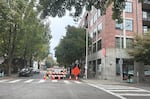
In this provided photo from Sept. 21, 2026, Northwest 12th Street in Portland's Pearl District is closed for construction of a internet cable line. The owner of Garnish Apparel, Erica Lurie, said there was no warning or appropriate signage ahead of construction, which ended up lasting more than three months during peak tourist season.
Erica Lurie
Lurie said she appreciates that Astound owned up to the lack of communication, but it doesn’t erase the uncertainty around construction she experienced over the summer.
“I didn’t know day to day or week to week if it was going to be continuing,” Lurie said. “There was a real lack of communication — and it’s also frustrating to know that they’re not going to get fined for that mistake.”
Inform with humor
Many local retailers in downtowns across the country have a similar story to what happened at Garnish.
Jordan Polon has been navigating these conflicts in Hartford, Connecticut, for the last 18 years as the executive director for the Business Improvement District, a quasi-government nonprofit that supports improving the downtown experience there.
“In this kind of work, when you’re dealing with small business owners and public-private investment and construction on a scale that can be disruptive to business, it’s not necessarily a solution as much as it is a mitigation,” Polon said.
She points out that making the improvements is in the interest of the businesses, as well as the community as a whole. But it’s messy.
“The long-term solution is the thing that’s causing disruption, and that’s the most challenging thing.”
Hartford is a much smaller metropolis than Portland, but the New England city’s downtown is similarly driven by commerce with little residential space. In both Portland and Hartford, downtown retailers rely on office workers, tourists and traffic from events like concerts and sports matches.
About a decade ago, a major retail hub in Hartford’s historic downtown was in desperate need of renovation, Polon said. It was going to be a massive disruption, but all buildings would still be accessible during the construction.
People just needed a reminder that businesses were open, Polon said. So her team got to work on a campaign to help out.
“They were just — they were street signs,” Polon said with a chuckle.
Street signs, but with flair.
Each brightly colored sign had a pun, often from a catchy song modified to reflect ongoing construction: “I like big trucks and I cannot lie,” “gettin’ diggy with it,” and “I got 99 problems, but a ditch ain’t one,” are a few of Polon’s favorites.
The bottom read “all businesses open during construction.”
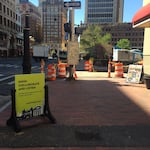
In this undated provided photo, a sign in downtown Hartford, Conn. riffs off a popular song lyric to let people know retailers are open during a major, long-term construction project.
Courtesy of Hartford Business Improvement District
They kept it simple. They used smaller lawn signs that could be moved to different construction sites and didn’t need a permit or special equipment to put up. The total cost was about $1,000.
Polon and her team bet that people would be amused by the witty signage and help spread the word — and it worked. Businesses and individuals started posting the signs on social media, exponentially increasing the outreach efforts of the business improvement district.
Construction was still disruptive and affected the bottom line for stores. But no businesses closed due to the construction, Polon said.
“The street is beautiful,” she said. “It actually did start a ton of investment in that area.”
Awareness and relationships
The Hartford Business Investment District offers the sign templates to other organizations and cities free of charge.
But Polon acknowledges that it was more than funny signs that made the downtown renovation project successful. For instance, the investment district knew the construction was coming and could plan for the impact. Building that awareness takes effort.
When short-term construction projects pop up, Polon relies on her relationships with different city agencies to help mitigate impacts to businesses.
If a private company, like an internet provider, applies for a construction permit, Polon is often notified by the public works director. The pair talk logistics and, in some cases, can schedule construction to avoid major civic events — like a victory parade for the perennially exceptional University of Connecticut women’s basketball team, Polon said.
Polon also works with her team and the city to make sure businesses are notified about the construction and proper signs are put up. They keep retailers and residents updated throughout the process if timelines change. Even if the company drops the ball on warning businesses about construction, it’s likely someone with the city or Polon’s group will let the retailer know.
An office of four
Portland doesn’t have a person with years of experience like Polon in a similar role, but it does have a newly created Office of Small Business.
“We’re a mighty team of four for the whole city,” Mitch Daugherty, the office’s manager, told OPB.
The office launched in May 2025 after Portland City Council allocated funding for its creation within Prosper Portland, the city’s economic development arm. Daugherty said before his office opened, businesses like Garnish had to figure out the city’s structure on their own — a daunting task for anyone, but especially for business owners with already overflowing schedules.
“The analogy is you can have the best airport in the world, but if you don’t have air traffic control, the planes don’t know where to land,” Daugherty said. “And so the Office of Small Business was started to be that navigation.”
But the office is only a year and a half old. Daugherty said they are still learning the pain points of small businesses when things like disruptive construction pop up.
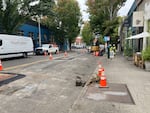
Parts of Northwest 12th Street in Portland's Pearl District, seen here on Sept. 18, 2026, were closed for construction from July through October.
Kyra Buckley / OPB
Lurie went through the process Daugherty previously described: she emailed her city councilors, the mayor, and others in the city that might be able to assist her. The response was lacking.
So Lurie did a bit more digging, and found the OSB. Daugherty said the situation with Garnish was a big learning curve for them.
Normally, permits are issued by Portland’s Bureau of Transportation. That was true for Astound’s fiber optic cable line. However, because the construction only closed the street during the day, the project’s permitting went through an office inside of PBOT that Daugherty hadn’t worked with before.
Eventually, the OSB and PBOT’s office of Temporary Street Use Permitting worked together to get “businesses open during construction” signs up.
Daugherty acknowledges that the city is limited in how it can help mitigate construction impacts, but constant communication with affected businesses should be the standard
“The city itself doesn’t have funds to compensate for lost sales, so I think that’s a really hard one,” Daugherty said. “And so the best we can [do] is keeping them totally updated on the progress of the situation.”
That’s the approach even when it’s bad news, like a two-week project that’s actually going to take closer to eight weeks.
“The more we can just get ahead of it with the planning, the better the business can, hopefully, try and forecast.”
Small businesses like the clothing maker Garnish not only sustain the local economy, Daugherty said, but make up the “fabric of the city.” If something as simple as communicating about construction and putting up signs can offer a small assist, it should be a top priority.
“And there’s probably 50 more things like this in the city that are going to pop up over the next year that we’ll hear from the business owners themselves,” Daugherty said, adding that he expects them to be upset and anxious when calling on his team. “That’s okay. That’s why our office is here.”
Portland businesses have suggestions
If Daugherty and his small office are looking for ways to soften the blow to businesses, shop owners like Lurie have ideas.
As a downtown business that relies on locals and tourists, Lurie says the timing of projects and support during them can matter a lot.

Garnish Apparel, a Portland-based clothing retailer, is ready for the busy holiday shopping season in the Pearl District, as seen on Nov. 24, 2026.
Kyra Buckley / OPB
“Don’t schedule major projects during peak tourist season,” Lurie wrote in an email to city councilors. “Provide parking vouchers for businesses to give to clients for nearby parking lots/garages. Offer marketing assistance to businesses experiencing long construction disruptions.”
Just like the summer months, business owners would prefer construction halt during the often make-or-break holiday shopping season. After the rush of the holidays, Lurie points out that January is one of her store’s slowest months, making it less inconvenient for infrastructure improvements.
Lurie also suggests the city consider having part of the permitting fee go to a fund to help businesses struggling through a long construction project. She said that could be especially helpful for new independent retailers — the type that many in the city want to see succeed downtown.
For her business, Lurie said the construction was detrimental. However, Garnish has been around for 22 years and will make it through.
“But a lot of businesses wouldn’t be able to,” Lurie said. “And I am grateful that it’s only three months. Sometimes people are dealing with these projects for years at a time, and in a city that is claiming to support small business, there is a lot they could be doing to make this easier for small businesses.”