Nestled in Portland’s Brentwood-Darlington neighborhood is a nearly 2-acre greenspace that, on any given week in the fall or spring, could see as many as 150 young people.
The Learning Gardens Laboratory brings in students — from primary schoolers up to graduate students — through partnerships with local schools and Portland State University.
“PSU’s whole thing is, like, knowledge serving the city,” said Camila Lautz, the community engagement and education manager at the Learning Gardens Lab and a PSU graduate. “It’s like wanting to put students into the city and … just immerse themselves in the community.”

From left to right, Juni Clifford and Ella McHan look for beans at the Learning Gardens Laboratory on Nov. 12, 2026, in Portland, Ore. This fall, K-8 students from across Southeast Portland are learning about the workings of a healthy garden from students at Portland State University.
Saskia Hatvany / OPB
Lautz said the gardening lab used to be part of PSU, but it became a nonprofit about a year ago. It offers free field trips to low-income elementary schools, thanks to funding from the East Multnomah Soil & Water Conservation District.
One course offering in particular helps college seniors learn to teach about food systems, while the elementary kids learn about farming.
“Sometimes, you really do see that … quiet kid who’s really shy,” Lautz said, “and then you just point them in the direction of a bug or a worm or a certain kind of plant, and they just light up.”
But the future of this partnership isn’t clear.
PSU plans to sunset the program that provides the field trip leaders, and some of the participating elementary schools are on Portland’s short list for school closures.
A day in the garden
On a crisp November morning, PSU student Jzl Santomin taught first and second graders from Peninsula Elementary School a dance to remember the different parts of a plant.
“Do you guys want to start from the beginning?” she asks.
The kids cheer back, “Yeah!”
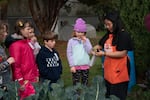
Jzl Santomin, right, lets students try cilantro from the garden at Learning Gardens Laboratory in Portland, Ore., on Nov. 12, 2026.
Saskia Hatvany / OPB
Everyone bends down to touch their toes — the roots. Then, they run their hands up to their hips and back down to their feet like an elevator, each time making silly “bloop” noises and a final “bing!”
Then, it’s the leaves. With jazz hands at their hips, they say “bop, bop, bop” and rotate toward the sun, then sigh with plant satisfaction, “Ahhhh.”
Finally, the plants produce flowers atop their heads, followed by fruit, which the kids enthusiastically pretend to “crunch,” before the seeds fall back into the ground to begin again.
This recent field trip is one of many that PSU students and their learning garden partners put on this term. For the college students, the learning curve involves figuring out how to work with young kids.
“For the first field trip, I was really nervous. Like, I could not fall asleep,” said Arlene Lopez, a senior studying psychology at PSU. “I just had the fear of messing up and not knowing what to say in front of the kiddos.”
Lopez said she was eventually able to be herself, be more whimsical and “channel my inner child.”
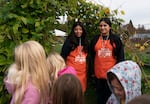
From left to right, PSU students Eliza Canul-Tellez and Arlene Lopez teach students from Peninsula Elementary School on Nov. 12, 2026, in Portland, Ore.
Saskia Hatvany / OPB
Lopez worked with Eliza Canul-Tellez at the “seed to harvest” station, where the elementary students learned about a plant’s life cycle.
Canul-Tellez wants to go into nursing, so she said it helped to work with kids from different backgrounds.
“Overall, just teaching them about the plants and stuff, there’s stuff I didn’t even know,” she said. “So, teaching them is great.”
On this November field trip, Canul-Tellez and Lopez were showing the younger students how to plant garlic. Canul-Tellez noted that not everyone knows how to plant their own food or gets excited about eating vegetables.
“Having them develop and learn about this stuff is really great for the future,” she said.
Ranmu Fukushima taught at the soil and compost station — or as the kids will likely remember it, the worm station.
“My particular section involves learning about the worms and teaching very complicated words to second graders like ‘decomposers,’” Fukushima said.

Tahara Randolph holds a worm in her hand at the Learning Gardens Laboratory on Nov. 12, 2026, in Portland, Ore.
Saskia Hatvany / OPB
Fukushima is studying art practice at PSU. He has experience teaching children in art, but he said he was particularly drawn to this course because “I like the idea of being involved with a farm to some small capacity.”
He taught the elementary kids about the roles of decomposers and how they affect the forest through a game of tag. The kids also got to watch as worms wriggled in their palms.
“I hope that most of the kids that we’ve met … were able to take something away from this experience as well,” he said, “and understand why farming is important and the places where our food comes from.”
Lessons from the classroom
Celine Fitzmaurice is the teacher behind the teachers. She’s taught at PSU since 2001 and runs the Farm Education for Youth course.
“I often say that this program was born of a partnership between a chef, a farmer and PSU,” she said.
It used to operate out of Sauvie Island under a different nonprofit, Fitzmaurice explained. But it merged with Learning Gardens a few years ago. Multnomah County’s soil conservation districts have supported it at each turn, subsidizing field trips for low-income schools.
Fitzmaurice said the conservation districts have “really allowed us to keep this program going, even during very lean times.”
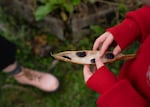
A student observes scarlet runner beans at the Learning Gardens Laboratory on Nov. 12, 2026, in Portland, Ore.
Saskia Hatvany / OPB
Fitzmaurice’s class is a capstone course. It’s a requirement for senior year in PSU’s general education program.
“Capstones are by nature interdisciplinary,” she said. “Some students choose a course that aligns with their major in some way. Other students choose something completely different.”
In the Farm Education for Youth capstone course, college seniors learn to be field trip leaders. That community-based learning complements what the PSU students are learning in the classroom.
“They are out here one day a week leading field trips, and then we’re in the classroom one other day of the week, and in the classroom we explore the Farm Bill.”
The U.S. Farm Bill was created in the 1930s during the Great Depression. Its three key aspects — supporting farmers, feeding the hungry and protecting the environment — play out in the Portland garden.
Fitzmaurice said they “talk a lot about what it looks like to provide transformative and holistic and interactive education for young people.” And they talk about the importance of healthy foods and being “future stewards of the environment.”

Zoie Beraka, a senior PSU student, helps a student classify different plants during a module at the Learning Gardens Laboratory on Nov. 12, 2026, in Portland, Ore.
Saskia Hatvany / OPB
Her students also teach the younger ones an Indigenous practice of kinship with our environment, which Fitzmaurice attributed to botanist Robin Wall Kimmerer.
The idea is to avoid competing with other species, like pollinators, that might need a particular plant. But if it looks like there’s enough, if the plant looks healthy, then the students can harvest from it.
“Kids get to taste, and then at the end of the honorable harvest, we always say thank you to the plant,” Fitzmaurice said. “It’s a way of teaching kids that plants are our kin in the larger ecological web of life.”
An uncertain future
Lautz said the garden lab donates most of the food they grow to Brentwood Middle School’s food pantry just across the street. A lot goes to PSU’s student pantry and other spots, too.
She said it’s all part of their work to relieve food insecurity.
“I think part of that is also just teaching people about food and what it tastes like, how to eat it, how to cook it, things like that,” she said, speaking more to the educational field trips. “And that’s something we want to do a lot more of.”
But the future of this partnership is unclear on multiple fronts.
PSU is restructuring its general education program.
The University Studies general education program oversees the capstone at Portland State. It’s being phased out as part of the school’s effort to balance its budget. As a result, the capstone will change to a “culminating experience” specific to individual disciplines.
“PSU made a decision within the last couple of years to reform our general education program,” Fitzmaurice explained. “And with that decision, the senior capstone course will be sunsetted effective September of 2028. So, we’re in our final stage.”

Students attend a session at the Learning Gardens Laboratory on Nov. 12, 2026, in Portland, Ore.
Saskia Hatvany / OPB
Fitzmaurice said faculty are debating what interdisciplinary, community-based learning will look like in the academic departments moving forward.
“There’s a real need for this form of education, and I’d love to see that continue,” she said.
Meanwhile, some of the elementary schools that currently partner with the garden — including Peninsula and Marysville — are on Portland Public Schools’ list of recommended closures.
“That’s going to be hard, because essentially we work with the same teachers every year because they really love the program,” Lautz said.
Lautz said the garden will continue to partner with schools and find ways to serve the community.
She added, “The need is still there.”