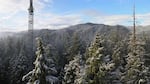
Researchers used the Wind River Canopy Crane to study conifers' ability to transport water at different times of year.
University of Washington
Scientists at Oregon State University have learned that Douglas fir and hemlock trees struggle to transport water from their roots to their crowns in the winter.
Conifers transport water from the soil to branches 300 feet off the ground using a network of pipe-like cells, each about the size of an eyelash. If the cells freeze and thaw, researchers found that air bubbles get trapped inside them. Kate McCulloh is an author of the study, which OSU announced Monday.
“When those tubes become full of air bubbles instead of full of water, it is harder for the plant to move the water that it needs every day,” she said.
McCulloh, who used the Wind River Canopy Crane to collect branch samples from the canopy, says that those bubbles can shut down half the water transport system in the top of a Douglas fir in the winter.
But by the time summer rolls around and the trees get thirsty, the trees have found some way to flush the air back out of their pipes. How they do that is still a mystery.
Summer drought places a similar kind of stress on the trees' water transport system. As soils dry out, trees need more tension to pull water up into their crowns. The high pressure inside a conifer's water transport system can lead it to suck in air bubbles from nearby cells. But McCulloh says that appears to be a less significant source of damage than the freezing and thawing cycles during winter.