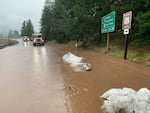
ODOT crew repairing I-84 at mile post 35 between Troutdale and Hood River that was hit by a landslide on Jan. 6, 2022
ODOT
From heavy snowfall to flood warnings and landslides, this week’s winter storms have wreaked havoc for motorists and transportation crews working around the clock to clear debris and make repairs to battered roads and highways. A landslide yesterday caused the closure of I-84 in both directions from Troutdale to Hood River in the Columbia River Gorge. But a buildup of high pressure may bring some relief as we head into the weekend, according to the National Weather Service. We hear from Don Hamilton, a spokesman from the Oregon Department of Transportation and Clinton Rockey, a meteorologist with the National Weather Service in Portland about the weather and its impacts on roads and highways.
The following transcript was created by a computer and edited by a volunteer.
Dave Miller: From the Gert Boyle Studio at OPB, this is Think Out Loud. I’m Dave Miller. From landslides and flooding to impassable snow and jackknifed semis, it has been one road closure after another since Christmas. In a few minutes, we’re going to hear from the National Weather Service about this. But first, we have the Oregon Department of Transportation which has been at the center of the response to this, working frantically to clear the state’s roadways. Don Hamilton is a spokesperson for ODOT, and he joins me once again. It’s good to have you back on the show.
Don Hamilton: Thanks. Good to be with you.
Miller: Let’s start with one of the more dramatic closures, yesterday. What can you tell us about the landslide that happened near Cascade Locks and closed down both lanes of I-84?
Hamilton: Wow. Well it’s never a surprise when we get as much rain as we’ve seen recently that we see slides coming after that. I think that everybody understands that around Oregon, and the [Columbia River] Gorge is one of the areas where we’ve always seen a lot of slides. Historically, that’s been one of the spots. One of the things that was a little unusual about this, we closed Interstate 84 in the Gorge twice in one week. I don’t think I’ve ever seen that before. We got hit by a big slide out there right about at milepost 36; that’s definitely a spot where we’ve seen slides in the past. We had to close both lanes, yep, that’s right.
Miller: Has been cleared away?
Hamilton: I’m sorry, I couldn’t hear what you said. What?
Miller: Has that been cleared away?
Hamilton: That’s been cleared up. The first thing we had to do is we had to look and make sure that nothing else was going to be coming down the hill at that point right there. We’ve got to make sure, before we get our crews out there that they’re safe, that they’re not going to get hit by falling rocks or anything like that. But yes, we got the road clear, got it opened up last night.
Miller: Am I right that this landslide was related to the Eagle Creek Fire from four summers ago?
Hamilton: That’s true. One of the things that our crews found in there was a lot of burned out stumps and logs and things like that, that had come down from the top of the hillside up there. That’s probably something we’re going to continue to see for the next five-ten years along in there, too, a lot of the refuse left over from the Eagle Creek Fire, from the burns from that. Yep, that’s true.
Miller: A reminder of just how long lasting the effects of the fire can be. In another part of the state, high water meant flooded roads near Seaside yesterday. What’s the situation there?
Hamilton: That’s a pretty common spot over there, just south of Seaside on [US Route] 101, especially aggravated by high tides. Sometimes it has to close, sometimes not. Sometimes we just will put people out there and caution [drivers] to drive through very carefully. Sometimes we’ll only flag people through if they’ve got high clearance cars or trucks. We’ve had a lot of high water in that area, but I don’t think it’s actually closed over the last day or two. And we hope the water is starting to recede now.
Miller: We have been talking about, since before Christmas, severe disruptions to road travel in so many parts of the state, including around Pendleton and Baker City, numerous times in the Gorge, near the coast as you’ve been talking about. The omicron variant, as we talked about in the previous segment, meanwhile, has been causing massive workforce disruptions. I’m curious if that has been the case for ODOT workers as well?
Hamilton: We are down in our staffing on our maintenance crews, like a lot of places have been. And a lot of other transportation departments around the rest of the country also have been down. But this is not something new. We’ve been down over the last couple of years, and we’re very aggressively hiring right now trying to get people to come on board for some of these maintenance jobs. Yes, we are down from what we’ve seen in the last couple of years. That’s had an effect on our services, too.
Miller: Have you seen an increase in collisions because of these storms?
Hamilton: Well, any time you get nasty winter weather like this, we do see an increase in crashes. We see a lot of fender benders. We see a lot of icy crashes in the snow. People tend to drive carelessly sometimes in the snow like this too. We do see an increase in that. This is why we ramp up our messaging on the signs on the highway. We’re encouraging the use of chains and snow tires and we’re trying to get the word out that people need to be very careful out on the roads.
Miller: Clinton Rockey joins us now. He is a meteorologist with the National Weather Service in Portland. Clinton Rockey, welcome to the show.
Clinton Rockey: Thank you.
Miller: So, after a few weeks of seemingly never ending dramatic weather, snow and rain and wind, what does the statewide forecast look like right now?
Rockey: Oh, man, you’re right. It’s been a rotten week. In fact, the interesting thing you bring up: just about everyone in the state of Oregon saw snow in the past few weeks. The only place that did not get snow was this very small narrow strip along the coast from about Newport or the Florence area, southward. Everyone else, snow, and in some places bunches of snow.
Miller: Is that unusual? I mean, given the gigantic variation in microclimates in this gigantic state, is it unusual for so many places to get snow?
Rockey: All at once? Yeah. It’s a little rare to see that much of the state get that kind of snowfall over that short a time. I mean a lot of times we see storms hit northeastern Oregon. The Blue [Mountains] get hammered pretty hard. At other times the Cascades and sometimes south central Oregon.. But that much of the state all roughly in the same amount of time, yeah, that’s a little more of a rare thing to see. And even more rare was the amount of snow that came down. We were looking at snowfall numbers; we’re talking 15 to 20 feet of snow fell since mid-December in parts of the Cascades. Even out in south-central Oregon and central Oregon, that doesn’t see a huge amount of snow, still saw 2 to 4 feet of snow fall since early to mid-December. So quite an abrupt change from the mild fall that we had into an abrupt welcome to winter as we got into mid-December.
Miller: So what about going forward in the next couple of days?
Rockey: Well, I think everyone can agree, we need a break, and indeed Mother Nature is bringing that. We’re going to have drier weather, still got a few snow showers over the Cascades tonight and tomorrow morning and maybe in the Blues as well. But, other than that, we’re going into dry weather for Saturday, Sunday and even Monday looks dry right now with temperatures about where they should be for this time of the year – seasonable temperatures. So, no warm temperatures that’s going to rapidly melt the snow off, but at least we’ll have the sunshine out and people can get out and enjoy a little fresh air finally. Some of us are probably feeling a little stir crazy being locked up since mid-December with no place to go with all the rain and snow.
Miller: What about high wind? There were reports of a number of power outages this morning. Is that expected to continue?
Rockey: No. That low pressure moved across the area this morning brought some winds to the coast as well as much of the interior Willamette Valley. Those strong winds have ended. Still low breezes through the eastern gorge and up over the higher terrain in the Cascades, but that too will be easing as the evening progresses. I don’t see any rough weather, outside just sitting back watching the water levels gradually go back down. That’s the worst conditions that are going on for the rest of today and into tomorrow morning. Fairly quiet, tranquil weekend coming for us.
Miller: You mentioned gigantic snowfall, including in parts that are not used to huge amounts of snow all happening at once. What does the snowpack look like right now? This is a crucial issue related to water storage for rivers and streams and fish habitat and agriculture.
Rockey: Right. Well, we’ve actually got a pretty good catch-up of snowpack sitting up there. As long as it doesn’t go away too fast, we’re in pretty good shape. Right now, we’re roughly double where we should be for right about now in early January. Some places [are] a little bit more than that. I was just looking at some of the numbers up across the Blues Mountains and they’re in pretty good shape as well. As long as things don’t melt away too fast, and that’s the key with the snowpack sitting up there.. If we go into a rather warm spring, we could lose that pretty quickly. But this is the middle of January; a lot can happen between now and March. I suspect we’ll lose some of that over time, but at least for right now, we don’t see indications down the immediate term that we’re going to lose that anytime soon.
Miller: I know that the further out you get, the murkier the picture gets because we’re talking about weather here and not long term climate patterns. But, to the best of your ability, what is the longer term projection for the rest of this winter right now?
Rockey: Well, we all know Mother Nature can throw anything she wants to wrenches, sinks, you name it. But right now it looks like we may continue on track with kind of a typical January into February. And, as many people that live around here know, that tends to be our snowier part of the year. So even though we had snow early on, perhaps we’ll continue to pile up snow in the higher terrain. Lower elevation it’s hard to say what’s exactly going to happen, but I suspect we’ll continue to see seasonable temperatures and precipitation about where we should be for this time of the year. There’s really no long indication for a change until we get later into the early to mid spring. And there’s some indication we may start warming back up a little above normal. But we’ll deal with that when we get there. We’ve still got the other half of winter to get through.
Miller: Don Hamilton, at least another half of winter to get through. What does that make you think about in terms of the work ODOT crews face for the rest of the season?
Hamilton: Well, the first thing I’m thinking of is, let’s get our crews some rest. They’ve been working really hard out there and they need some downtime so we can get our supplies restored and get everything ready to go. But I want to make sure that our most important resource, our work crews out there, get a chance to replenish themselves over the next couple of days. From the way things look, it’s gonna be a busy rest of the winter.
Miller: Don Hamilton and Clinton Rockey, thanks very much.
Hamilton: Thank you.
Rockey: You’re welcome.
Miller: Don Hamilton is [public information] officer for the Oregon Department of Transportation. Clinton Rockey is a meteorologist with the National Weather Service of Portland.
Contact “Think Out Loud®”
If you’d like to comment on any of the topics in this show or suggest a topic of your own, please get in touch with us on Facebook or Twitter, send an email to thinkoutloud@opb.org, or you can leave a voicemail for us at 503-293-1983. The call-in phone number during the noon hour is 888-665-5865.