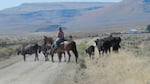
Ranchers in Southern Oregon are facing droughts and the aftermath of wildfires.
Amelia Templeton / OPB
Rancher Becky Hyde was less than two miles away when the Bootleg Fire roared through Southern Oregon last year. Her ranch was surrounded by fire resources and fire personnel were nearby to combat the flames. We get an update from Hyde on how her ranch has fared nearly a year after the fire and what drought in the region means for her.
The following transcript was created by a computer and edited by a volunteer:
Dave Miller: This is Think Out Loud on OPB. I’m Dave Miller. We’re focusing on the Klamath Basin for the full hour today. A few months ago, Oregon Governor Kate Brown once again declared a state of drought emergency in Klamath County. It was the third year in a row. So we thought we would check back in with some of the people we talked to last year when we spent a week in the basin. Becky Hyde is one of them. She’s a rancher in the Upper Klamath Basin and in the high desert east of Bend. Becky Hyde, thanks for giving us some of your time.
Becky Hyde: Thank you. Good morning to you.
Miller: Good morning. When we last talked in mid-July of last year, the Bootleg Fire was burning a mile and a half away from you, and you were under Level Three evacuation orders. But you were staying because your ranch was being used as a staging area for firefighters. What happened after that?
Hyde: Well, the ranch that I was at at that time is a family operation. So my brother-in-laws, my nephews, a lot of family were around, both trying to protect the ranch and also protect the livestock on the ranch. Unfortunately this is pretty traumatic for our family. My nephews, two of my nephews, lost over 100 head of animals in that Bootleg Fire. So they actually burned, and it’s pretty stressful. My nephews and my sons and some community members helped my nephews, and they actually had to go out into the burned area in the forest and put down some animals that were partially burned. There was even a burned up mountain lion out there, which gives you a sense of just how fast the beginning of that Bootleg Fire burned, which eventually went on to burn over 400,000 acres. Pretty traumatic really. I say pretty traumatic, but I’m trying to get over it. Like this quote [I read] last week, ‘don’t be a worrier or a whiner, be a warrior’. But this drought has really put us in a pretty stressful situation as a family, both above Klamath Lake and out in the desert east of Bend. Exceptional drought category is a real thing. It’s affected us deeply, not just with fire, but also in other ways.
Miller: Last year, as you’re noting in a really personal way, it was tremendously hard for your family and for basically everybody we heard from in the basin. And although in November and December, there was some hope that snowpack and rain would make this year very different. It turned out that in the spring it’s less different than everybody was hoping. It’s not looking like it’s going to be too much better. What does it look like to you right now?
Hyde: What it looks like to me right now is, my husband has the the $12.50 rain gauge at the Ranch and Brothers. And every time we get 2/10 of an inch of rain, we celebrate. I think that I’ve had the opportunity recently to travel up into northeast Oregon, that has gotten plenty of moisture, and over into the valley, and have heard that the Coast Range is just getting inundated. We have got some moisture, but as far as the reservoirs and Klamath Lake and stock water ponds that would normally be full, springs that would normally be running, we are still very up against the blades. And what that looks like in our area is people really selling off a lot of cattle. So we personally have sold off a quarter of our herd. My brother and sister-in-law sold their cows, which is a serious thing to do, because that’s the future.
Miller: That’s big, that’s the future. And so just to remind folks, so for a cow-calf operation: the calves, sorry if I’m mistaken, I’m obviously not a rancher, but those are the ones that you normally would sell when they’re big enough, but you keep the cows so they can make more calves the next year. But you’re saying but selling cows is different.
Hyde: Yeah, it’s a big deal because you’re basically moving out of that business. I would say it’s been a pretty stressful year, but not just for our family. If you think about this happening at scale above Klamath Lake, but also in all of these extreme drought places, on the east side of Oregon, especially southeast Oregon. It’s been pretty intense. So the moisture we’ve been getting recently, I can’t even tell you how we feel when we get moisture events. And the first really good rain that we got, it’s probably been 2.5 months ago, when we already had dust over here, dust on dirt roads 2.5 months ago. That’s not a good sign. But I just felt like the soil, that everywhere the earth was just soaking it in. I can’t even explain it. I just felt like the earth just went with a big, big slurp.
Miller: So can I ask you though, you had that striking quote you mentioned at the beginning, that you saw recently, you don’t want to be a worrier or a whiner, you want to be a warrior. But, how can you be a warrior when we’re talking about just climatic conditions? You can’t fight a war to create water. All you can do is deal with what you’re given. So, how do you go forward?
Hyde: What we’re facing is exceptional drought, climate change, political issues, and so when I say a warrior, I’m actually not really a warrior, right? That’s just my own way of being ‘okay, you gotta keep getting out of bed in the morning and taking care of your communities and your family and your animals’. So I think what it means to me is how do we adapt, and how do we create resilience in all of these communities for the future? And how do we express the importance of that to our neighbors all over Oregon? Not only that this is tough, but also root for us, right? Be our neighbors. There’s a lot of transition happening, and so I don’t know, that’s just kind of a lot of words. But these communities matter, and they are deeply connected to natural resources, and we are deeply resilient. And a lot of these families have been through tough times in the past. Those are my thoughts
Miller: Becky Hyde thanks for giving us your time and your thoughts today. I really appreciate it. Best of luck to you and here’s for water.
Hyde: Thank you. Alright, bye bye.
Miller: That’s Becky Hyde, a rancher in the Upper Klamath Basin and in the high desert east of Bend.
Contact “Think Out Loud®”
If you’d like to comment on any of the topics in this show, or suggest a topic of your own, please get in touch with us on Facebook or Twitter, send an email to thinkoutloud@opb.org, or you can leave a voicemail for us at 503-293-1983. The call-in phone number during the noon hour is 888-665-5865.