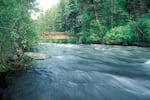
In this undated, provided photo, Catherine Creek State Park is pictured, one of the less frequently visited parks near La Grande, Oregon. State parks draw more than 50 million visitors a year, according to the Oregon Parks and Recreation Department website.
Courtesy of Oregon State Parks
Day-use parking fees for some state parks went from $5 to $10 at the beginning of the year, and the Oregon Parks and Recreation Department will be applying those same fees in locations where there were none previously. According to the department website, the agency manages 259 properties, which include camping at 52 parks as well as the entire ocean shore along 362 miles of the Oregon coast. The parks and recreation department is also raising camping and other fees to close its budget gap, which it says stems from rising costs and decreased contributions from the Oregon Lottery. State parks receive no operating money from Oregon’s general fund.
We’re joined by Oregon Parks and Recreation Department Director Lisa Sumption to tell us more about how the agency balances access to facilities in the state’s parks and shoreline with maintaining those public resources as costs continue to rise.
Note: The following transcript was transcribed digitally and validated for accuracy, readability and formatting by an OPB volunteer.
Dave Miller: From the Gert Boyle Studio at OPB, this is Think Out Loud. I’m Dave Miller. Day-use fees for some Oregon State Parks went from $5 to $10 at the beginning of this year. Now, to close a major budget shortfall, the Oregon Parks and Recreation Department will be increasing the number of sites where visitors have to pay that fee. It’s also raising some camping and other fees.
Lisa Sumption is the director of the Oregon Parks and Recreation Department. We called her up yesterday to talk about this. I started by asking her just to give us a sense for the scale of the budget shortfall her agency is facing.
Lisa Sumption: The current budget shortfall we’re anticipating, if we do nothing between now and the 2027-2029 biennium, would be about 14%. And our total overall budget is just over $400 million, so it’s a pretty significant number that we would be short. So we’re trying to get creative and reimagine how we can do things a little bit differently in parks to generate some additional revenue.
Miller: What are the reasons for that shortfall?
Sumption: There’s several different reasons. There are all the current pressures on the system, like high demand, increasing costs. The system is over 100 years old and a lot of our infrastructure is aging. It’s well loved. We have a lot of historic structures that need a lot of love and we also have a decrease in our lottery funds. So that’s probably the biggest. It’s just everything, all at the same time.
I think everybody’s feeling the increase in costs. For example, people don’t think about utilities, but in a campground, we have electricity that’s up 34% to 38% in the last couple of years. Our construction costs are up about 40%, so everything is just rising.
Miller: You mentioned lottery revenue is down. Can you just break down where your funding comes from? I think it might come as a surprise to a lot of listeners.
Sumption: People always think that we’re general funded and we’re not. We are publicly funded, but we do not receive General Fund tax dollars. Primarily, about 49% of our budget comes out of lottery funds, so it’s constitutionally dedicated out of the Park and Natural Resource Fund for the organization.
The rest is from what we refer to as “other funds” – our park user fees, a little bit of federal funds for some of our grant programs that we administer on behalf of the federal government, like the Land and Water Conservation Fund or the State Historic Preservation Office. But the bulk of our state park budget is all lottery and other funds.
Miller: What goes through your mind when you go by a lottery terminal in a bar, a restaurant or a deli that is essentially a place where Oregonians go to play lotto games?
Sumption: What goes through my mind? I’m always excited when I see people who are playing. It was a little rough during the pandemic when parks were closed and all bars and restaurants were closed. So you think about that, it turned off our entire revenue stream. So it’s nice to see people actually in those places.
Miller: Can you tell us about the day-use fee increases that were instituted last year?
Sumption: OK, so there’s a lot going on right now. Because we’re not general funded, we also know that the legislative body has a lot of priorities right now. And we know that we probably aren’t financially going to be one of them. So we took proactive steps to try to get in front of the shortfall because we would have been short in our current operating budget.
So we increased our day use fees from $5 to $10, effective July 1. That was a big shift. And now we will be making some other changes in October, but you were just referring to the current day-use, correct? And we also added a $2 out-of-state fee. So if you’re coming from out of state, it’ll be a $12 parking fee.
Miller: The new change, which is now to come, is to have 21 parks where you didn’t have to pay a day-use fee … now, those people will have to pay them. What’s the thinking for this particular list? I should say it includes places like Tryon Creek, Oswald West, Prineville Reservoir and another 18 others.
Sumption: If you think about every one of those locations, they have some type of facility. They have a feature there. And when you think about this, it’s a parking fee. You can walk in, you can bike in, you can come in any other way. It’s a parking fee and I think it’s super important to remember that part. So we look at [inaudible] visitation. Some of this is about congestion. Some of these places are very popular. It’s hard to get a parking spot. There’s a lot more people there than there used to be. So this gives us the ability to manage the resource and care for the resource, and also take care of some of the infrastructure that’s there. People don’t think about a restroom, but to even put in a CXT vault toilet is a very expensive endeavor. So we try to recoup some of those costs.
Miller: I want to play you a voicemail that came in from one of our listeners. This is Heather in Portland:
Heather [voicemail recording]: In regards to the increase in park fees, it will impact my family. It’ll impact a lot of families, although I do understand the need to close the gap in the budget and increase the intake of funding. But to double the fees, to double them, that’s where my mild outrage arises. So I mean, not only to double the fees but to increase the number of locations where fees are being charged and to go right for that double that double charge, it just feels like a lot. So I say tax the rich and tax the corporations.
Miller: Lisa Sumption, what’s your response to what our listener Heather describes as her mild outrage?
Sumption: Oh, Heather, if only I could do what you said in the end. So the answer to this is, I think, a little bit easier. We do have an annual pass and it’s $40. That gets you into all 250 locations. So we are highly encouraging people to buy those annual passes. That really would be four park visits or prior to that, it would have been eight park visits – well worth the money. And I get it. I hear it. A lot of the county parks had already gone to $10 for parking fees. Tillamook County, I think, was the first one.
So I totally empathize with her. At the same time, I don’t have the ability to do the other things she suggested. So I’ve got to use the tools I have in the box that we’ve got to play with.
Miller: Right. As you were saying earlier, you don’t get General Fund money, tax fund money. Your money comes 50% from the lottery and the balance from other places, including these user fees. Some of that, a smaller amount, historically has come from the federal government. Is that also in jeopardy?
Sumption: Currently, no. All of the programs that we operate have been funded for the fiscal year and most of those are through the State Historic Preservation Office. It’s the Oregon Recreational Trails Program. They’re mostly grant programs we administer on behalf. So currently, we are looking good on the federal side.
Miller: Did you notice any drop in visitors when you bumped up the day-use fee … or I should say the parking fee? I appreciate your correction that people can walk in or bike in, and use it for the day and not pay that money. But did you see a drop in visitors when you doubled that fee in most parks at the beginning of the year?
Sumption: Actually, it was the opposite. We saw an increase and more compliance for parking.
Miller: How do you explain that?
Sumption: People are coming. Since the pandemic, it’s what people go do, right? And I think a lot of folks just continue to come. We were actually quite surprised. I’ll be curious to see what this next quarter looks like, but so far, we’ve stayed either on trend or we’ve increased visitation.
Miller: That’s an interesting point because you had said earlier that, for example, some of those parks I mentioned earlier, Tryon Creek, Oswald West, are busy parks. And part of the thinking of doubling that parking fee is that it might be a way to limit the number of visitors in high traffic places. But it seems like that wasn’t your experience system-wide in the fees that have already been doubled?
Sumption: That’s correct. We may even look at things like we’ve done in the Gorge where we could look at timed entry. So you could buy the time that you want to go in. It’s like a two-hour entry or something like that, if we need to focus more on congestion. Folks don’t want to go somewhere that they can’t park. They have to park down the road, walk into the park and all those things. So if we can try to make the experience better, we’ll continue to look at how we can handle congestion.
Miller: Are you still looking at or assuming there are going to have to be cuts even with these fee increases?
Sumption: I think we’re close. I wish I had that crystal ball to know what the economy is going to do, what lottery funds are going to do and what the visitors are going to do. To your point, are they going to continue to come? Are they gonna pay? I’m hoping we’re good at this point. We’ll take another quarter. We will take a look and see where things are, and start making some other adaptations if we need to.
Miller: What’s your vision for sustainably and stably funded Oregon parks going forward?
Sumption: Ideally, I would love to be in a place [where] there was some larger public investment into the infrastructure. People think about the one state park they go to. They don’t think about the system overall – and we’re very large. I mean, we’re a small but mighty system, but we’re large in the state of Oregon: 250 parks, 54 overnight campgrounds.
We are just trying to get public funding to be able to take on the aging infrastructure. Think about places like Vista House, Fort Stevens, Kam Wah Chung, Silver Falls and the historic structures that are up there. If we have the ability to have public infusion into the aging infrastructure, so we can use lottery funds just to operate the system, we wouldn’t have to focus so much on fees.
Miller: Lisa Sumption, thanks very much.
Sumption: Absolutely, thank you.
Miller: Lisa Sumption is the director of the Oregon Parks and Recreation Department.
“Think Out Loud®” broadcasts live at noon every day and rebroadcasts at 8 p.m.
If you’d like to comment on any of the topics in this show or suggest a topic of your own, please get in touch with us on Facebook, send an email to thinkoutloud@opb.org, or you can leave a voicemail for us at 503-293-1983.