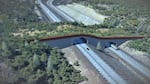
This undated artist's rendering from the Oregon Department of Transportation shows the design of an overpass crossing for wildlife spanning above four lanes of traffic on I-5, looking southwest. ODOT is expected to begin construction on the crossing in 2028 in the Cascade-Siskiyou National Monument, less than two miles north of the California border.
Oregon Department of Transportation
The Oregon Department of Fish and Wildlife estimates 14.5 million wild vertebrate animals are killed on Oregon’s roadways each year. Data shows it’s difficult to control driver behavior with things like road signs and traffic regulations. A more effective way to mitigate animal fatalities is by redirecting the animals themselves.
Wildlife crossings — human-made structures that allow animals to safely pass through habitats near roadways — have been a successful tool in preventing animal-motor fatalities. States like Montana, Colorado and California have over 100 wildlife crossings, while Oregon has only six.
Rachel Wheat is a spatial ecologist who serves as the wildlife connectivity coordinator for the Oregon Department of Fish and Wildlife. She joins us to discuss her work and tactics for improving transportation infrastructure for wildlife in Oregon.
Note: The following transcript was transcribed digitally and validated for accuracy, readability and formatting by an OPB volunteer.
Dave Miller: From the Gert Boyle Studio at OPB this is Think Out Loud. I’m Dave Miller. The Oregon Department of Fish and Wildlife estimates that millions of wild vertebrates, from elk to martens to frogs, are killed on Oregon’s roadways every year. One way to prevent these deaths is wildlife crossings, structures that allow animals to safely pass through habitats near roadways. But Oregon is well behind other Western states in creating these crossings.
Rachel Wheat is a spatial ecologist who serves as a wildlife connectivity coordinator for the Oregon Department of Fish and Wildlife. She joins us now. It’s great to have you on Think Out Loud.
Rachel Wheat: Thank you so much. Thanks for having me.
Miller: The punchline of the old joke, if you can call it a joke, “why did the chicken cross the road,” famously doesn’t really answer the question of what’s on the other side [that] the chicken, the elk or the frog wants. So what do these animals want?
Wheat: These animals want to get to the other side. They’re all looking for the resources that they need to live their lives. So in the same way that you and I may need to drive to the grocery store or a market to get food, and we may be driving to school or our jobs, and there’s all these locations that we access on a regular basis to live our lives, wildlife are doing the same things. They need to access things like food, water and shelter. They may need to access other members of their species for opportunities to reproduce. And those resources aren’t necessarily all located in the same place, so they are moving across the landscape through their habitats to access those different things. And we as humans tend to build roads right in the middle of their habitats, so they really have no choice but to cross roadways to get at the things that they need to survive.
Miller: Can you give us a sense for the scale of the problem?
Wheat: It’s a tremendous problem. Here in Oregon, we estimate that we have about 14.5 million vertebrate animals that are killed every year based on our roadways and our road traffic. It’s an estimated 1 million animals a day in the United States, so it’s a tremendous problem that affects a very wide diversity of species. There are a lot of species that are moving on a regular basis and even some of our small-bodied species that don’t move as much. You mentioned frogs, things like salamanders, some of our invertebrate species like butterflies and bees, they’re still heavily impacted by road traffic. And we have some species that are becoming threatened, or even potentially endangered, because of losses due to vehicle traffic.
Miller: Sometimes it’s super obvious that an animal has been hit by a car, we can maybe see their carcass on the side of the road or if there’s a major collision with a deer or elk, the driver is very clear about that. But what are the challenges with accounting for the full mortality of smaller animals, or animals that are eaten by scavengers or limp into the woods?
Wheat: That’s an excellent question because it is very difficult for us sometimes to accurately census every wild animal that may be struck and killed by a car. First and foremost, you mentioned a deer or an elk. A driver is absolutely going to notice if they hit a deer or an elk with their car. That is a significant collision.
Miller: They could die themselves.
Wheat: They could die themselves, they could be injured, they could have damage to their car. But most drivers aren’t going to notice if they hit, for example, a songbird or a salamander. They probably won’t even notice that that animal is there.
Also, in terms of the carcasses that are created by these collisions, a deer or an elk is a large-bodied animal. That carcass is going to persist on the landscape for a long time; they’re very easy for us to find visually. But those smaller bodied species like salamanders, frogs and snakes, since they are so small, a collision may just totally obliterate that individual, so it’s not even something that we can find after the collision happens.
We also have instances where animals may be struck by a car but move off of the road before they succumb to their injuries. So if they’re not directly on the roadside, it becomes much harder for us to account for those, because they’re moving off into natural habitat and we just don’t find them.
Miller: All reasons why that 14.5 million vertebrates killed a year in Oregon is an estimate?
Wheat: It is an estimate, that’s correct.
Miller: I want to go back to what you said earlier that some species are at risk of extinction, specifically because or largely because of road collisions. What are those species?
Wheat: There’s a couple of dozen species, actually in the United States, that are at risk of extirpation because of vehicle traffic. A couple of good examples that I like to use are the Florida panther down in the Florida Everglades and the red wolf located in North Carolina. Those populations are blinking out, largely because of collisions due to vehicle traffic.
Here in Oregon, we do have a couple of species for which vehicle mortality is a significant concern, including the federally threatened coastal Pacific marten, a very cute little animal that’s part of the weasel family. And also northwestern pond turtle, for which we’re starting to see greater population impacts from these vehicle collisions.
Miller: I want to hear more about collisions in just a second, but what are some of the other effects of road traffic on wildlife in addition to collisions?
Wheat: Our roadways can have tremendous impacts to wildlife behavior. So if we think about a road, that roadway carries with it a lot of noise, lights and vibrations that are unnatural for a wild animal. An animal may not want to use otherwise really high quality habitat near a roadway because of those behavioral impacts, from the noise of traffic and the lights of cars at night, and the vibration of some of those large semi trucks that are rumbling down the roadway.
They also fragment wildlife habitat. So every time we implement a new roadway, that’s taking habitat out of production for wildlife to be able to make use of. And we see impacts from pollution. So things like oil spills, runoff from roadways and tire particulates as tires wear down on our roads, those all wash off into adjacent habitats, those can get in our road systems, those can impact water quality and wetlands and have further detrimental health impacts for our wildlife species.
Miller: I’m glad you gave us that whole list because we’ll talk more deeply now about wildlife crossings, but if I understand what you’re saying correctly, most of those other problems you just outlined really wouldn’t be addressed at all by wildlife crossings. It’s one piece, the mobility piece, that could be slightly ameliorated.
One of the really surprising facts I learned in preparation for our conversation is that Colorado and California each have more than 100 wildlife crossings, Montana has over 120, and Oregon has 6. How do you explain that?
Wheat: I’m sure there’s a lot of factors that go into the low number of wildlife crossing structures in Oregon. But I think the single biggest thing we can point towards is lack of funding for implementing these structures. In Oregon, we do not have a dedicated funding mechanism for implementing wildlife transportation mitigation projects, whether that’s these wildlife crossing structures, or things like habitat modification, or other techniques that we may be able to use to limit the negative impacts of roadways on wildlife.
And these projects are not inexpensive, a lot of the times to build these crossings it requires significant infrastructure. If we’re looking at trying to reduce collisions with those large-bodied animals like deer and elk that have a nexus with motorist safety, obviously we want to keep our drivers safe, we want to keep these deer and elk from getting hit, then we’re looking at relatively large bridges. Those animals are large animals, the bridges need to be big enough to accommodate the size of the wildlife that are going to be moving through those. So that’s not an inexpensive infrastructure to be able to build. So we need the funding to be able to implement those projects, and we really just don’t have the funding here in the state.
Miller: So there’s no dedicated money for this work. But what have lawmakers directed state agencies to do in terms of these crossings?
Wheat: So the Oregon Department of Transportation has been directed to create a wildlife passage program to reduce collisions between wildlife and motorists. And the state agencies have also been directed to form an advisory group to bring together all of the stakeholders throughout the state that are interested in this topic, and to pool our resources together to talk about priorities, funding and capacity to try to really generate more momentum for this topic in the state, and prioritize the areas of the state that we want to focus on the most. And then ideally, use that momentum to take that forward and pursue the funding that we need to start implementing more of these projects on the ground.
Miller: In terms of the planning of priority areas, how do you think the state should decide where wildlife crossing should go, if there is way more need than money?
Wheat: Well, we do have a couple of tools in the toolbox already that we have developed to help us identify where we should be prioritizing. So first and foremost, the Oregon Department of Transportation collects information on where collisions between vehicles and large-bodied animals like deer and elk are occurring. So we already know throughout the state some of those hotspots of wildlife mortality where there’s risks to the motorists, risks to public safety from collisions with those animals.
And the Oregon Department of Fish and Wildlife has also developed what we call priority wildlife connectivity areas. We did a big statewide assessment of wildlife movement and all of the species’ needs for the different resources like we talked about before: water, food, shelter, opportunities to reproduce. And we looked at the areas of the landscape that are disproportionately important for facilitating wildlife movement. And so the first step in this process is to take those priority wildlife connectivity areas and see where they overlap with our roadkill hotspots for things like deer and elk. And those are probably the areas that we should look at first for investment, because not only are we improving motorists’ safety by reducing those collisions with large-bodied wildlife, but we’re also benefiting wildlife movement and wildlife connectivity.
Miller: Can you tell us about the new training program that you’re developing for ODOT staff?
Wheat: Absolutely. So one of the big things that we’re going to be working on this coming year is to develop a training program to initiate new ODOT staff into the world of wildlife connectivity. So a lot of the staff that are going to be joining ODOT, they come from engineering backgrounds or infrastructure backgrounds, and they may not have that understanding of wildlife connectivity, wildlife movement, wildlife collisions, to know what that means in terms of wildlife transportation mitigation. They might not even know that it’s a problem. So we’re going to be developing a training program that will ideally start and provide that foundation for those new staff. What is wildlife connectivity? Why do animals move? Why do they need to get to the other side of the road? Why do we have these wildlife transportation conflicts? Why is it important? Why is it a topic that we should care about? And then, what can we do to help solve that problem?
Miller: I understand that one of the challenges in terms of wildlife crossings in Oregon is that there are constitutional limitations on what state transportation money can be spent on. What are those limitations and what does that mean for the work you’re trying to do?
Wheat: So one of the major funding sources available to the Oregon Department of Transportation is a state highway fund. And that state highway fund comes from things like the gas tax. And that funding source is the primary funding source that the Oregon Department of Transportation can use to implement some of these wildlife passage projects. But there are constitutional restrictions on those funds that say that those funds have to be used to improve conditions for the traveling public, for the motorists. So that would be looking at those projects where there is a significant risk to motorist safety from collision with a deer or an elk.
But unfortunately, this problem expands far beyond collisions with deer and elk. We have a whole diversity of hundreds of species that are being impacted by road mortality that also need wildlife crossing structures or other mitigation to reduce the impacts from our transportation infrastructure on those species.
But the state highway funds, because of those constitutional restrictions, cannot be used for that purpose. And so we have to seek funding elsewhere and there really just isn’t that much funding available out there for these types of projects.
Miller: I mentioned there are very few crossings, but there is a relatively new one near Sauvie Island. And can you tell us about it?
Wheat: So our newest crossing structure on state highways is on U.S. Highway 30 just outside Portland near Sauvie Island. It is a pipe culvert that was designed specifically to facilitate the passage of northern red-legged frogs and other native amphibians in the state. So red-legged frogs are a migratory species, they spend most of the year up in forested habitat. This particular population spends most of the year up in protected habitats in the Forest Park area. But then during the winter they have to migrate from that forested habitat to wetlands to be able to breed. They lay their eggs, the tadpoles hatch, they need space to grow up. So these frogs are migrating from Forest Park to wetlands, and then once they reproduce, they’re migrating back up into Forest Park.
But U.S. Highway 30 runs directly through those habitats, so the frogs really don’t have a choice but to cross U.S. 30, which is a four-lane highway with a median, with a speed limit of something like 55 MPH and thousands of vehicles traveling that roadway every day. And if you’re looking at a 2- or 3-inch frog crossing 4 lanes of traffic where traffic is going 55 miles an hour, it’s a very high mortality risk for those frogs. So we’re seeing a lot of frogs being lost to collisions there.
So this crossing structure is meant to help facilitate their movement. Now, they have a safe passageway that they can use to cross under the highway. They don’t have to get up on the roadway and cross that way. And we’ve seen tremendous success. The project was completed in December of 2024, so we’re just over a full year of crossing use. We’ve seen hundreds of northern red-legged frogs using the structure, in addition to a couple dozen other species, which is excellent.
Miller: That’s one of the, to me, real surprises about this, that if you build it, it seems, many animals will cross. They know where to go.
So that’s been open for about a year. Almost exactly a year ago, we talked about a $33 million federal grant for a wildlife crossing over I-5. It would be the only one over I-5 in Oregon. This is in the Cascade-Siskiyou National Monument in Southern Oregon, a place of great biodiversity. Where does that stand right now?
Wheat: So we were awarded a federal wildlife crossings pilot program grant to be able to construct that project. It would be the first overcrossing in the state and the first overcrossing on Interstate 5. So that would be a tremendously valuable project, we’re very excited about it. However, that funding has been held up due to some changes in the federal administration and we are still waiting to learn the ultimate outcome of that funding source.
Miller: Finally, you’ve argued that there could be multiple benefits from better wildlife crossing infrastructure, in addition to the species that would be crossing. That fish, for example, can also be helped. Can you explain that?
Wheat: I think there are opportunities where we could combine the needs for both fish and wildlife passage to really maximize our investment in the state. So Oregon obviously has some very important fish species in our salmonids. There’s a lot of existing state statutes that trigger fish passage laws, when we’re replacing old culverts or other water conveyance structures. So we do have laws in place that say if you have a culvert, and it’s undersized, and there are fish in the stream, you need to replace that culvert so that fish can access the habitat on the other side of that road crossing. We need to improve habitat for fish so that fish have passage under the roadway.
And I think one of the great opportunities that we could leverage in the state – which we’ve actually seen in other states, Washington, for example, has started to implement a program very similar to this – is to maximize investment in areas that could benefit both fish and wildlife. So if we’re going in and replacing one of these fish passage structures, if we make the culvert just a little bit bigger, or if we replace the culvert with a bridge instead of a culvert, or with a viaduct instead of a bridge, then we are benefiting fish passage, but we are also making these structures large enough to accommodate wildlife. And at the same time, we are reducing flood hazard risk because then those structures become large enough that they can accommodate very high water flows as we start to see these higher intensity rainstorms.
Miller: Rachel Wheat, thanks very much.
Wheat: Absolutely. Thank you.
Miller: Rachel Wheat is spatial ecologist and the wildlife connectivity coordinator at the Oregon Department of Fish and Wildlife.
“Think Out Loud®” broadcasts live at noon every day and rebroadcasts at 8 p.m.
If you’d like to comment on any of the topics in this show or suggest a topic of your own, please get in touch with us on Facebook, send an email to thinkoutloud@opb.org, or you can leave a voicemail for us at 503-293-1983.