
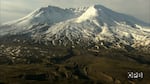
FILE - An undated photo of Mount St. Helens from the north. Through his Volcano Listening Project, University of Oregon professor Leif Karlstrom turns datasets from Mount St. Helens and other volcanoes into music.
Michael Bendixen / OPB
Music and science don’t often overlap, but University of Oregon professor Leif Karlstrom is making it happen with the Volcano Listening Project. Karlstrom turns datasets from the volcanoes he studies every day into sound, then uses those soundtracks to make music with a wide array of musicians. The project will be on display at a pair of upcoming shows in Portland and Hood River on Jan. 28 and 29.
Karlstrom joins us to share music from the Volcano Listening Project and what it takes to turn data into song.
Note: The following transcript was transcribed digitally and validated for accuracy, readability and formatting by an OPB volunteer.
Dave Miller: This is Think Out Loud on OPB. I’m Dave Miller. Leif Karlstrom got a degree in violin performance from the University of Oregon, and then went on to become a professor there, but not in music. He is an earth scientist who studies volcanoes and glaciers and how landscapes evolve.
Then again, he has not left music behind. He’s melding it into his scientific work. Karlstrom turns datasets from the volcanoes he studies into percussive or atmospheric prompts. Then he partners with a wide array of musicians who layer their music on top of that sonified data. He calls this the Volcano Listening Project. He released a full-length album about a year and a half ago. He’ll be performing with some of his collaborators at a pair of live shows this week, in Portland on Wednesday and in Hood River on Thursday. Leif Karlstrom, welcome back to Think Out Loud.
Leif Karlstrom: Thank you for having me.
Miller: Before this project, how much crossover or conversation was there between your musical and scientific lives?
Karlstrom: It’s a great question. These are very different worlds in some sense – both in my own person, but also in the world at large – and they’re different communities who care deeply about science and different communities who care about music. Typically there’s not a lot of overlap, so when I’ve developed my own interest in these, and I’ve been doing so for much of my entire life, we don’t really cross over too much. It was only a few years ago that I started to realize that there might be some common ground and something interesting to pursue.
Miller: What was the beginning kernel for you?
Karlstrom: Well, I guess it started, as many things in science do, with conversations with colleagues, and this particular conversation happened with a visiting scientist named Ben Holtzman from Columbia University at the time, who was visiting our department to talk about his work. We went out to lunch and it turns out that Ben had been listening to data for many years, actually, and I really grabbed a hold of that and we started immediately talking about the technical details, and it’s led to a collaboration that continues today.
But it really got me excited about the crossover, because Ben also cared deeply about the musical side of things and really had an aesthetic sense, which I hadn’t really encountered before in the scientific realm, so that really led to a pretty exciting phase that continues today for me.
Miller: The first track on your album is called “A Walk Through Fresh Tephra.” Let’s have a listen to part of this short first track, and then we can talk about it.
[music plays]
Miller: What is Tephra?
Karlstrom: Tephra is a volcanic product, tiny little fragmented pieces of magma that erupted from the volcano in an explosive manner and then blanketed the ground. This particular recording I made myself, actually, and it’s a field recording. I visited Kīlauea volcano, which features heavily on the record and also features in my research scientifically, and there was a spectacular eruption that happened in 2018.
We visited a few years later, but that’s really quite near the eruption, so when we were walking over this deposit, it was quite fresh. It looks like… you certainly wouldn’t want to walk over it without heavy boots on, because your feet would get cut up, but it’s an amazing experience walking over this because the sound is much like snow. It’s winter now...
Miller: Crunchy icy snow.
Karlstrom: Correct, yeah. And I think about that when I walk around through snow, but it’s not quite snow. There’s a brittle texture to that sound, so I thought it would be an interesting way to start the record because it’s at once familiar and then the more you listen to it, not familiar.
Miller: Yeah, I was fascinated by that choice because it’s also very different, as I understand it, from everything that follows. This isn’t particularly manipulated. This is not data turned into sound, which we’ll talk about that process. This is the pure sound of a person walking through sharp, crunchy rocks. Why did you want to start an album that ends up being very different with this walk?
Karlstrom: Well, I think it helps put you in a place. The nature of this project is, I guess at its core, this kind of crossover, and it’s a little unusual because of that. Neither the scientific community or the musical community really have engaged with this subject before, and it’s helpful, I think, to place yourself at the volcano, listening to it in real time before we then depart into slightly more abstract versions of that.
Miller: So let’s get to this. We’re going to listen in just a second, to one of the examples. It’s called “650 Years of Global Explosive Eruptions.” That’s the name of the track. It features Stash Wyslouch on guitar. What is this data from, before we hear it, I think you can hopefully help us listen for what we’re actually going to be hearing. So what are the different pieces here?
Karlstrom: The data set for that particular track is a compilation of data from the global record of explosive volcanic eruptions. And 650 years, it’s not necessarily a long period of time geologically speaking, but that’s essentially spanning most of recorded human history, and so in some sense, this is the volcanoes that our society has experienced globally. Each recorded event has attached to it a few different qualities which we then try to represent through sound.
So first, just how much stuff erupted, the magnitude of the eruption. But then also something about the composition. Was it basalt? Was it rhyolite? These sorts of things. And finally, the third component of this, which we try to represent through sound, was the type of volcano that it erupted from. Was it a caldera? Was it a stratovolcano?
We really tried to incorporate those aspects, those qualities of the data, as well as when and where the eruption occurred into each sound. This is a procedure that requires sound design. There’s not a natural sound that’s associated with this data, so we have to make something up, and so we do this in a way that tries to convey these different aspects.
Miller: And when you do that, for example, a lot of Oregonians may be familiar with basalt, since it’s so much a part of our hard landscape in the Northwest. But you said, basalt versus rhyolite. How do you, as a scientist and a musician, think about the different musical qualities of those two different kinds of rock?
Karlstrom: Yeah, I think it’s a great question. In some sense, from the science side, the best way to understand these things is in terms of their composition and then how the magma behaves. Very roughly, we can think of the difference between basalt and rhyolite as being the percentage of silica that’s present in the magmatic fluid that’s erupting. The results of that silica is that the behavior of the magma is really, really different. Basalt’s runny, low viscosity. You might be familiar with it by looking at, sort of, present eruptions of Kīlauea in Hawaii. That’s basaltic magma.
Rhyolite, on the other hand, is extremely sticky, orders of magnitude more viscous, and so it’s actually quite unfamiliar and tends to erupt rather explosively. It doesn’t flow very easily at all. So you can imagine that those qualities could be conveyed musically. We could ask somebody to play in a viscous manner or a fragmented manner, for example, so we try to incorporate that into the sounds we designed.
Miller: All right, let’s have a listen. This is “650 Years of Global Explosive Eruptions,” featuring Stash Wyslouch on guitar.
[music plays]
Miller: I don’t know, maybe they were sometime in the 1600s right now, maybe the 1700s, I’ve lost track of the years a little bit in this musical version of seismic activity. How did you recruit musicians for this album?
Karlstrom: It was really easy in some sense because everybody is interested in this data. Volcanic data, I think, maybe volcanoes in general have a bit of a mystique to them and the data is quite musical in structure. So when I think of people who I believe could have fun with this or contribute something interesting, I’ve never had anyone say no so far, and Stash took a really interesting approach to this.
He actually transcribed this much like a jazz musician might transcribe a solo or something like that. Notated it out, and then composed his own counterpoint to the data, and that’s by no means the only way that one could interact with data, but I think it was a really neat representation of what one can do musically with volcanic data.
Miller: You know, it’s striking that you said it was not hard to get people, that these musicians… first of all, part of it has to do with the general fascination that many people have for volcanoes, but the other is just these musicians who were excited to play around with this and to take part. Do you think it would be easier to get musicians to collaborate with you on this project than scientists?
Karlstrom: Well, I don’t know about that. I guess in some sense the musicians are engaging with the creative aspects of this project, that I’m giving them free reign. Once people agree to participate, I prepare a sonification, which is its own process, but then I just send it to them and say go for it, whatever approach you want, and so there’s really no guidance actually as to what to do. And that, I think, appeals as well to the musical aesthetic.
From the scientific standpoint, usually collaborations are much more focused. We have research questions and there are plenty of research questions that we could talk about for the dataset that we just listened to. We don’t understand what controls when volcanoes happen at all, really. It’s a great mystery. We understand a lot about volcanoes, but that temporal patterning of eruptions is a quite active topic of research and so it’s something that I’m working on and I can collaborate with others on. But it’s a much more focused thing, and so they do occupy this different space, and yeah I think that’s kind of the beauty of the Volcano Listening Project is that we can occupy both parts simultaneously
Miller: Let’s listen to another track, and then we can talk about it. This one is from our own backyard in the Northwest. It’s called “Mount Saint Helens drumbeat seismicity and eruption, 2004,” and it features the musician Billy Contreras.
[music plays]
Miller: What do those drums represent in the background?
Karlstrom: This is a dataset of a seismic record, ground motion that was recorded near Mount St. Helens in 2004 preceding a dome collapse eruption. So this is sort of culminating with a big event at the end of the piece, and you could think of this as measuring vibrations of the ground at very high frequency, 100 samples per second or so.
What happened in the lead up to this eruption was that there are all these tiny earthquakes, they were actually called drumbeat seismicity by the scientists who studied these things. Maybe they listened to them, maybe they didn’t, I actually have not talked to the people who authored the first papers.
Miller: And who gave you that name.
Karlstrom: Yeah, so this appears in the scientific literature, this term “drumbeat seismicity,” and there are all these sort of repeating earthquakes that you can hear, and what we’re doing to sonify the data is just speeding it up until we can hear it. Seismic frequencies occupy a range that’s below the human auditory bands, which is 20 hertz to 20 kilohertz, so we can’t hear this ground motion happening in real time, but if we just resample it and speed it up we can. And it turns out there’s a tremendous amount of information – really, really rich information – below the human auditory band, so that’s the sonification procedure here.
Then we gave that to Billy Contreras, who composed this piece of music to it, and maybe in a similar vein composed a counterpoint. He recorded himself three times, so it’s an ensemble of himself, and this amazing composition where he was reacting to changes in the data, building musical gestures around change points as the seismicity intensified towards this culminating eruption at the end.
Miller: What do you think sound and music can teach people that looking at graphs and charts can’t?
Karlstrom: It’s a common question that we get. It’s often actually posed from the standpoint of scientists as, “Did you learn anything new here?” I think one way to answer that is to think of our ears, and our eyes, for that matter, as sensors. That we’re actually recording data all the time as we move through the world, and these sensors, our eyes and our ears, are very finely tuned for different things. If we want to listen to changes through time, our ears are much better equipped at detecting temporal changes than our eyes. So from a scientific standpoint, I think you can learn a lot by listening to data, by recognizing patterns that are happening, and that can lead to scientific discovery.
You can also just learn about the processes occurring underneath our feet by listening to data. That drumbeat seismicity from Mount St. Helens, you can look at a graph of it and be impressed by the sort of activity that’s on display in the graph, but the aesthetic of listening to it, there’s a visceral reaction that one gets that allows one to appreciate the volcanic processes, and maybe earth science in general, a little bit better as a result.
Miller: I mentioned you’ve got the two shows, in Portland and Hood River, coming up later this week, but you had a show just last night in Eugene. How did it go?
Karlstrom: It was great. It was a huge validation of a lot of work over many months putting this together. It was a sold out show, the first foray with this band, which is an amazing group of musicians, all of whom feature on the record, but we were able to bring them together as an ensemble, and we played at the Art House in Eugene. It was great.
Miller: Let’s have a listen to part of what you all did yesterday.
[music plays]
Miller: What has it meant to you personally to be able to combine these two once-disparate aspects of your experience, of your being?
Karlstrom: It’s a really satisfying and invigorating exercise, it sort of feels like I’m connecting some dots that have always lived there, for the first time, and so it’s both terrifying, because I don’t really know where it’s going, or how to do it, but also really exciting because I care deeply about these things and I think there’s a lot of potential there.
Miller: We’re gonna go out with one more piece. It’s called “Large earthquakes during caldera collapse, Kīlauea 2018.” Leif Karlstrom, thanks so much.
Karlstrom: Thank you.
[music plays]
Miller: Leif Karlstrom is going to be performing pieces from his Volcano Listening Project this Wednesday at Portland’s Alberta Rose Theater and this Thursday at the Columbia Center for the Arts in Hood River.
“Think Out Loud®” broadcasts live at noon every day and rebroadcasts at 8 p.m.
If you’d like to comment on any of the topics in this show or suggest a topic of your own, please get in touch with us on Facebook, send an email to thinkoutloud@opb.org, or you can leave a voicemail for us at 503-293-1983.
