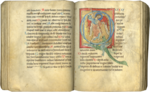
A parchment page from a German psalter from around 1240-1260. It was made for lay use and depicts the biblical contest between the Archangel Michael and the dragon.
Courtesy of Les Enluminures via Lewis & Clark College
If you want to see some really old stuff, Portland isn’t a bad place to be.
With dozens of antique shops around the city, it isn’t hard to find objects more than a hundred years old.
But from now until March 6, Lewis & Clark College will do you one better: Its special collections department has unveiled an exhibit featuring manuscripts from the Middle Ages, some dating back to 13th century Europe.
While rare now in the 21st century, the items on display were once mundane, everyday objects, including legal documents and prayer books with colorful illustrations.
It’s not often that small liberal arts colleges gain access to such rare documents, as larger research institutions and elite universities frequently take priority.
In fact, it’s the first time in nearly three decades that a collection this old has made its way to the Rose City.
The exhibit, “Shaping the Soul,” is free and open to the public.
At Lewis & Clark College, Hannah Crummé is the head of special collections, and Karen Gross is a medievalist and professor of English. They join us to share more about the manuscripts and their significance today, hundreds of years later.
Note: The following transcript was transcribed digitally and validated for accuracy, readability and formatting by an OPB volunteer.
Dave Miller: From the Gert Boyle studio at OPB this is Think Out Loud. I’m Dave Miller. If you want to see some old stuff, Portland is not a bad place to be. With dozens of antique shops around the city, it’s easy to find objects that are 100 years old. But for the next month, Lewis & Clark College will do you one better. Its special collections department has an exhibit featuring manuscripts that date back to the 13th century. They include seemingly mundane legal documents and richly illuminated prayer books. The exhibit is called “Shaping the Soul.” It’s free and open to the public, and it’s the first time in nearly three decades that a collection this old has made its way to Portland. Hannah Crummé is the head of special collections at Lewis & Clark College. Karen Gross is a professor of English who curated the exhibit. They both join me now. It’s great to have both of you on Think Out Loud.
Hannah Crummé: Thank you for having us.
Karen Gross: Thank you, Dave.
Miller: Karen, first, how did you decide what to include in the exhibit?
Karen Gross: The bulk of the manuscripts have come from a dealer who’s based in Chicago and Paris, and she, kind of like on a cooking show, presented us with a box of ingredients and said, “Go make something with it.” We were able to tweak a little bit. So, there’s a very sweet psalter, a book of psalms, that was owned by a German family, and you can actually see evidence of a child learning how to write on one of the pages in it. She agreed to add that one to the list, as well as a very large, what’s called a gradual choir book, that we requested because we wanted something for our music students to be able to perform some hymns from.
Miller: And they’ll be reading directly from this hundreds-year-old choir book for a performance.
Gross: We transcribe the hymn from it.
Miller: Right, OK.
Gross: But it is indeed the same prayer and melody that is on display now. Part of the fun in putting together the exhibit though was actually the constraints of having the list prepared by someone else.
Miller: Hannah, so we heard a couple examples just now from Karen. I mean, what else is on display as part of this exhibition?
Crummé: My favorite item, which is actually a manuscript Lewis & Clark owns, so is not on loan, is a scroll which witnesses a woman’s effort to leave her property to her daughters as opposed to her husband and sons in France, produced in 1499.
I love this item because it’s visually striking. It’s a scroll, so it incorporates a type of document manufacture that is unusual – or it wasn’t so unusual at the time – but it isn’t the codex book that we’re familiar with, it is instead a large round scroll, and it shows people fighting for their rights 500 years earlier than we really think of. This woman is interested in the rights of her daughters and maintaining a legacy through the female line, which I find a fascinating little story.
Miller: Do you know what happened? Was she able to actually pass on some of her wealth to her daughter?
Crummé: I don’t think we have the conclusion of the case, do we?
Gross: Yes, I do.
Crummé: OK, Karen knows.
Gross: Well, our scroll is missing the seals, which indicate the closure of it, but it does have notification that the daughter’s lawyer was successful in maintaining their rights. My understanding is that in Brittany, this part of France, women actually had more legal and property rights because so many of the men were away. It was a maritime culture, so many men were at sea.
Miller: And so many men died at sea.
Gross: Died at sea, but women were left on the land to look after the day-to-day.
Miller: This exhibit is called “Shaping the Soul.” What does that phrase mean in the context of these very old versions of writing?
Gross: Oh, I’m glad you asked that, because one of the things, going back to your first question of how to make a narrative out of these items that came, as I was looking at the list of who would be coming to visit the books this spring, I was struck by how much work these books did. In bringing people together in liturgy, in educating people, in making connections, friendships, having people prepare for the afterlife, it just became clear to me that ultimately what these books did was really shape people’s senses of themselves and their interiorities and how they connect with each other.
Miller: Hannah, that reminds me of one of the lines from the exhibition write-up that really caught my attention: “Medieval designers may have changed the nature of books, but books in turn changed their users.” What does that line mean to you?
Crummé: Well, to me, as the person in charge of special collections at our college, it’s really about how we impact our community and our students. We use these books, after they come out of the cases, in Karen’s class to teach our students about medieval manuscript culture and how modern humanity came to be. And that’s also the opportunity I think they’re offering visitors to the exhibit, to engage with the continuous emotional relationship between people and books, the intellectual relationship between people and books. How it is that we come to be ourselves through a relationship with text, which is hopefully what we’re offering our students in special collections, but is also what we’re trying to make available to our community in Portland.
Miller: What would it have taken in 1400 or 1500 or 1300 to make what we now think of as a book?
Crummé: This is a better question for Karen than for me, but I would say just briefly, the exhibit documents how wide the definition of a book might be. Some of these clearly could be made relatively quickly. They’re not as decorated, but the process is quite laborious in any case, and I’ll let Karen answer that because it’s her actual field.
Miller: So in a pre-industrial age, what did it take to make a book?
Gross: Well, ultimately, at the basic level, it took sheep to get the parchment to write on. But, that’s, I suppose, a flippant answer.
Miller: But telling, too.
Gross: Yes, I mean, that’s one of the things that makes these manuscripts so amazing, is the way that they embody the whole network of trade, in terms of pigments needing to come from minerals all across Asia or Africa or Northern Europe, plants grown in the Iberian Peninsula, all coming together to then be read by a housewife in England. So, in part, books required a large network.
A lot of books were made in a kind of workshop set up, where there would be one person preparing the page, another person – the scribe – would be writing, a third person would be doing illumination in it, somebody else would be bookbinding. But then you also have cases of self-made individual books, as Hannah says, a real range.
Miller: Early zines.
Gross: Yes, that’s one of the things that’s so endearing about seeing these in person, is the degree to which people personalize these books. And one of the things my students always remark on, especially given their own interest in DIY culture and their own bookmaking zines and stuff, is that human beings have been wanting to customize their books and make them their own, have used them and abused them, kissed them, scribbled in them for centuries.
Miller: That makes more sense to me in some ways, if it’s a cheap mass-produced book, that you have a sense… not a disposable object, but was easily produced and easily replaced in our current society. But people doodled in books 800 years ago?
Gross: Indeed, yes. And in some cases, as I say, your prayer book would also be used for instructing your child how to read and form their letter shapes. One of the books that’s on display right now is a legal manual, and it has what seemed to be little doodles in it, but they’re memory prompts. It’s open right now to a very jaunty little horse, next to the law that permits travelers to allow them to have their steeds graze on the side of the road.
Miller: So some law student hundreds of years ago said wait, there’s a page somewhere about transportation policy, so let me put a horse there to remind myself when I’m leafing through…
Gross: Absolutely!
Miller: This is the horse section?
Gross: This is the horse law…
Crummé: You’re kind of increasing the value, and you might think of it as – because we like perfect objects now – as somehow diminishing the perfection to write in it. But there’s a really different culture at the time where you’re increasing its value. If it’s your child writing in it, you actually might be increasing its poignancy for you, but in this case, you’re giving yourself a little index to use it more readily. So it really was the case in medieval times and for many hundreds of years going forward that you could improve the value of an object by altering it.
Miller: Karen, you mentioned an English housewife being able to read this book, which is a product of global trade and mineral mining and a lot of different kinds of artisans. It does make me wonder about class. Who would have had access to these extraordinary objects?
Gross: That’s a common question that people ask. I know that making a manuscript, as the word manuscript suggests, “made by hand,” is a laborious process and such. By the later Middle Ages, with the increase in literacy, there’s a particular kind of prayer book known as a book of hours. It’s a kind of simplified, streamlined way of doing the same set of devotions that monks and nuns would be using, and it’s common to call that a medieval bestseller.
I often say to students that yes, this is a luxury good, but so are cars and smartphones, so if you had the income it was one of the first things you would acquire. Like a car, you could customize it, you could get a very basic beater. We know that even apprentices in late medieval London would have acquired a very simple, humble version of this kind of prayer book. Also, like a car, you might pass it on to your child when you get a fancier updated model. And these books were ubiquitous, as I say, they would go with people everywhere.
Miller: Hannah, what’s the experience like for you to actually, I imagine with gloves on and with care, to interact with a handmade transmitter of human thought and emotion and devotion from perhaps 800 years ago?
Crummé: Well, I love it, but I will say, never wear gloves. We don’t wear gloves in special collections unless we’re dealing with photographs. The oils in your skin degrade the chemicals that make photographs, but otherwise they reduce your dexterity and make you more likely to damage the object. So don’t look like a goofball. Don’t wear gloves when you come to special collections.
Miller: OK, I feel like I’ve seen movies, where…
Crummé: I know! It’s always in movies!
Miller: Where people in your position wear them. Does it drive you crazy?
Crummé: Well, people are so sad when I don’t give them gloves. They come in and they’re like, “Where are my gloves?” Like, you can’t have any gloves.
Miller: I got stuck in the technical piece of it, but emotionally, what’s the experience like for you?
Crummé: For me it’s funny, because it is my job and I do it all the time, but it is amazing. I love how even the most bureaucratic documents witness a moment in a life from 600 years ago, in this exhibit sometimes 800 years ago, that we wouldn’t otherwise have access to. And what, for me, they really demonstrate, is the humanity of the person from the past.
So where, as I’ve said before, Skype used to be an amazing thing. Like I’m talking to someone in Australia and I can see them. This, you’re talking to somebody from 800 years ago and in some ways you can see them. You have the actual thing they touched and made and, again, wrote their exercises in. You’re actually talking to somebody through time.
Miller: Or they’re talking to you, at least.
Crummé: Yeah, they’re talking to you. And in some ways, the fact that they made this and kept it, anticipated that there would be a person who would see it one day. So they’re not talking to you intentionally, but they’re sort of intending that their legacy would live on through time like this. It’s an amazing experience.
Miller: Karen, what are you hoping people will take away from a visit to this exhibit?
Gross: You know, just to second what Hannah was just saying, these books do so much and they’re still doing that work, in eliciting this wonder and bringing us together to celebrate them and to see the past. So yes, I think most of all, not just to appreciate the artistry and wonder at their survival, but to take these as a testament to just how much we love our books and see them as an extension of ourselves.
Crummé: And the real world, our life is so digital, and one wonders, will I have any kind of legacy like the people who wrote in these books? I’m pretty sure all my emails will get deleted when I leave the college or whatever. How will people know who I am, like this woman who has this scroll? I don’t know.
Miller: Hannah Crummé and Karen Gross, thanks very much.
Gross: Thank you, Dave.
Crummé: Thank you.
Miller: Hannah Crummé is the head of special collections and college archivist at Lewis & Clark College. Karen Gross is a professor of English at the college.
“Think Out Loud®” broadcasts live at noon every day and rebroadcasts at 8 p.m.
If you’d like to comment on any of the topics in this show or suggest a topic of your own, please get in touch with us on Facebook, send an email to thinkoutloud@opb.org, or you can leave a voicemail for us at 503-293-1983.