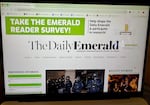
The online front page of University of Oregon's student-run paper, The Daily Emerald, as pictured Feb. 24, 2026.
Allison Frost / OPB
College newspapers are often on a shoestring budget. At the same time, they’re a vitally important source of information, especially for their student readers. At the University of Oregon’s Daily Emerald and Portland State University’s The Vanguard, reporters have been tear gassed while covering immigration protests. Though reporters at Oregon State University’s Daily Barometer have not faced that challenge, the editor-in-chief says the paper would like to be prepared for that situation if it arises. All three papers also cover stories in the community that affect the campus. Managing these competing priorities with limited resources can be a major challenge. We get more details from the editors-in-chief at the University of Oregon, Oregon State University and Portland State University: Tarek Anthony, Jenna Benson and Noah Carandanis.
Note: The following transcript was transcribed digitally and validated for accuracy, readability and formatting by an OPB volunteer.
Dave Miller: This is Think Out Loud on OPB. I’m Dave Miller. For decades now, the newspaper industry has been forced to cover its own slow demise. According to the Local News Initiative, more than 3,500 local papers have closed in just the last 20 years. Tens of thousands of people have lost their jobs. But college newspapers persevere, training a new generation of journalists and providing crucial local information to their student audiences.
We’re going to start today with a check-in at three of the most prominent college papers in Oregon. Jenna Benson is the editor-in-chief of The Daily Barometer at Oregon State University. Noah Carandanis is the editor-in-chief of The Vanguard at Portland State University. And Tarek Anthony is the editor-in-chief of the Daily Emerald at the University of Oregon. It’s great to have all three of you on the show.
Noah Carandanis: Thank you. Happy to be here.
Miller: Jenna, first – what do you see as the role of a campus newspaper these days?
Jenna Benson: Especially for the Daily Barometer, we want our role to be a place for students to have their voices heard, especially because there’s a lot of like things that go on at the university level and at the faculty level that students just aren’t privy to, that’s still public knowledge, but they just don’t know where to go to find out things like budget decisions from our board of trustees and things like that. So just being a mouthpiece for student voices in response to these decisions, but also finding out about these decisions in the first place.
Miller: Noah, what about you? What, what do you see as the purpose of the Vanguard at PSU?
Carandanis: The wonderful thing about student papers is that we’re not confined by a profit motive. We don’t need a certain amount of clicks to run a story. So I really see student news as a training ground for journalists, kind of JV for the varsity of professional papers. It’s a place to experiment. It’s a place to have your voice heard. You have a captive audience as well, just by having your other community members and students read.
Miller: It’s interesting because one of the explicit goals of, I think, all of your papers, and Noah as you were saying, is to train your student journalists. Do you also see in any way that you’re providing training to your student audience, that you’re getting them used to being consumers of reported, edited, fact-checked news?
Carandanis: Absolutely. It’s a common conversation that I have to have with students of “that was an opinion piece. That’s not what The Vanguard believes, that’s different from a news section.”
Miller: That’s something that professional papers have to explain as well, and some of them have gotten so sick of explaining that they’ve gotten rid of editorials.
Carandanis: Absolutely, yeah, it is a common misconception. I also think when it comes to reading news, teaching people that you can have your own biases, but the paper’s not there to pander to certain biases. It’s there to provide facts that you can then situate in your own worldviews. It is training that part of the brain of reading neutrally, but implementing it into your own worldview.
Miller: Tarek, what about you? What do you see as the goals of the Daily Emerald?
Tarek Anthony: Like the other two, I think the main goal internally is to provide that training ground for journalists to get that experience with news writing and stuff like that. But we also run into the same issues with also educating our students about the difference between an opinion column and a news story, and basically media literacy. So I think that provides a service for students in general. And then we’re also one of the only free newspapers in the city. So for students who mostly aren’t paying for subscription papers, we have become the primary daily news source outside of like the Eugene Weekly, which is an alt weekly paper. So I think that it provides an important service for our community all around.
Miller: Jenna, how do you think about that, the question of the rest of the news ecosystem where you are? I think I’m right that there are fewer news organizations covering Corvallis than Eugene, and certainly fewer in either of those cities than in Portland. Does that affect the circle you draw, in terms of what belongs in The Daily Barometer?
Benson: Yeah. We are in what our journalism advisor calls a news drought. We have the Corvallis Gazette-Times, and there’s the Albany Democrat-Herald. But then they both are kind of city focused. The Gazette-Times recently had some budget cuts, so they’re down to, I believe, just two reporters covering Philomath, Corvallis, the entire area. So without our presence being in Corvallis, the campus news and things in Corvallis as well wouldn’t have any eyes on it
So that’s where we come in to fill in those gaps. Our primary focus is making sure that our coverage is relevant to our OSU audience. But we are aware that we are also a news source for these farther communities, the outskirts of Albany, smaller towns of Philomath and Monroe, Harrisburg, all these smaller areas that aren’t covered. So we’re definitely trying to fill in these news drought gaps.
Miller: Noah, I think it’s fair to say that for PSU, what’s maybe more spread out is the students. There’s PSU students who live in a really wide geographical area and then commute from maybe an hour away or so to come to downtown Portland. How does that affect the way you think about coverage?
Carandanis: Because we are in a city where there’s, thankfully, plenty of newspapers covering Portland news, we do try to hyperlocalize as much as possible when it comes to our coverage. I mean, my arts and culture editor commutes in from Keizer every day, it’s not a small little commute. So being able to make news relevant to a large swath of the student population that has different interests but also lives in different contexts, lives in different environments. Most students aren’t in dorms. Most students are commuting, living in family homes and things.
So when thinking about how we make news relevant that you might not be able to get from The Oregonian or Willamette Week, we really do try to focus on what scoops can we get through our relationships with administrators, faculty members, staff. And I see it as a positive that we have so many commuter students and students from non-traditional backgrounds, because it makes our stories more diverse. We also have the ability to cover protests at the waterfront ICE facility, because we have PSU students that live in those apartments right next to it, so it becomes relevant to PSU Vanguard. So I see it as a great excuse to cover news all over the Portland City metro area.
Miller: Tarek, Noah mentioned ICE protests in the Portland area. How much coverage of ICE raids or ICE protests have you been doing at the Daily Emerald over the last year?
Anthony: We haven’t done a lot of coverage of ICE raids because luckily there hasn’t been a strong presence of them in Eugene. There’s been a few here and there, there was one in Cottage Grove. We don’t have the resources to chase those down, so we’ve really been focusing on the Eugene Federal Building where protesters are being tear gassed and pepper balls, and all sorts of chemical munitions on a regular basis. In the last month or so, that’s been our main focus.
Then also how that’s playing out on our campus. We have very strong advocacy for an ICE alert system, so following that through our student government, through the on-campus protests in addition. And those are the most peaceful and mundane coverage compared to being tear gassed, but it’s all equally important. So covering what’s going on by federal agents in the city, as well as what’s occurring on our campus has been our focus.
Miller: Do your reporters or photojournalists have access to gas masks or other personal protective equipment if they’re covering those protests?
Anthony: When the tear gas really started becoming like a regular activity at the end of January, we didn’t have anything but the shirts on our backs. I told our publisher there’s no rainy day fund for gas masks in our budget because we didn’t ever anticipate needing that. And so now we’ve spent hundreds and hundreds of dollars that we hadn’t budgeted on gas masks, helmets and gloves in the past month that we never anticipated needing, but that’s what we’ve had to acquire to keep our people safe. But the first weekend, we were all getting tear gassed with no PPE because we simply didn’t have it and it wasn’t readily available.
Miller: Noah, what about your reporters?
Carandanis: We do have access to some pretty old PPE equipment. We actually are in the process of investing in more PPE equipment as tear gas has been a much more familiar scene there.
I think the other thing that we’ve had to internally do is, student journalism is changing in the sense that what we’re covering is more serious. Student journalists going to protests now have to be prepared to inhale dangerous chemical munitions, or be pepperballed, or have their face photographed by federal agents. So internally, we’ve been really trying to hone and develop a protest protocol to keep our journalists safe. Dealing with PPB is one thing, dealing with federal agents is another. So we’ve been really trying to focus on liability. What do we do if one of us gets arrested? These are questions that previous editorial staff didn’t have to consider as deeply, that we are now having to be faced with.
Miller: Jenna, are these issues that you’re talking about in Corvallis as well?
Benson: We floated around the idea of getting some kind of PPE equipment, but it’s a question of budget and weighing necessity. We’ve only had a few ICE incidents in Corvallis. We have a larger presence of student-led protests, whether that’s at the city level or on our campus. But at the moment, we have it more as a theoretical rather than an actuality – do we have the budget to prepare for this for the future?
Miller: Jenna, what other big issues are your readers and your journalists focused on right now at OSU?
Benson: Right now, there is a big readership for a lot of environmental issues. At OSU, we’re a big research university, so a lot of what our College of Earth, Ocean and Atmospheric Sciences is doing, environmental policies, carbon research – all of that is a big focus for our readership.
But also, there’s been a lot administration-wise with some program closures, faculty layoffs and re-budgeting for the coming 2027 fiscal year for the school. So we’ve been covering a lot of that, which our readers are interested in because tuition is in the talks, adding in additional fees. There was one proposed last month, an athletics excellence fee, that would be, in addition to tuition and everything, to field more money into our athletics program because of the dissolvement of the Pac-12 a couple of years ago. And while we’re trying to rebuild that conference, there’s still that kind of gap and lowered enrollment, and all these issues that are affecting the cost of our university that students are very interested in.
Miller: Noah, what about you at The Vanguard? We talked about ICE protests. What else are your readers interested in learning about right now, and your journalists interested in covering?
Carandanis: We did a lot of coverage on faculty union bargaining in the last bargaining session. The university’s budget situation has not changed. It’s still kind of this ever-present conversation in board meetings with faculty and among students as well. Our journalists and I believe our readers are interested in how is PSU going to dig itself out of this enrollment decline? We can’t offer a traditional four-year college experience like University of Oregon and Oregon State University. How are we going to have a healthy athletics department when a lot of people, if you want sports, you’re gonna go down to Eugene, you’re gonna go down to Corvallis?
Our board leadership has changed as well. So there is a certain sense of instability at the administrative level, and also on the city level. Portland’s going through a lot just as a city. So being situated smack dab downtown, the city’s issues become our issues. So that’s what we’re really focusing on and I believe that’s what our readers are interested in as well.
Miller: And Tarek, what about at the Daily Emerald? What about in Eugene?
Anthony: There’s been a few major things. Mostly, all school year long is budget cuts. At the beginning of the school year, there was a $25 to $30 million , projected budget deficit for the university, and that resulted in 117 people being laid off, in the fall and over the past summer. So tracking not only the layoffs and the consequences on individuals who are laid off, but also how are programs being affected, how are class sizes being affected. They’ve been slashing a lot of humanities and languages programs here at the university, so just tracking down all the different impacts of that.
And then in other things, last week they approved the use of medicated abortion on campus starting in the fall, so we’ve been covering that process and the advocacy that went into that. And then I would say lastly, we’ve tragically had two students now this school year who have been killed in traffic crashes while biking in the city, so there’s been a lot of conversation around street safety and redesigning Eugene roads to be safer for bicyclists and pedestrians. So covering that, and the transportation forums, the memorials and all the stuff that comes out of these tragic crashes that have occurred.
Miller: Noah, it occurs to me that all three of you talked about budget questions, and all three of you talked about a lot of issues where you have no choice but to ask difficult questions of the administration. How would you describe your relationship with university leadership right now as a paper?
Carandanis: I think that every editorial staff that comes into Vanguard and into the leadership positions takes a different stance with administration. My stance is I see my role as editor-in-chief as a door opener. I want to be able to open as many doors for my journalists to walk through and ask the questions that need to be asked. Our relationship with the administration has been one where they’ve been willing to talk to us more so we can ask those questions.
Miller: You say more, meaning more than in past years?
Carandanis: More than in past years. There’s less hesitation, I believe, on the part of administration, in the sense that they feel that they will get a more fair shake than in years past. Doesn’t mean that we’re not critical of administration when we need to be. But we also see administration as necessary voices to get the entire story that we’re trying to tell. We have, termly, press conferences with President Ann Cudd, we will actually be holding that in our newsroom. So the president will be coming into our newsroom next week to just discuss the issues of the day on campus.
Miller: Jenna, it seems like one of the challenges of running a student paper in general is that there’s just a ton of turnover from year to year. How do you manage that?
Benson: I think a big part of that is, especially one of my goals being editor-in-chief, is getting this current year’s reporters and news staff prepared for that next year, building these connections with the administration at the university level. Because while our positions change, theirs do not. So if we can build that trust with the university that the incoming team is prepared and competent in their roles – and I have no doubt that they will be – we can just build on these relationships and keep an open line of communication between us and the university.
But also, I think a lot of transparency comes into play; what we do, how we do it. For the reporters, what I do with my job. For our audience, the paper as a whole. For the university, why we do what we do, why we’re asking these questions.
Miller: Jenna, Noah and Tarek, thanks very much.
All: Thank you.
Miller: Jenna Benson is editor-in-chief of The Daily Barometer at OSU. Tarek Anthony is editor-in-chief of the Daily Emerald at the U of O. And Noah Carandanis is the editor-in-chief at The Vanguard – that’s at PSU.
“Think Out Loud®” broadcasts live at noon every day and rebroadcasts at 8 p.m.
If you’d like to comment on any of the topics in this show or suggest a topic of your own, please get in touch with us on Facebook, send an email to thinkoutloud@opb.org, or you can leave a voicemail for us at 503-293-1983.