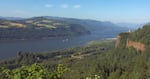
FILE - An undated Oregon Field Guide image of a barge navigating the scenic Columbia River Gorge.
Oregon Field Guide / OPB
The Columbia River Gorge Commission oversees land use and stewards both economic development and conservation efforts within the National Scenic Area. Robert Liberty served as the Multnomah County appointee to the commission since 2015, and was most recently reappointed in 2023. But he resigned earlier this year with more than a year to go in his term, citing “the gentrification of working lands with luxury homesites for the wealthy” and “the anti-conservation, pro-development interest of some of the Commission members,” among other reasons.
Liberty joins us with more details on his decision to resign and his concerns about “growing threats to the Gorge.” We’re also joined by Alex Johnson, chair of the Gorge Commission’s Executive Committee, to get his perspective and learn more about the commission’s work.
Note: The following transcript was transcribed digitally and validated for accuracy, readability and formatting by an OPB volunteer.
Dave Miller: From the Gert Boyle Studio at OPB, this is Think Out Loud. I’m Dave Miller. We turn now to some drama at the Columbia River Gorge Commission. It oversees land use and stewards both economic development and conservation efforts within the National Scenic Area. Robert Liberty had served on the Commission since 2015. But he recently stepped down with more than a year to go in his term. He cited the gentrification of working lands and too much of a focus on anti-conservation, pro-development interests, among other reasons.
Robert Liberty joins us now. It’s great to have you on the show.
Robert Liberty: Thank you, Dave. I’m glad to be on the show.
Miller: What do you see as the most serious issues that the Gorge is facing right now?
Liberty: We’ve identified some in the introduction, and that is part of a global phenomenon. We have 5 million more people in the two states than we did when the Gorge Act was passed. We have a lot more wealth in the world globally, 4 billion middle class people in the world. And we have a lot more income inequality. All these things translate into a lot more pressure on the few beautiful, wonderful places in Oregon and in the world.
Then we also have the phenomena of digital shopping, digital commuting, which is changing where and how people live. And finally, we have disinformation, mass disinformation campaigns, and problems with mass extinction and climate change. Those are things I think that should be in front of us.
Miller: You said that one of the reasons that you were stepping down is that the Commission has been catering too much to the “anti-conservation, pro-development interests of some of the Commission members.” What specifically do you think is at risk in the Gorge because of the Commission’s current direction?
Liberty: I think we’re getting a lot more luxury home site development. We’re getting more commercial activities in farm and forest land. We have more homes and property in places which are likely to burn. So I see all of that coming together and risking the things that make the Gorge special. Not only its landscape, but its wildlife, natural resources, natural beauty.
Miller: What’s an example of the kind of decision that you fear the Commission is going to make that is making the kind of, for example, rural gentrification you’ve talked about more likely? So we just understand the specifics of your critique?
Liberty: Here’s a good example. So one of the reasons I’m off the Commission, I’m able to talk to you about these issues, whereas tomorrow there’s a committee meeting, the Economic Vitality Committee. And what are they discussing? Allowing accessory dwelling units to be built in farm and forest lands in the Gorge. Accessory dwelling units, it’s actually something I’ve worked on for over 20 years. I’m consulting on it actually later today. It’s great for providing housing in urban areas.
But building more of those is just more short-term rentals. And the people who can build ADU’s are people who have access to $250,000 to $300,000 to invest in something like that. That’s not the average person. So we should be talking about economic vitality that actually helps people who are struggling economically, not people who can afford to build an ADU.
Miller: I want to run something by you that I read from the Republican State Representative Kevin Waters from Washington state. He agreed with you that gentrification in the Gorge is a problem, but he disagreed with the reasons for it. This is what he said: “Current scenic area policies make it far easier for wealthy individuals to build than working families or generational residents. Those with significant financial resources can wait years and spend hundreds of thousands of dollars navigating planning and engineering requirements. Most local residents cannot. It’s effectively impossible for someone earning a median Skamania County wage to build a home under current Gorge Commission policies. That’s not preservation, it’s exclusion.”
He continued, “The same contradiction applies to agriculture. While Mr. Liberty has expressed concern about the loss of working farms, policies advanced under his leadership make it more difficult for farmers to operate sustainably. Requirements that limit farm stands, sales and housing flexibility undermine the very agricultural viability the Commission claims to protect.”
There’s a lot there, but I’d like to get your response to it. I read this on a public Facebook post.
Liberty: Right. There’s two things, two parts of this. One is about wealthy people who have more advantages to get what they want and build houses …
Miller: And work this complicated system to their advantage with their money and their time?
Liberty: That’s true of everything. That’s why people want to be wealthy. And I see it working through, now in the Oregon Legislature, with property interest groups trying to get things that benefit them, that increase their land value. But there are 13 urban areas in the Gorge and there’s lots of land to build housing there. And there’s no special permits to go through there. In fact, the Oregon Legislature and the Washington Legislature have made it a lot easier to build the kinds of housing that’s affordable – apartments or accessory dwelling units and duplexes. That’s been a remarkable success.
In fact, home prices in a place like Klickitat County are about the same as they are in Utah, generally; too expensive, but the 13 urban areas are where housing belongs and where it should be built. So if you want to build a house in the National Scenic Area, yes, it’s harder to do. But I think the answer to that is to make the process simpler and clearer, but you may not be able to build a house. People are buying land in the Gorge, these big parcels, they have a lot of money. This is not an average person.
Now, let’s talk about farming. In Hood River County, the average farm gross is about $270,000 right? But what you earn off that is only $12,000. So farmers have to have access to land to operate their business. And when people start putting $2 million homes on the land, they can’t afford to buy that land to operate a business. As for farm stands, they’re already authorized. It’s a disinformation campaign, of the type Rob Davis talked about, that people can’t have pumpkin patches, hay rides or even concerts. All of that is already allowed. But that is the kind of rhetoric that’s being used to push a bill in the legislature today to allow 10,000 square foot stores on farmland.
Miller: One of the classic conundrums for people who disagree with the direction of an organization they’re a part of is moving in or some body that they’re a part of is moving in is: Do they try to move it from within or do they quit? Sometimes publicly and pointedly the way you did. I’m curious how you decided to make that decision. In other words, why quit as opposed to being a voice of your conscience on the Commission?
Liberty: Very good question and something I had to wrestle with. The problem was I looked at what we were going to be talking about over the next year and two months, and it just wasn’t these issues that I think are important. So I think I’m having more impact being on your show talking about this than I’d be on the Commission. But yes, I had to wrestle with that.
Miller: You also wrote this in your resignation letter: “At 72, I have limited time and years ahead of me, so I must focus on issues where my contributions will be more useful.” Where are you placing your focus now?
Liberty: This show is the first example.
Miller: OK, but we’re going to end this conversation in just a couple of minutes. After this show?
Liberty: So I’m working with a group of farmers, Ag for Oregon, that is concerned about commercial development and agricultural land. I’m representing some vintners who are concerned about urban growth boundary expansions. I do work in Montana with a group called Friends of Park County. It’s a county where there’s no zoning, and it’s magnificent northern entrance into Yellowstone National Park. Those are all areas where I think I can make a difference.
Miller: Robert Liberty, thanks very much.
Liberty: Thank you, Dave, very much.
Miller: Robert Liberty is a former member of the Columbia River Gorge Commission.
For another perspective on these issues, I’m joined now by Alex Johnson. He recently finished his first year as a member of the Commission. And he was recently elected the chair of the Commission’s Executive Committee. Welcome back to the show, Alex.
Alex Johnson: Thank you. So good to be here.
Miller: What went through your mind when you read Robert’s letter of resignation?
Johnson: It was a surprise. I don’t think it was a massive shock, just because there was a fair bit of friction. Not only including Robert, but there was a lot of friction between commissioners, and a lot of eyeballs and frustration, I would say, last year, certainly around some of the management plan amendments that we were considering in response to the Rowena and Burdoin fires. Anytime public meetings are charged you’re aware that somebody may come to the end of their rope. But yeah, it was a surprise. And I think we’re going to have a hard time replacing the deep expertise that Robert has brought to the Commission.
Miller: What’s your take on one of the specific charges that he was levying, that the Commission overall is too development-friendly right now?
Johnson: Some of his concerns I certainly agree with. I don’t fully agree with some of his diagnoses. I think there’s plenty of differing opinions and backgrounds among the commissioners of the Columbia River Gorge. But none of them strike me as anti-conservation or pro-development. I certainly think there’s plenty of consternation, especially from commissioners that are more tied to agriculture – and I’m one of them – about how tough agriculture is, not only within the National Scenic Area, but in America right now.
And casting about for things that we can do to help those folks who are on working lands in the National Scenic Area, ADUs were one of those. But the Economic Vitality Committee has quite a few different things that they’re investigating. That’s all part of a public process to look at things which that Committee can recommend for future inclusion in our next management plan.
Miller: Do you see tensions between the Commission’s twin missions of economic and ecological sustainability?
Johnson: Yes, there’s some. But I think the fact that we have two purposes and that protecting and supporting the economy of the area, both encouraging growth to occur in urban areas, but also by allowing economic development elsewhere … That needs to tie to the four prongs of protecting and enhancing scenic, cultural, recreation and natural resources of the area. Honestly, I really like it. It’s part of what I’m excited about being on the Commission, is that we are not only allowed to, but we are asked by Congress to look at all of those things.
With something as nationally, internationally unique as the Columbia River Gorge, I think we can grow the local economy and make it more resilient, while also protecting and enhancing scenic, cultural, recreational and natural resources. And that’s a really innovative way to do it, and certainly working across state and county boundaries is a great way to do that as well.
Miller: I’m curious how you think about the issue of rural gentrification that Robert Liberty brought up, as well as the state lawmaker? They had different definitions of how to address the problem. But they both agreed that this is a real issue, of prime land being snapped up by a small number of very wealthy people.
Johnson: Yeah, it’s a real issue; I mean, no doubt about it. And again, I think the diagnosis is where good faith actors can disagree. I’m on a farm here in Hood River County and the stated value has gone really crazy just in the last five years. So yeah, it’s a big issue. It’s pressure. And American farmers are under a lot of pressure outside of land value. So there’s no easy answer.
I do think that my vision, and certainly plenty of commissioners seem on board with this, [is] we’re all looking to build a Columbia River Gorge Commission that is a little bit more muscular and works beyond – doesn’t step away from – what people know us as, which is really the scenic parts. And [we want to] get more into natural resource management, economic vitality, have actual programs and staff that are committed to those other things.
So funding would really help, and I think that, outside of Commissioner Liberty’s resignation, there’s more drama this year. We actually, just a week ago, were alerted there may be another budget cut coming from the Washington state legislature. Last year, as your viewers may have heard, we had a 27% reduction from Washington. And then this year, just last week, we heard that the state of Washington, in the House bill, was cutting the Climate Commitment Act funding. Which is only $69,000, so not very much for the state of Washington, but would really kill a lot of the programs we have that reach out to rural areas and that are trying to both collect data on resiliency, natural resources, agriculture, forestry. But then also, establish ourselves as a coordinating body and ideally a funding body in the future for improving rural resiliency.
Miller: Alex Johnson, thanks very much.
Johnson: Thank you.
Miller: Alex Johnson is a member of the Columbia River Gorge Commission and the chair of the Commission’s Executive Committee.
“Think Out Loud®” broadcasts live at noon every day and rebroadcasts at 8 p.m.
If you’d like to comment on any of the topics in this show or suggest a topic of your own, please get in touch with us on Facebook, send an email to thinkoutloud@opb.org, or you can leave a voicemail for us at 503-293-1983.