Portland’s attempt to incentivize housing construction is beginning to pay off – maybe.
In a memo sent to Portland city councilors on Friday, city officials said the city “is seeing some promising results” in the first five months of a new program that temporarily waives certain fees developers are required to pay to build in city limits.
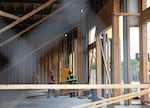
Two construction overseers consult each other on the Modera Woodstock residential and retail building construction site on July 7, 2023. The development will have 194 housing units, retail spaces, and a parking garage.
Caden Perry / OPB
Officials said it saw a small increase in the number of new housing permits issued to developers compared to the previous year.
The report highlighted that October 2025 saw permits for 42 additional units compared to October 2024.
City officials described this as a “noticeable increase.”
Missing from the report is data showing that in November 2024, the city issued permits for 274 units – twice the number of units that received permits in November 2025, suggesting the new program hasn’t spurred development.
In all, the city issued permits for 531 new units in the first five months of the new waiver program. That’s 338 fewer than the number issued during the same five months of 2024. And developers only sought waivers for 206 of those new units, according to the report.
A city spokesperson shared this data after a request from OPB.
The program is one of several plans introduced by Mayor Keith Wilson meant to stimulate housing construction in Portland, after a period of decline in new development.
It waives fees called system development charges, or SDCs, which are meant to offset the cost that new construction may have on certain city utilities and services, like sewers, streets or parks.
Portland developers pay around $20,000 on average in these fees per new housing unit.
The goal of this waiver program, adopted by councilors last summer, was to suspend those fees on any new housing developments in Portland for three years — with the hope of creating 5,000 new homes in that period.
Developers must request a waiver to qualify for the exemption.
According to the officials who oversee the program, the city has received waiver requests for projects that could result in 1,720 new apartments and houses since the policy went into effect on Aug. 1. That represents 34% percent of the 5,000 unit goal.
But only a small portion of those new projects have begun construction.
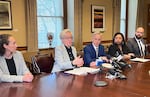
FILE - Gov. Tina Kotek and Portland Mayor Keith Wilson speak at a press conference on housing construction in Portland City Hall, March 6, 2025.
Alex Zielinski / OPB
It’s hard to know how many developers requested permits based on the SDC requirement – or if it’s a considerable change from previous years’ permitting pace.
While the data is inconclusive about the success of the fee waiver program, city officials consider it a win.
“The number of units in the pipeline is an encouraging early indicator that this temporary SDC exemption program is achieving what it intended: to make it easier to build new housing in Portland and to reduce financial barriers for those builders,” said Donnie Oliveira, deputy city administrator overseeing the city’s Community and Economic Development area, in the memo.
The city is still lagging far behind the pace of new housing developments from just a few years ago.
In 2021, the city issued permits for roughly 5,400 total housing units. In 2025, the city saw about 1,400. A mix of factors, ranging from skyrocketing construction costs to high interest rates, has made new construction a hard sell for developers in Portland.
The proposal was the result of a task force convened last spring by Wilson and Gov. Tina Kotek to address Portland’s lagging housing construction.
“By temporarily waiving these fees, we can turn stalled plans into real homes for real people,” Wilson said at the time.
Since then, Wilson has announced a longer-term goal to build 20,000 new housing units over the next eight years.
Waiving SDCs means a funding cut for many city bureaus that rely on those fees, and it comes as the city is facing a budget shortfall of nearly $170 million.
The city initially estimated that the three-year-long SDC waiver program would lose an estimated $63 million in revenue across city bureaus, including Portland Parks & Recreation, Portland Bureau of Transportation and Portland Water Bureau.
If the first five months of project permits advance as planned, the city will forfeit roughly $32 million in waived fees.
City Councilors will discuss the results of the waiver program at a Housing and Homelessness Committee meeting next week.